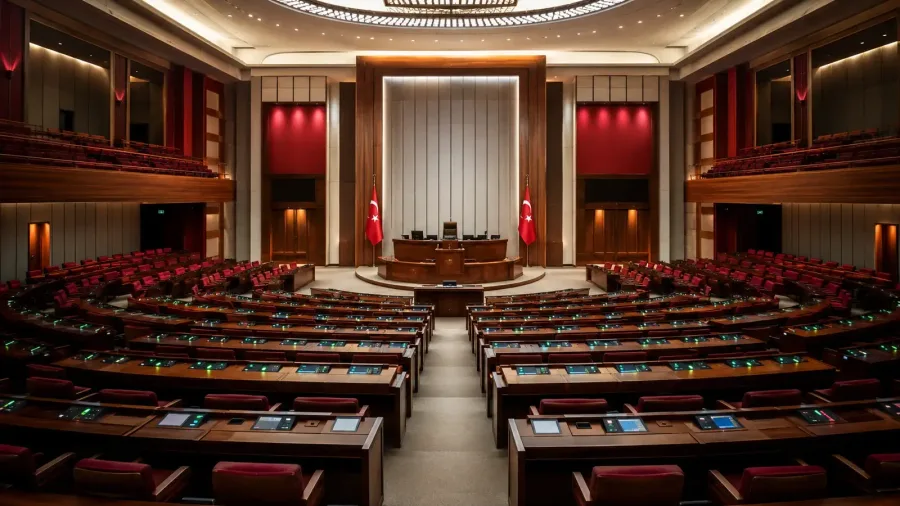
Türkiye’s Grand National Assembly has approved the Bill on Strengthening National Solidarity and Social Integration. According to an official parliamentary announcement dated August 11, 2026, the proposal completed its plenary stage after a final vote. Anadolu Agency reported that the debate lasted about 12 hours and that the bill received 467 votes in favor, 87 against and seven abstentions, with two votes recorded as duplicates. The proposal had been submitted to parliament on August 5 under file number 2/3793.
Implementation depends on a formal finding
The parliament’s bill record and its post-vote announcement make clear that the framework is not designed to take effect automatically in every respect upon the vote. The text requires security institutions to determine that the PKK/KCK and connected formations have ended their effective existence and surrendered the weapons and ammunition under their control. A National Security Council decision confirming that determination must also be published in the Official Gazette before the procedures described in the law can begin.
This condition separates parliamentary approval from the operational stage. The plenary vote is the central legislative decision, while the postponement measures and other procedures defined in the text require an additional security finding and an Official Gazette publication. Approval therefore does not mean that every consequence described in the legislation began at the moment the vote was completed.
Investigations, trials and sentence enforcement
The official parliamentary summary says the law establishes a framework for specified cases involving founding or directing an organization, membership, deliberate assistance, propaganda, certain offenses considered to have been committed within organizational activity, and defined terrorism-financing cases. The postponement periods for qualifying investigations, prosecutions and enforcement of final sentences vary according to the penalty range in the law. Cases carrying an upper limit of 15 years or less may be postponed for five years, while cases in higher penalty categories may receive a ten-year period.
The parliamentary announcement also states that certain serious offenses and specific historical exceptions listed in the text remain outside this postponement mechanism. The measure should therefore not be read as a single, unconditional result applying to every file. Whether an individual case qualifies will depend on the offense, applicable penalty range, date of the file and the statutory conditions, with the assessment left to the competent authorities.
A board and administrative process
The legislation provides for a board to oversee parts of the implementation process and separately defines the terms “organization” and “board.” The composition of that body, evaluation of files and operation of postponement procedures are tied to the provisions contained in the adopted text and the parliamentary commission report. Parliament’s records show that the proposal reached the Justice Commission on August 5, that the commission completed its report on August 8, and that report number 290 was then presented to the plenary.
The vote does not end political or legal debate about the measure, but the verified current position is that the proposal passed the Grand National Assembly. The next official milestone to monitor is publication of the adopted text in the Official Gazette with its final law number and entry-into-force provisions. Any practical timetable will become definitive only through the decisions and administrative steps published by the authorized institutions.
