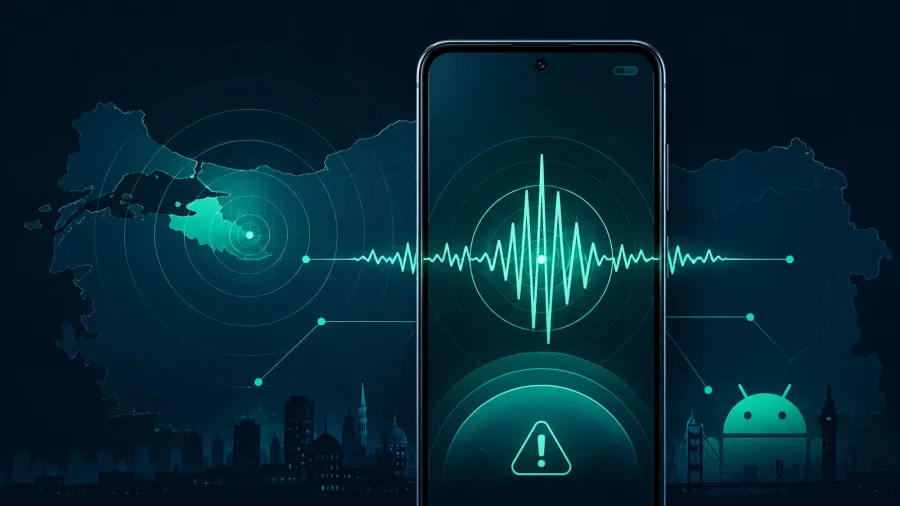
Android Earthquake Alerts, which turns sensors inside Android phones into a large-scale earthquake detection network, faced one of its most extensive real-world tests in the Marmara region. A new preprint published in July 2026 reports that the system detected the magnitude 6.2 earthquake off Marmara Ereğlisi on 23 April 2025 just 5.31 seconds after it began and delivered alerts to more than 16 million users.
Key findings from the research
According to the study, aggregated motion data from phones was used to confirm the earthquake quickly and send notifications to areas expected to feel shaking. The researchers report a 90 percent true-positive rate and 99 percent precision in the overall evaluation. In some distant locations expected to experience weak shaking, warning time reached as much as 150 seconds, while the median warning time for that intensity level was calculated at 56 seconds.
Warning windows were naturally shorter closer to the epicentre because seismic waves reached nearby areas rapidly. Even so, the paper argues that the dense Android phone network detected this offshore event faster than traditional stations. The finding does not suggest that smartphones should replace official seismic networks. Instead, it indicates that they may provide an additional detection layer that complements existing infrastructure.
How phones detect earthquakes
Android Earthquake Alerts uses accelerometers inside smartphones as miniature seismometers. Movement recorded by one device is not enough to declare an earthquake. When many phones in the same area detect similar vibrations, the system combines the data on its servers, estimates the likely location and strength of the event and can alert users in areas at risk.
Google’s technical explanation describes two main notification types. A “Be Aware” alert is used for expected lighter shaking, while a louder, full-screen “Take Action” alert can be issued when stronger shaking is expected. Users need an internet connection, location services and the Android Earthquake Alerts setting enabled to receive notifications.
Why do the figures differ from earlier reports?
Google’s initial technical assessment, published in July 2025, said the first alert for the same earthquake was issued roughly eight seconds after the event began and that more than 11 million alerts were delivered. The newer preprint reports a 5.31-second detection time and more than 16 million notified users. The difference may reflect a broader final dataset and different definitions for detection, first alert and users reached. The two sets of figures therefore should not be treated as identical measurements.
Warning time influences user response
A separate study published in Scientific Reports in May 2026 analysed more than 500 public social-media posts after the same earthquake. It found a strong relationship between timely alerts and user trust. People who received a warning before shaking were more likely to report taking protective action, warning others and expressing confidence in using the system again.
The findings show that earthquake warning technology depends not only on gaining seconds but also on presenting a clear notification at the right moment. Android Earthquake Alerts does not predict earthquakes. It detects an event after it starts and uses communication networks, which move information faster than damaging seismic waves, to try to warn people before shaking arrives. The notification should therefore be viewed as an extra safety layer, not a substitute for official guidance or disaster preparation.
What it means for Türkiye
Türkiye’s large Android user base can provide a dense stream of sensor data for phone-based detection. However, performance depends on variables including device density, internet connectivity, enabled settings, earthquake depth and distance from the epicentre. Research indicates that even a few seconds may be valuable in large urban areas, allowing people to take a safer position or enabling automated systems to pause sensitive operations.
The latest study remains a preprint and has not yet completed peer review, so it should not be treated as a final peer-reviewed publication. Nevertheless, it provides an important technical dataset by measuring how a network of millions of smartphones performed during a real Marmara earthquake.
