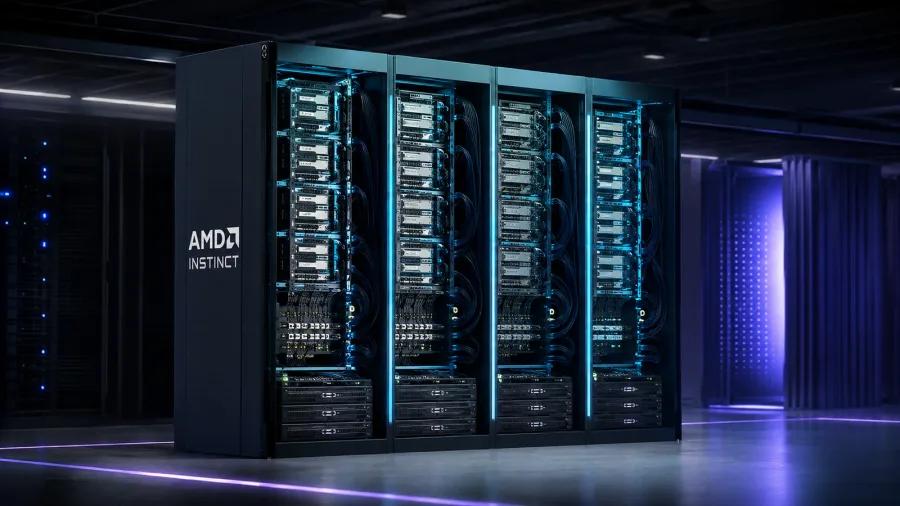
Competition in AI infrastructure no longer depends only on the speed of a single GPU. Running large models requires processors, accelerators, networking, cooling, power distribution and software to be designed together at rack scale. AMD’s Helios platform is a comprehensive response to that shift. The source review confirms that Helios is a real product program based on open standards, with major customer deployments planned from the second half of 2026.
Why rack scale matters
The theoretical capability of one accelerator does not determine the real performance of a large AI cluster by itself. Results also depend on how quickly data moves between accelerators, how processors manage data preparation, whether cooling can sustain continuous workloads and whether software can coordinate hundreds of components. Rack-scale platforms such as Helios therefore treat compute, networking, power, cooling and software as one architecture instead of assembling unrelated products after the fact.
The verified Helios architecture
AMD’s official Helios press kit states that the platform combines Instinct MI455X accelerators, sixth-generation EPYC “Venice” server processors, Pensando networking and the ROCm software ecosystem in one rack design. It is being developed for large-scale AI inference, foundation-model training and fine-tuning workloads.
Helios is presented not as one closed server, but as a rack architecture that manufacturers and hyperscale data-center operators can adopt and customize. AMD aims to address data movement and system management at rack level by co-designing compute, networking and software.
What the open rack approach means
According to AMD’s 2025 Open Compute Project announcement, Helios is based on the Open Rack Wide format introduced by Meta through OCP. The double-wide rack is designed for high power density, liquid cooling, wider hardware trays and easier serviceability. The design supports industry standards including DC-MHS, UALink and Ultra Ethernet.
Open does not mean that every component is vendor-neutral. Helios remains centered on AMD accelerators, EPYC processors, Pensando networking and ROCm software. The difference is that the rack format and interconnect layers are based on shared standards and can be adapted by system manufacturers.
Microsoft deployment confirmed
Microsoft’s official July 20, 2026 announcement says Azure will use Helios-powered ND MI455X v7 virtual machines for AI inference workloads. AMD’s parallel announcement states that Microsoft will deploy Helios at scale on Azure and that shipments are planned to begin in the second half of 2026.
This matters because it shows that Helios is being turned from a reference design into a commercial cloud service. The announcements still describe future deployments; delivered system volumes, installed capacity and customer performance results have not yet been disclosed.
The verified scope of the OpenAI agreement
The joint AMD and OpenAI announcement dated October 6, 2025 confirms a multi-year, multi-generation agreement covering six gigawatts of AMD GPUs. The first one-gigawatt Instinct MI450 Series deployment is planned to begin in the second half of 2026. AMD’s press release and its filing with the U.S. Securities and Exchange Commission state that the collaboration includes MI450 Series products and rack-scale AI solutions.
The agreement is strong evidence of demand for AMD’s rack-scale ecosystem. The official text does not disclose the exact number of systems or commit OpenAI to one specific Helios configuration. More detailed purchase quantities therefore remain unverified.
Commitments from Meta and Anthropic
AMD and Meta’s February 2026 strategic partnership covers up to six gigawatts of AMD Instinct GPUs across multiple product generations. The first one-gigawatt deployment is expected to begin in the second half of 2026 using a custom MI450-based accelerator and the Helios architecture.
AMD and Anthropic’s July 2026 announcement covers up to two gigawatts of MI450 Series GPUs in Helios solutions, with the first gigawatt scheduled for the first half of 2027. These agreements show demand from several major customers for AMD’s new rack architecture, but they do not mean that all planned capacity has already been installed.
What has not yet been proven
The official sources reviewed describe Helios architecture, customer commitments and deployment targets, but they do not provide independent production results for tokens per second, time to first token, performance per watt, multi-rack scaling, uptime or total cost of ownership using the same AI model.
A fair comparison should use the same model, numerical precision, software version and comparable power limits. Comparing vendor peak-compute figures alone can exclude network latency, software efficiency, cooling costs and long-term system stability. Independent production testing should therefore examine energy use, failure rates and scaling efficiency in addition to raw speed.
It is not yet possible to say that Helios is faster or cheaper than competing rack systems. Vendor theoretical figures are not a substitute for production performance. ROCm stability across large production clusters, network efficiency at scale and on-time delivery will determine the platform’s real position.
Conclusion
The verified evidence shows that Helios is more than a promotional concept. Microsoft’s Azure plan, the six-gigawatt agreements with OpenAI and Meta, and Anthropic’s commitment of up to two gigawatts confirm that AMD has built a serious customer pipeline for rack-scale AI infrastructure. Performance leadership has not yet been demonstrated. Helios will ultimately be judged by production data emerging from deployments beginning in the second half of 2026 and during 2027.
