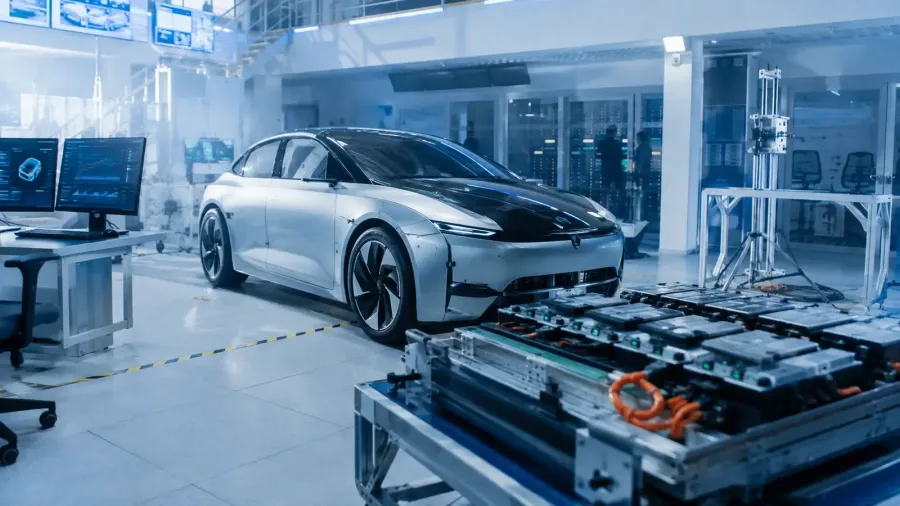
The United Kingdom has announced a package worth nearly £130 million for zero-emission vehicle technology and connected and automated mobility projects. According to Reuters on August 10, close to £65 million of the total will come from public funding, with the remainder expected to be provided by the automotive industry. The structure combines government support with industry contributions rather than treating the full amount as direct public spending.
Two main parts of the package
The largest component supports automotive companies and research partners working to develop and scale zero-emission vehicle technology. Reuters reported that nearly £50 million in government funding has been awarded for this work. The program is intended to strengthen technical development and production capabilities in the electric and zero-emission vehicle ecosystem. The announcement provides financing for development, but it does not guarantee that every supported project will reach commercial production.
A separate £17 million allocation covers nine connected and automated mobility projects. Examples cited by Reuters include sensor technology, brake-by-wire systems and artificial-intelligence simulation. These projects extend beyond the source of power used by a vehicle. They address the control, testing and digital systems required for vehicles to interact with their surroundings and for new functions to be assessed before wider deployment.
The wider policy context
The new funding sits alongside the UK government’s broader policy to support the transition to zero-emission vehicles and the automotive supply chain. The official Powering Up Britain plan places transport decarbonization, electric vehicle infrastructure and manufacturing capacity within the net-zero strategy. That government document does not provide the individual figures in the new package; it is used only to confirm the longer-term policy direction.
The government’s Powering Up Britain plan also places the shift to zero-emission vehicles, charging infrastructure and supply-chain investment within its net-zero strategy. The latest funding can therefore be viewed as a current implementation step within a longer program of industrial and transport policy. Reuters’ breakdown remains important: nearly half of the headline package is expected from industry, so the £130 million figure is a combined commitment rather than a new government grant of that full size.
Why connected mobility is included
Zero-emission policy focuses on the energy used by a vehicle, while connected and automated mobility projects address control, sensing and validation systems. Their inclusion in the same package shows that the technology program is not limited to powertrains. The £17 million figure is a total allocation across nine projects. The announcement does not establish that every project will receive an equal share or produce results on the same timetable.
What to watch next
The practical impact will depend on whether recipients meet technical milestones, move prototypes toward manufacturing and secure the planned private-sector co-funding. For connected and automated mobility projects, test results and compliance with safety standards will also matter. The funding announcement establishes the starting resources, but it does not by itself determine how many products will reach the market, how much production capacity will be created or how many jobs will result.
The package directs money both to zero-emission vehicles and to supporting sensor, control and simulation technologies. For the UK, the stated policy direction is to reinforce domestic research and manufacturing capacity during the transition. Concrete outcomes will become clearer through project schedules, award details and progress reporting after the initial funding decisions. Until then, the most firmly supported conclusion is that government and industry have committed nearly £130 million across two related technology areas.
