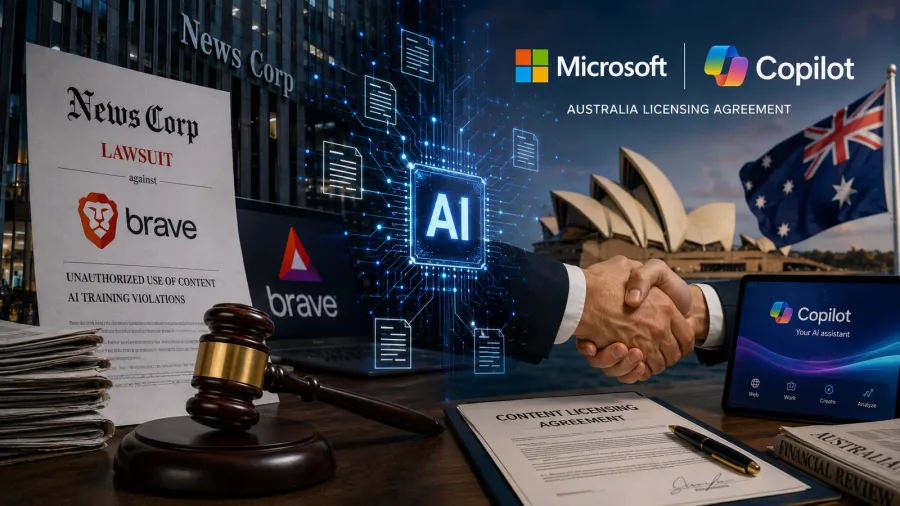
The battle over generative AI and content licensing has entered a new phase in 2026, with News Corp filing a lawsuit against Brave while Microsoft signs a major deal in Australia for its Copilot AI assistant.
News Corp lawsuit against Brave
News Corp, the global media conglomerate, has sued Brave, the privacy-focused browser and search engine company, alleging unauthorized use of its content for AI training. The lawsuit claims Brave's AI models were trained on News Corp articles without proper licensing, violating copyright laws.
Legal implications
The case could set a precedent for how AI companies handle copyrighted material. News Corp has previously taken a tough stance on content usage, having signed a landmark deal with Google in 2021. Brave has not yet responded to the lawsuit.
Microsoft Copilot Australia deal
In contrast, Microsoft has taken a collaborative approach by signing a licensing agreement with Australian publishers for its Copilot AI assistant. The deal allows Microsoft to use publisher content for AI training and responses, with revenue sharing terms.
Deal details
While financial specifics remain undisclosed, industry analysts view this as a model for future AI-publisher relationships. Microsoft aims to improve Copilot's accuracy and relevance by accessing high-quality news content, while publishers gain a new revenue stream.
The divide in AI content licensing
The contrasting approaches of News Corp and Microsoft highlight the uncertainty in the AI content landscape. Some publishers are choosing litigation to protect their content, while others see licensing deals as a viable path forward.
As of 2026, the industry is watching these developments closely. Regulatory frameworks remain unclear, and both tech companies and media groups are navigating uncharted legal and commercial territory.
