The Digital Evolution of Pen and Paper: What Flowtica Scribe Offers
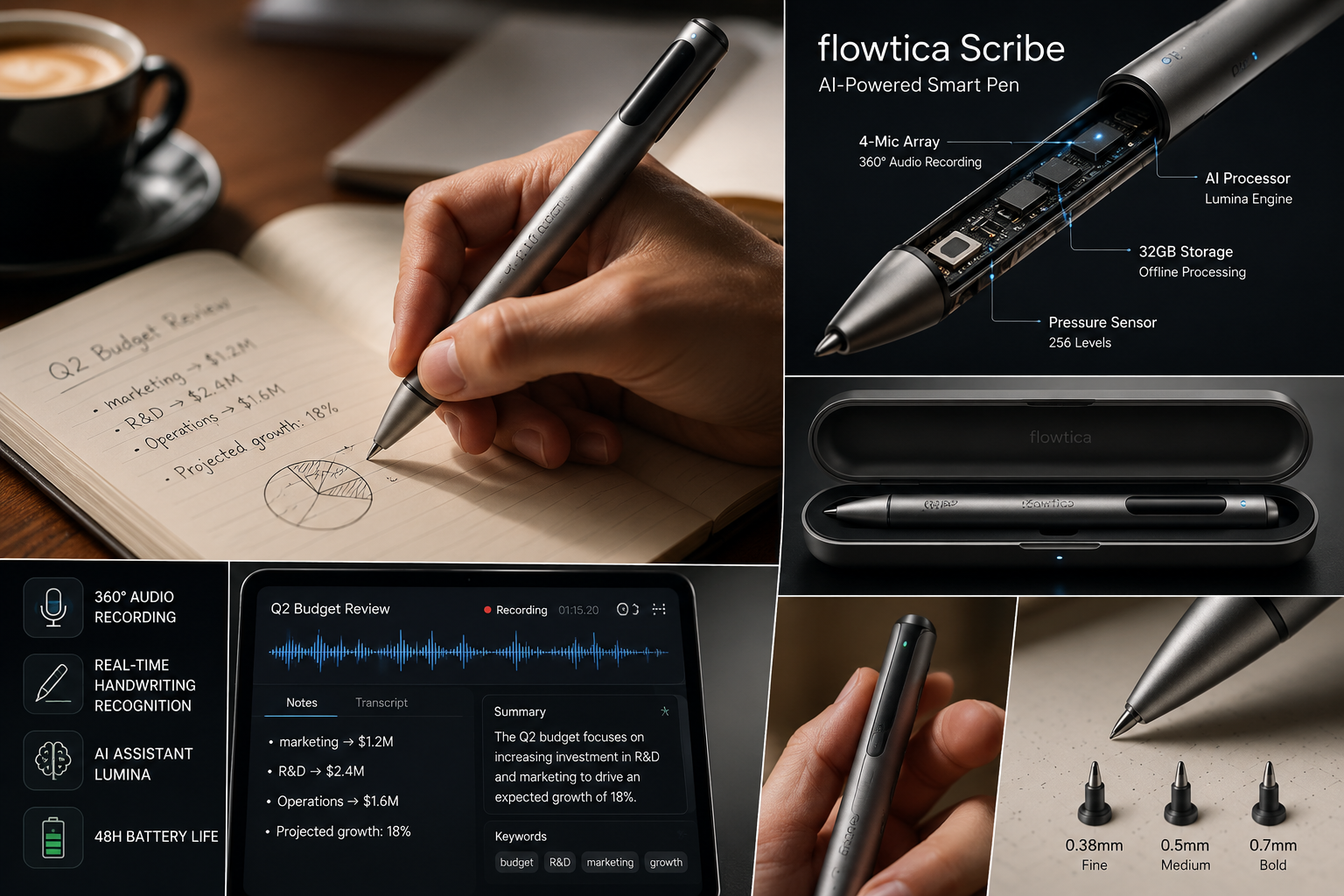
As 2026 unfolds, we are witnessing the rise of devices that seamlessly merge the physical act of writing with digital intelligence. San Francisco-based startup Flowtica officially unveiled its highly anticipated smart pen, the Scribe, at a launch event yesterday. At first glance resembling an elegant fountain pen, Scribe transcends being a mere writing tool thanks to its integrated multi-directional microphone array, 32 GB of onboard storage, and a real-time AI processing chip. The device converts everything you write on paper into digital text within milliseconds while simultaneously capturing 360-degree ambient audio. During a live demo by Flowtica CEO Elena Marchetti, Scribe isolated a speaker's voice in a noisy café and transcribed it with 97 percent accuracy, earning minutes of applause from the 2,500 invited guests in the auditorium.
Dual-Layer Recording Technology
Scribe's most striking feature is its dual-layer recording system operating in true simultaneity. The four beamforming microphones embedded within the pen's body do more than just capture sound; Flowtica's proprietary EchoSilence algorithm suppresses background noise by up to 89 percent. While rival products like the Livescribe Symphony, released last year, only digitize handwriting, Scribe can establish semantic links between audio and text. For instance, a single tap on the phrase 'budget approved' in your notes instantly takes you to the exact corresponding moment in the audio recording. This feature could play a critical role in pushing the global smart pen market from the $1.2 billion volume reached in 2025 toward surpassing the $2 billion mark by the end of 2026.
Meet Lumina, the On-Device AI Assistant
The real power of Scribe lies not in cloud-based processing but in Lumina, its on-device AI assistant. Operating entirely without an internet connection, Lumina can summarize your notes, format meeting minutes, and even translate your handwriting into 47 different languages in real time. Flowtica's design choice is a direct response to growing sensitivity around data privacy. The dedicated NPU chip inside the pen is capable of 12 trillion operations per second, roughly a quarter of the processing power of an average laptop.
An Adaptive System That Learns Your Habits
One of Lumina's most impressive capabilities is its adaptive learning, which adjusts to each user's handwriting style and personal habits. After an initial 72-hour usage period, the system begins recognizing your handwriting almost flawlessly and can even interpret your commonly used abbreviations, symbols, and even scribbles. According to data released by Flowtica, 84 percent of beta test participants reported that Scribe increased their note-taking productivity by at least 40 percent. In writing-intensive fields such as law, medicine, and academia, this improvement rate climbed as high as 62 percent.
Hardware Design and Ergonomics: Where Nostalgia Meets the Future
Flowtica has pursued a retro-futuristic design language for the Scribe. Its titanium alloy body weighs just 39 grams and offers a balance sensation nearly identical to a standard fountain pen. During an 18-month ergonomic study, the company scanned the hand anatomy of 600 different users to optimize the pen's grip point. Bundled with a magnetic charging case, Scribe promises 48 hours of uninterrupted use on a single charge, more than double last year's industry average of 20 hours. A quick 15-minute charge via USB-C delivers up to 8 hours of usage.
Interchangeable Nib System and Paper Sensor
Another invaluable detail of the Scribe is its interchangeable nib system. Offering three different tip sizes—0.38 mm, 0.5 mm, and 0.7 mm—the device can mimic the sensation of ballpoint, rollerball, or even pencil writing. A pressure sensor that detects 256 distinct levels per square millimeter provides professional-grade precision for everything from calligraphy to engineering sketches. Additionally, an optical sensor located at the rear of the pen automatically detects the type of paper you are using and adjusts the ink flow simulation accordingly.
Pricing, Release Date, and Competitive Landscape
The Flowtica Scribe will hit the shelves in September 2026 with a starting price of $399. While this price point is higher than existing stylus solutions like the Apple Pencil Pro ($179) and Samsung S Pen Pro ($99), Scribe positions itself in a different segment, being a standalone device that requires no tablet whatsoever. Compared to ReMarkable's Marker Plus, released in 2025 at $129, the Scribe's audio recording and dedicated AI features appear to justify the price difference. The initial pre-order campaign saw its entire stock of 15,000 units depleted within the first three hours.
Early Reactions from Industry Experts
Tech analyst Dr. Mehmet Yilmaz described the Scribe as 'one of the boldest hardware ventures of 2026,' while Gartner Senior Research Director Sarah Lin stated, 'We should not underestimate the impact this device will have on the education and corporate worlds; especially in an era where hybrid working models have become permanent, audio-note integration could change the rules of the game.' The Verge's first impressions piece notably called Scribe 'the smoothest bridge between paper and digital.' Unlike dozens of failed ventures that insisted on a 'fully digital' transition, Flowtica's strategy of strengthening rather than rejecting the pen-and-paper habit seems to have struck the right psychological chord. So, by the end of 2026, will you still be taking notes the old-fashioned way, or will you redefine your productivity with a device like the Scribe?
