What Is WhatsApp Plus and How Has It Arrived in Turkey?
As of 2026, WhatsApp remains the world’s most widely used messaging app with over 2 billion active users. The paid subscription tier, WhatsApp Plus, which was announced last year and piloted in select markets, has now officially launched in Turkey. Owned by Meta, the company introduced this model to generate sustainable revenue while keeping the core app ad-free. Turkey, with its nearly 70 million WhatsApp users, becomes a critical testbed for the service’s global expansion.
Meta’s New Monetization Strategy
After years of being completely free, WhatsApp began shifting its revenue model in 2025 by raising API fees for businesses and teasing a consumer subscription. As of June 20, 2026, Turkish users can purchase WhatsApp Plus via the App Store and Google Play. According to Meta CEO Mark Zuckerberg, the subscription unlocks an AI-powered chat assistant, unlimited cloud storage, and priority support. To start, users simply navigate to the WhatsApp Plus tab in settings and pay via their Google or Apple account, with a 7-day free trial to test the waters risk-free.
Features That Set WhatsApp Plus Apart
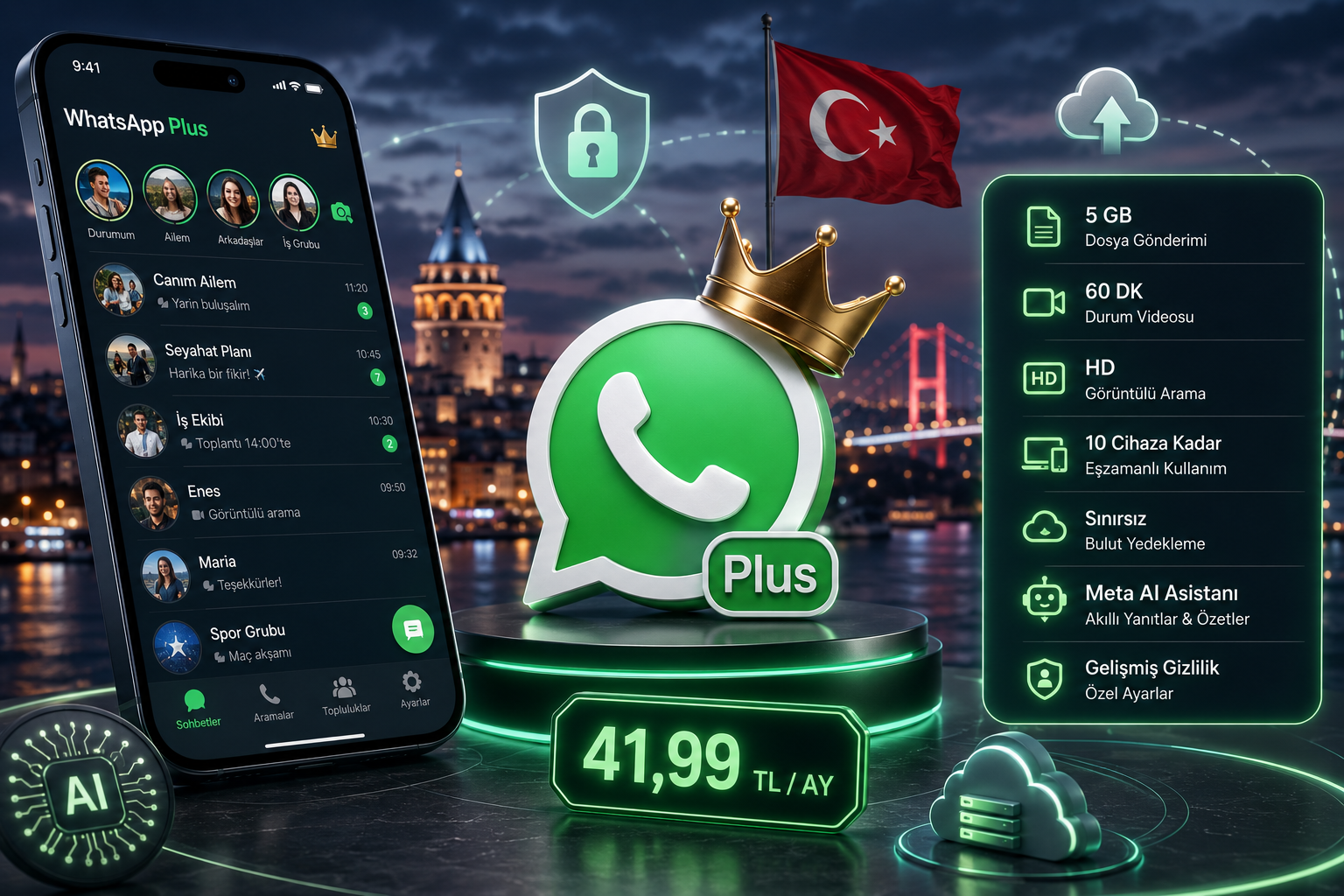
So what exactly does a user get for 41.99 TL a month? WhatsApp Plus significantly expands the standard app’s capabilities. File sending limits jump from 2 GB to 5 GB, video statuses can last up to 60 minutes, and video calls are now in HD quality. Furthermore, the number of linked devices increases from 4 to 10, making it a boon for tablet and desktop users who need seamless multi-device access.
Unlimited Cloud Storage and AI Integration
The standout feature is the Meta AI personal assistant. It can summarize long chats, suggest auto-replies, and even manage group conversations via voice commands. Cloud storage becomes unlimited, bypassing Google Drive or iCloud caps, so users can archive chats for years without worry. Subscribers also get exclusive profile badges and enhanced privacy controls—such as hiding online status from specific contacts.
Turkey’s Pricing and How It Stacks Up Globally
At 41.99 TL per month, WhatsApp Plus in Turkey is priced aggressively compared to international markets. The same service costs $4.99 in the United States (roughly 160 TL) and €5.99 in Europe (around 200 TL). This represents a discount of up to 70% for Turkish users, reflecting local purchasing power. Even so, the annual cost of about 503 TL may spark debate among students and younger demographics. Meta’s 2025 data shows that 60% of Turkish users are open to in-app purchases, but it remains unclear whether that enthusiasm will translate to a recurring messaging subscription.
The Value Proposition Against a Cup of Coffee
In a country where a regular coffee costs between 50-60 TL in 2026, the monthly fee equals roughly one coffee. Yet, the fact that basic messaging remains free could hinder adoption. By comparison, Telegram Premium launched in Turkey last year at 28.99 TL/month. To justify its higher price, WhatsApp is betting on advanced AI and limitless storage. On the flip side, users weighing the same amount against Spotify Premium or Netflix’s basic plan may question spending priorities. Still, given that the average user spends 33 minutes daily on WhatsApp, the subscription can be seen as competitive in terms of usage frequency.
User Reactions and Market Outlook
Social media erupted with mixed reactions following the announcement. Some users welcomed the AI and storage perks as “worth it,” while others fear a slippery slope toward a paywalled core service. Aziz Alkan, Meta’s Country Director for Turkey, stressed in a press release that “WhatsApp’s essential features will always remain free; Plus is purely an optional enhancement.” Despite this, suspicions linger that the free version might see gradual feature limitations over time. Importantly, end-to-end encryption remains identical to the free version, and Meta pledges that AI data will not be shared with third parties.
Telegram Premium vs. WhatsApp Plus: The Numbers
When Telegram Premium hit Turkey in 2025 at 28.99 TL, it sparked similar conversations. Telegram’s offering includes 4 GB file transfers and faster downloads. WhatsApp Plus ups the ante with AI and unlimited backups. Analysts predict the premium messaging market in Turkey could grow by 25% in the second half of 2026, driven largely by business users and content creators. Even if only 1% of WhatsApp’s 70-million-strong Turkish user base subscribes, that’s 70,000 subscribers translating to over 35 million TL in annual revenue.
As WhatsApp Plus rolls out across Turkey, it has the potential to reshape digital communication habits. Whether users will pay for an enhanced experience when free alternatives abound remains to be seen. What’s your take? Is a 41.99 TL monthly investment in messaging worth it to you, or do existing apps do the job? Join the conversation and share your thoughts below.
