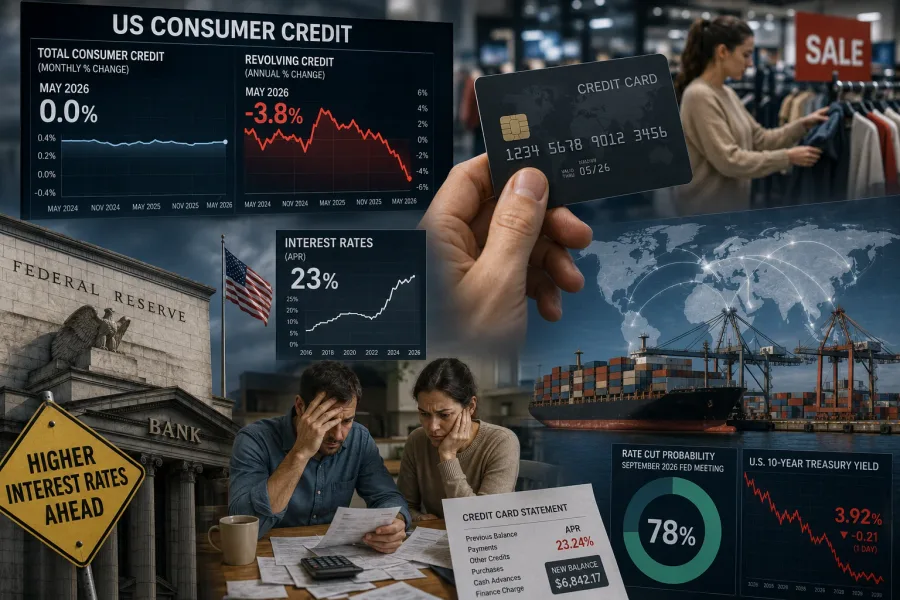
A sudden chill swept through American household finances in late spring 2026, as the engine of US consumer borrowing — the credit card — sputtered to a halt. According to Federal Reserve data released on July 19, 2026, total consumer credit showed zero growth on a seasonally adjusted basis in May, a stunning reversal from the robust borrowing trends that defined the post-pandemic era. The unexpected stall, driven by a sharp contraction in revolving debt, has ignited a fierce debate among economists about whether the long-resilient American consumer is finally capitulating under the weight of persistently high interest rates.
The Great Credit Card Retreat: Unpacking the Revolving Debt Decline
Revolving credit, which primarily encompasses credit card balances, plummeted at an annual rate of 3.8 percent in May 2026. This marks a stark contrast to the 5.2 percent surge recorded in May 2025, underscoring a dramatic shift in consumer behavior. The average annual percentage rate (APR) on US credit cards has hovered around 23 percent throughout 2026, a three-decade high, as the Federal Reserve maintained its benchmark policy rate at 5.50 percent for most of the previous year. With the era of 'free money' firmly in the rearview mirror, households are aggressively paying down their high-interest debt.
Data from the Commerce Department corroborates this trend, showing that the personal saving rate dipped to just 3.2 percent in May 2026, the lowest since the 2008 financial crisis. Americans are liquidating their pandemic-era savings buffers to escape the crushing weight of credit card interest. Major retailers, including Walmart and Target, noted in their Q1 2026 earnings calls a distinct consumer shift away from discretionary purchases, particularly in electronics and home goods. 'The pain of high interest rates is no longer theoretical for the average household; it's a line item on their monthly statement,' noted Diane Swonk, chief economist at KPMG, in a research note following the release.
Shifting Priorities in Household Budgets
The pullback in credit card usage is not merely a financial calculation but a psychological one. The University of Michigan's Consumer Sentiment Index hit an eight-month low in early July 2026, reflecting growing anxiety about the economic outlook. Consumers are increasingly prioritizing essential spending on groceries and healthcare over discretionary items, a trend that threatens the services sector which has been the primary growth engine of the US economy throughout 2025 and early 2026.
Non-Revolving Credit Growth Slows to a Crawl
While the spotlight remains on the credit card retreat, the non-revolving credit segment — which includes auto loans and student debt — also flashed warning signs. This category expanded at a modest 2.1 percent annual rate in May, a significant deceleration from the 4.5 percent monthly average observed in 2025. The auto sector, centered in Detroit, Michigan, is grappling with bloated inventories as high financing costs deter buyers. The average interest rate on a new car loan surpassed 9 percent in 2026, pushing monthly payments beyond reach for many middle-income families.
Student loan growth, meanwhile, has been tepid despite the Biden-era income-driven repayment plans that took full effect in 2025. A cooling labor market for recent university graduates has tempered new borrowing, while existing borrowers are prioritizing repayment over new debt. The Federal Reserve's Senior Loan Officer Opinion Survey (SLOOS) indicates that over 40 percent of major US banks tightened their standards for auto loans in the second quarter of 2026, signaling that the credit crunch is supply-driven as well as demand-driven.
Banking Sector Braces for Delinquencies
Financial giants like Bank of America and Citigroup have increased their loan loss provisions in anticipation of rising delinquencies. The tightening of credit standards is a classic precursor to an economic slowdown, as it restricts the flow of capital to both consumers and small businesses. This dual contraction — consumers avoiding debt and banks avoiding risk — creates a feedback loop that could amplify the economic cooling already underway in mid-2026.
Global Ripple Effects of a US Consumer Slowdown
The American consumer has long been the world's buyer of last resort, and any sustained pullback in US spending sends shockwaves through the global economy. For export-driven economies like Germany, China, South Korea, and emerging markets such as Turkey, a deceleration in US import demand poses a significant headwind. According to the Turkish Exporters Assembly (TİM), Turkey's exports to the United States reached a record $15 billion in 2025, with textiles and automotive parts among the leading categories. Preliminary data from the first half of 2026 suggests a softening in new orders from American buyers.
However, the silver lining for emerging markets lies in the shifting monetary policy outlook. The Chicago Mercantile Exchange's (CME) FedWatch tool saw the probability of a September 2026 rate cut jump from 65 percent to 78 percent immediately following the consumer credit data release. A pivot by the Fed would ease global financial conditions, potentially reversing capital outflows from developing nations and providing relief to currencies like the Turkish lira, which has faced pressure from the strong dollar environment.
September Rate Cut Odds Surge After Data Release
Market pricing now strongly favors a quarter-point rate cut at the Federal Open Market Committee's (FOMC) September 2026 meeting. Bond yields tumbled on the news, with the 10-year US Treasury yield dipping below 4 percent for the first time since early 2025. For central bankers in Ankara, Brasília, and Johannesburg, a weaker dollar and lower US rates would provide much-needed breathing room to manage their own domestic inflation battles without crushing economic growth.
Economists Weigh In: Soft Landing or Recession Signal?
The unexpected stall in consumer credit has polarized economic opinion. Mark Zandi, chief economist at Moody's Analytics, described the data as 'the clearest evidence yet that the consumer has hit a wall,' predicting near-zero growth in personal consumption expenditures for the second half of 2026. Conversely, Nobel laureate Paul Krugman argued in a blog post that the decline in revolving credit could be interpreted as a healthy deleveraging process, with households opting to live within their means rather than accumulating unsustainable debt.
The critical variable for the remainder of 2026 remains the labor market. As of June 2026, the US unemployment rate has held steady at historically low levels, keeping a floor under consumer confidence. If job creation remains stable, the credit pullback may simply represent a normalization of household finances rather than a prelude to recession. The next major test will come with the release of June retail sales data and the July consumer credit report, which will confirm whether the May stall was a one-off anomaly or the beginning of a sustained retrenchment by the American consumer.
As Wall Street navigates this uncertainty, one thing is clear: the era of relentless consumer borrowing that fueled the post-pandemic recovery is over. Whether this transition ends in a soft landing or a hard stop will define the trajectory of the global economy well into 2027.
