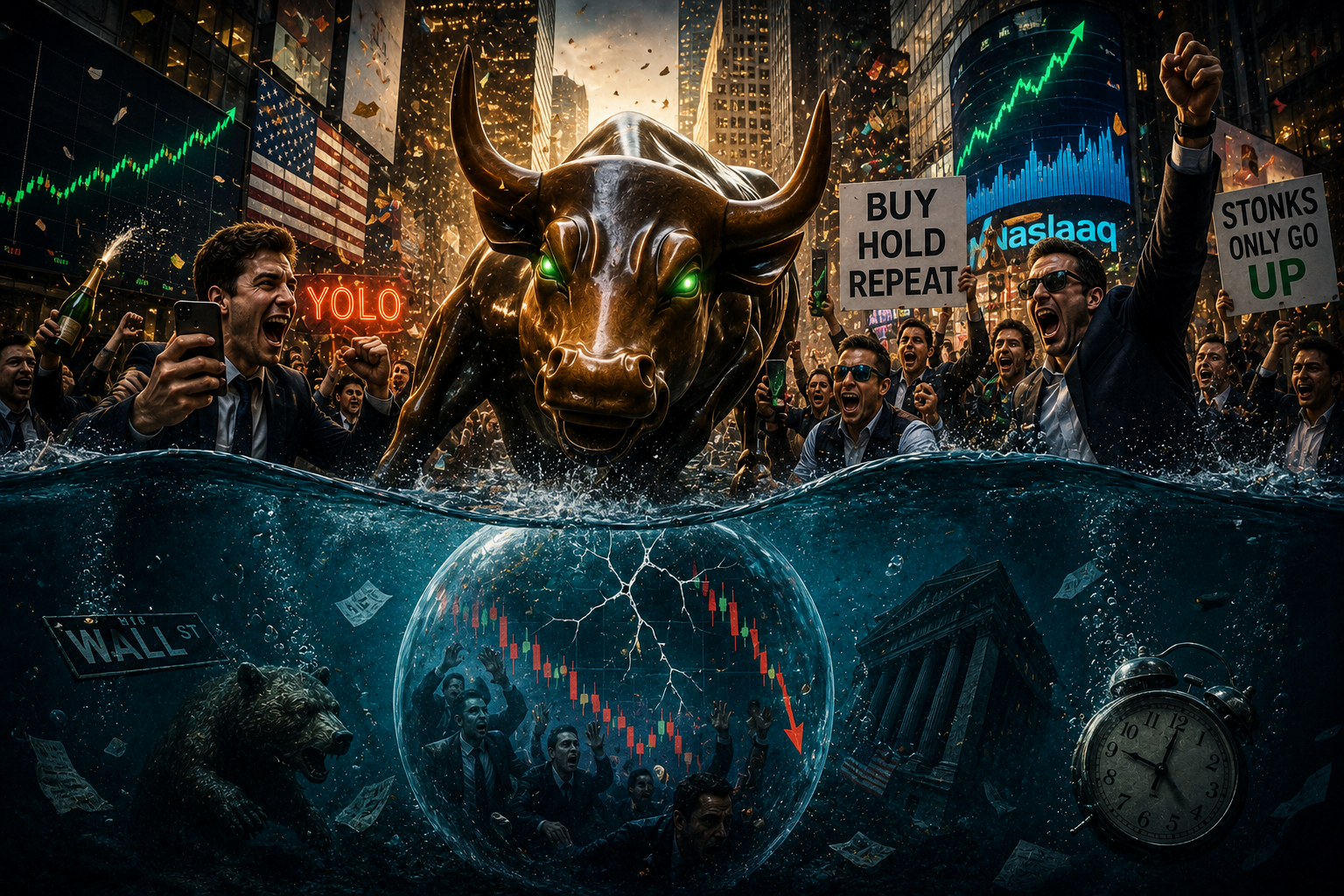
As we pass the midpoint of 2026, American stock markets appear to have crossed the vital boundary between 'rational exuberance' and 'irrational frenzy.' The share prices of technology behemoths are not merely rising; they are charting new flight paths almost daily, while investors rush into complex derivatives that promise overnight riches, piling on leverage at a rate unseen in decades. The recovery that began with the Fed’s rate cuts in 2025 has now morphed into a self-perpetuating mania.
Major indices shatter records, buoyed by the swagger of double-digit returns in 2025, yet the forward P/E ratio of S&P 500 leaders has soared past 30. This level is a classic excess signal, echoing the preludes to 1929 and 2000. The market’s most telling behavior, however, is the near-total evaporation of risk perception.
Valuations Skyrocket as FOMO Becomes a Pandemic
Traditional valuation metrics have stopped working. The Shiller CAPE ratio is testing the 40 level—a sight previously reserved for the dot-com peak and the 1929 blow-off top. Meanwhile, the VIX 'fear index' is anchored artificially below 12, reflecting an eerie calm. Investor surveys reveal cash allocations have plummeted to 3.8%, the lowest in twenty years, while equity positioning has surged to an all-time high.
This casino-like atmosphere is fueled by a social media narrative of 'you missed the bottom.' Retail investor inflows have averaged $15 billion weekly over the past six months. Most fascinating is the near-cult status conferred on just seven mega-cap stocks. Market-cap-weighted indices force every portfolio manager through the same narrow gate, creating a vicious cycle of concentration.
AI Stocks: The Engine of the Everything Bubble
Nvidia, following its 180% rally in 2025, has not slowed in 2026, now eyeing a $5 trillion market cap. Demand for chips powering large language models still outstrips supply, but the key question remains: how sustainable are these valuations? Corporate spending on AI infrastructure as a percentage of GDP has hit a record, yet tangible revenue from consumer-facing applications lags far behind expectations. Investors are pricing in not today’s earnings, but an uncertain future market of mythical proportions.
Analyst price targets for the second half of 2026 are being revised upward by 25–30% over just the past three months—typical late-cycle behavior. The 'Greater Fool Theory' still holds: everyone believes they can find someone willing to pay an even higher price tomorrow.
The Options Frenzy: The Overnight Millionaires’ Club
The most unmistakable sign of mania in 2026 is the explosion in options trading volumes. According to OCC data, total contract volume has surged 40% year-over-year to a daily average of 65 million, with call options accounting for nearly 60%. Investors are betting exclusively on upside, feeling no need to hedge.
In particular, zero-day-to-expiry (0DTE) options have become the darling of retail gamblers. These ultra-short-dated contracts, which settle within a single trading day, can trigger sudden price spikes in underlying stocks. The 'gamma squeezes' seen in Tesla and Apple on Fridays prove that the market has decoupled from fundamental valuation; the tail of the derivatives market is now firmly wagging the dog.
Leverage Speculation and Hidden Fragilities
FINRA margin debt figures hit a record $1.1 trillion as of March 2026. Investors are accelerating stock purchases by borrowing against their portfolios. This strategy works brilliantly on the way up, but a mere 10% correction could trigger margin calls that force liquidations, draining market liquidity instantly—just as happened during the shocks of 2020 and 2022.
On the institutional side, the picture is identical. Hedge fund net long positions stand at a decade high. The liquidity spigot opened by central banks in 2025 has inflated risky asset prices, while everyone conveniently forgets how narrow the exit door becomes when all rush to leave simultaneously.
Echoes of the Dot-Com Era? Not Exactly, but Beware
There are both similarities and differences between today’s mania and the 2000 bubble. In 2026, giants like Microsoft and Alphabet—driving the AI revolution—actually generate massive cash flows; pets.com had no such luxury. Yet across the broader market, hundreds of profitless 'story stocks' continue to arrive via SPAC mergers. The Nasdaq price-to-sales ratio hovers near 5.5, almost double the historical norm.
Perhaps the biggest commonality is the orthodoxy of the 'this time is different' mantra. Everyone recites like scripture that AI will boost productivity, permanently lower inflation, and widen profit margins. History, however, shows that even transformative technology cannot prevent bubbles: railways, radio, and the internet all shared the same fate.
The Invisible Fragility of Passive Funds
With over half of assets now pooled in passive index funds, the market carries a high structural risk. Inclusion in the S&P 500 virtually guarantees a wave of automatic buyers, divorcing prices from fundamentals. The fixed-weighting mechanics of index funds are programmed to buy more of the stocks that are already rising. When the decline begins, the opposite will occur: mechanical selling will accelerate the fall. No one questions the 2008-style portfolio insurance or the circuit breakers until it is too late.
What Could End the Party? The Fuses Under the Bonfire
In periods of such extreme exuberance, the beginning of the end often arrives from an unexpected corner. The biggest risk for the second half of 2026 is sticky headline inflation hovering around 3.5%, disappointing the Fed and derailing rate-cut hopes. The labor market remains tight and services pricing resilient. Futures markets now price in no rate cuts until mid-2027; if talk of a rate hike even begins, today’s asset values could suffer deep erosion.
Geopolitical factors also lurk in a dark corner. Tensions in the Taiwan Strait, energy supply fragility in the Middle East, and rising trade protectionism around the U.S. election cycle could produce shocks the market has entirely ignored. A market that sailed through 2025 without a scratch is now dangerously vulnerable to any surprise.
What Should Investors Do? Hedge, Don’t Chase
Financial planners are urging clients to return to goal-based allocation and disciplined rebalancing. Unlike 2025, bonds now offer meaningful yields and are a tempting competitor again. Reducing portfolio risk does not mean timing the exit—no one can perfectly call the top. But pouring fresh money into the latest mania usually results in permanent damage. An investor who entered the Nasdaq in March 2000 waited 15 years just to recover their principal. 2026 may be only a few months away from a reenactment of that cycle.
Market participants may be living the last breath of the 'buy everything' mindset. The real question is whether the next 10% gain is worth chasing. On this ship where drunken sailors dance, the few cool-headed investors who hold the compass are preparing the lifeboats before they hit the rocks. Which side are you on?
