From Bastille Day to the eastern front: A new security paradigm
The thunder of boots on the Champs-Élysées carried a message far beyond ceremonial pomp on July 14, 2026. For the first time in history, Ukrainian troops marched in France's Bastille Day parade, their presence a calculated declaration that Europe's security architecture has fundamentally shifted. The soldiers who walked those historic cobblestones were not merely honored guests — they represented a nation that has, through three years of relentless warfare, transformed into the continent's most battle-hardened and technologically innovative fighting force.
The invitation extended by French President Emmanuel Macron was no routine diplomatic gesture. It formally acknowledged what defense analysts have been arguing since the winter of 2025: Ukraine is now Europe's de facto first line of defense against Russian expansionism. The Ukrainian military, forged in the crucible of the largest land war in Europe since 1945, has developed capabilities that no NATO member currently possesses — particularly in the realm of unmanned aerial systems and electronic warfare. This expertise, rather than remaining confined to Ukraine's borders, is being systematically integrated into the European Union's broader defense framework.
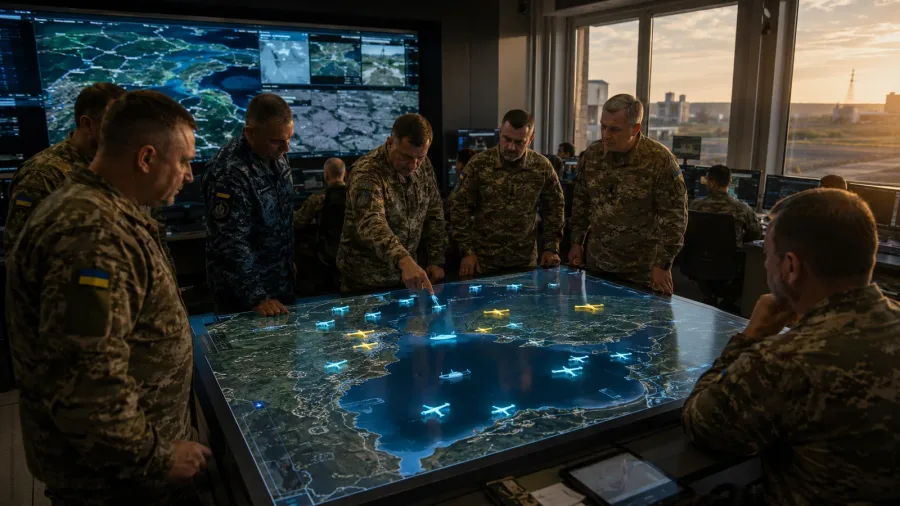
The Bastille Day appearance capped a year of unprecedented military integration between Ukraine and EU member states. Throughout 2025, Ukrainian drone units conducted joint exercises with Polish, Romanian, and Baltic forces along NATO's eastern flank. By mid-2026, Ukrainian-manufactured reconnaissance drones were conducting regular patrols from the Baltic Sea to the Black Sea, feeding real-time intelligence into NATO's command structures. The parade in Paris was the public face of a military relationship that has already become operationally indispensable.
Macron's strategic calculus and the European defense identity
Macron's decision to feature Ukrainian forces so prominently reflected more than solidarity — it was a strategic investment in France's vision of European strategic autonomy. With the United States increasingly focused on the Indo-Pacific theater following the 2024 presidential transition, European leaders have been forced to confront uncomfortable questions about their own defense capabilities. Ukraine, with its proven combat record and rapidly expanding defense industry, offers a compelling answer to those questions.
The French president has been the most vocal advocate for integrating Ukraine's military expertise into EU defense structures. His argument, increasingly accepted in Brussels and Berlin, is that the billions of euros invested in Ukrainian defense since 2022 have yielded an asset too valuable to leave outside Europe's formal security umbrella. The Ukrainian soldiers on the Champs-Élysées were, in this reading, the human embodiment of Europe's best return on a defense investment in decades.
The drone revolution that redrew the battlefield
Ukraine's emergence as a drone superpower represents one of the most rapid military transformations in modern history. When Russian forces crossed the border in February 2022, Ukraine's drone arsenal consisted primarily of Turkish-made Bayraktar TB2s — effective but limited in number. By July 2026, the country hosts more than 200 domestic drone manufacturers producing everything from $400 FPV (first-person view) attack drones to long-range strike systems capable of reaching targets 1,500 kilometers inside Russian territory.
The scale of this industrial mobilization is staggering. Ukrainian factories now produce over 100,000 drones monthly, a figure that surpasses the combined output of all EU member states. More significant than quantity, however, is the pace of innovation. The feedback loop between frontline operators and domestic manufacturers has compressed development cycles to weeks rather than years. A software patch developed in a Kharkiv workshop on Monday can be deployed across an entire drone fleet by Wednesday — a tempo that Western defense contractors, bound by lengthy procurement processes, cannot match.
Artificial intelligence has been the decisive force multiplier. Ukrainian engineers have pioneered AI-driven target recognition systems that allow drones to operate effectively even when electronic warfare jamming severs their connection to human operators. These autonomous capabilities, tested and refined in actual combat conditions, represent a technological edge that no other military currently possesses. The implications extend far beyond Ukraine's borders: the lessons learned in the Donbas are being studied intently by defense planners from Taipei to Tel Aviv.
Naval drones and the Black Sea paradigm shift
Perhaps no domain illustrates Ukraine's asymmetric innovation more dramatically than the Black Sea. Lacking a conventional navy, Ukraine developed the Magura V5 maritime drone — a low-cost, high-impact system that has fundamentally altered naval warfare. These unmanned surface vessels, carrying explosive payloads and guided by Starlink-connected AI, have forced the Russian Black Sea Fleet to abandon its historic base in Sevastopol, Crimea. By 2026, improved versions of these drones are patrolling the coastlines of NATO members Romania and Bulgaria, providing a cost-effective maritime security layer that would have been unthinkable just four years earlier.
The naval drone success story encapsulates Ukraine's broader defense philosophy: leverage technology to neutralize an adversary's numerical and material advantages. A single Magura V5 costs approximately $250,000 — a fraction of the value of the Russian warships it has destroyed or disabled. This cost-imposition strategy has become the template for how smaller nations can deter larger aggressors, and it has made Ukraine's defense industry an object of intense international interest.
Reshaping the global defense industry landscape
Ukraine's drone revolution is sending shockwaves through the global defense industry. Traditional arms exporters are scrambling to adapt to a marketplace that now prioritizes cheap, attritable, AI-enabled systems over expensive platforms. The F-35 fighter jet and the main battle tank are not obsolete, but their dominance in defense budgets is being challenged by the demonstrated effectiveness of drone swarms that cost less than a single guided missile.
European defense giants have recognized the shift and are moving aggressively to partner with Ukrainian firms. Germany's Rheinmetall opened a joint drone production facility in western Ukraine in early 2026, while France's Thales has invested heavily in Ukrainian AI startups specializing in electronic warfare countermeasures. These partnerships are not charity — they represent a recognition that Ukraine possesses intellectual property and combat-proven expertise that European defense companies cannot develop internally at the same speed.
The EU's 2026 defense budget reflects this new reality, with €2.5 billion allocated to joint research and development projects with Ukrainian partners — a 300% increase from 2025. This funding is accelerating the integration of Ukrainian innovations into European armed forces, from AI-powered battle management systems to electronic warfare-resistant communication protocols. The transfer of technology is no longer a one-way street from West to East; Ukraine is now a net exporter of military innovation to its European partners.
The Turkish connection and emerging defense axis
Turkey occupies a unique position in this evolving landscape. As the original supplier of the Bayraktar TB2 drones that proved crucial in the war's early months, Turkey has deep ties to Ukraine's defense ecosystem. In 2026, those ties are deepening into a strategic partnership that could reshape the global arms market. Turkish defense contractors are collaborating with Ukrainian counterparts on next-generation drone technologies, combining Turkey's manufacturing scale with Ukraine's combat-driven innovation.
This Ankara-Kyiv defense axis represents an emerging alternative to both American and Chinese dominance in unmanned systems. Joint Turkish-Ukrainian projects are developing drone platforms that incorporate the best of both nations' expertise: Turkish airframe design and production efficiency, Ukrainian AI software and electronic warfare hardening. The partnership is particularly significant for NATO's southern and eastern flanks, offering member states access to battle-tested technology without the political constraints that sometimes accompany American systems.
Strategic implications for European security in 2026 and beyond
Ukraine's transformation into Europe's first line of defense carries profound strategic implications. The most immediate is deterrence: Russia's military planners must now contend with a Ukrainian armed forces capable of striking deep into Russian territory with drone swarms while simultaneously providing NATO with unprecedented situational awareness along the entire eastern front. This layered defense architecture has, by mid-2026, effectively frozen the conflict into a stalemate that favors the defender.
The longer-term implications concern NATO's future force structure. The Alliance's July 2026 Washington Summit formally acknowledged Ukraine's 'irreversible path to membership,' but the operational reality has already outpaced the political process. Ukrainian forces are interoperable with NATO commands, equipped with NATO-standard weapons, and integrated into NATO intelligence networks. The distinction between Ukrainian and NATO defense capabilities has become increasingly blurred — a development that the Bastille Day parade made vividly visible to the world.
For the United States, Ukraine's emergence as a self-sustaining defense power offers strategic flexibility. As Washington pivots resources toward the Indo-Pacific, a militarily robust Ukraine backed by European partners reduces the demand for direct American involvement in European security. This aligns with long-standing U.S. calls for greater European burden-sharing while maintaining a formidable deterrent against Russian aggression. The Champs-Élysées parade, watched by defense attachés from around the world, signaled that this vision is becoming operational reality.
The post-war horizon and technological legacy
Looking beyond the current conflict, Ukraine's drone industry faces the challenge of transitioning from wartime production to a sustainable peacetime economy. The same companies that revolutionized military drone warfare are already exploring civilian applications: agricultural monitoring, infrastructure inspection, and emergency response systems that leverage the AI and autonomous flight capabilities developed for combat. This dual-use potential positions Ukraine to become a global hub for civilian drone technology, much as Israel's defense industry spawned a thriving tech sector in previous decades.
The soldiers who marched in Paris on July 14, 2026, carried with them the weight of a nation's sacrifice and the promise of its technological renaissance. They represented not just a military that has held the line against a larger aggressor, but a society that has turned existential threat into transformative innovation. As Europe's first line of defense, Ukraine has earned its place on the Champs-Élysées — and in the continent's security architecture for decades to come.
