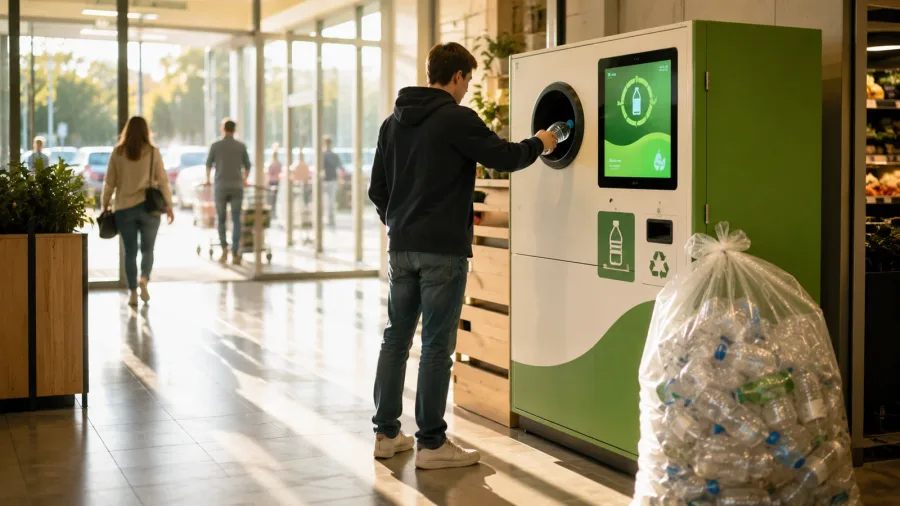
ISTANBUL — For 15 years, Mehmet Yılmaz pushed his cart through the narrow streets of Istanbul's Zeytinburnu district, collecting plastic bottles and glass containers to sell by the kilogram to scrap dealers for a meager income. But on the morning of July 1, 2026, everything changed. Turkey's long-awaited Deposit Return System (Depozitosu Olan Ambalajlar, or DOA) went live nationwide, and Yılmaz found himself earning more in a single day than he used to make in a week. 'I collected 120 bottles today and earned 120 Turkish lira (about $3.70). Before, I would need three full sacks to make that much,' he said, his weathered hands sorting through a bag of deposit-labeled containers.
The DOA system, implemented by Turkey's Ministry of Environment, Urbanization and Climate Change, represents one of the most ambitious recycling initiatives in the developing world. Under the program, all beverage containers between 0.1 and 3 liters bearing the official DOA logo can be returned to reverse vending machines installed at supermarkets and designated collection points across all 81 provinces. Each container yields a deposit refund of 1 Turkish lira (approximately $0.031 at current exchange rates), which can be redeemed as cash or applied to shopping receipts. While the system was designed primarily to boost Turkey's dismal recycling rates, its most profound impact has been on the country's estimated 500,000 informal waste collectors — a largely unregistered workforce that has long formed the backbone of urban recycling efforts.
Early data from the ministry indicates that the system is already exceeding expectations. In the first three weeks of operation, more than 150 million containers were returned through the network of 12,500 reverse vending machines. The ministry plans to double that number to 25,000 machines by the end of 2026. For waste collectors like Yılmaz, the shift from weight-based scrap pricing to a per-unit deposit model has been nothing short of transformative. 'Before, a kilogram of plastic bottles would fetch maybe 3 or 4 lira at the scrap yard. Now, each bottle is worth exactly 1 lira. The math is simple, and the money is better,' he explained.
But the transition has not been seamless. Elderly collectors unfamiliar with digital interfaces have struggled with the touchscreen-operated machines. In response, the ministry has launched free training programs at neighborhood muhtar offices — the lowest administrative units in Turkey's local governance system — and several supermarket chains have stationed assistants near machines to help collectors navigate the process. The government has also introduced a registered collector card system, offering an additional 5% bonus on returns and covering 50% of social security premiums for those who sign up, a significant step toward formalizing a sector that has operated almost entirely off the books.
From informal economy to formal recognition: A paradigm shift
The DOA system's most innovative feature, according to development economists and urban policy experts, is its deliberate integration of informal waste collectors into a formal recycling infrastructure. Unlike deposit systems in Germany or Norway — which primarily target end consumers — Turkey's model explicitly acknowledges the role of street collectors and creates economic incentives for their participation. 'This is a uniquely Turkish approach to inclusive recycling,' said Dr. Ayşe Kaya, a sociologist at Istanbul University who has studied waste-picking communities for over a decade. 'Instead of displacing these workers, the system empowers them. A bottle that was once worth pennies by weight now has a fixed, transparent value. That's a revolutionary change for people who have been invisible in the urban economy.'
The numbers support this assessment. Field surveys conducted by independent researchers in August 2026 found that daily incomes for waste collectors in major cities increased by 40% to 60% compared to pre-DOA levels. In Ankara's Altındağ district, 58-year-old Fatma, who has supported her family through waste collection for a decade, reported her monthly income rising from 2,500 lira ($77) to 4,200 lira ($129). 'Before, people threw bottles in the trash and I had to dig through bins. Now, citizens know a bottle is worth 1 lira. Sometimes they hand them to me directly, saying, 'Here, auntie, this is worth something.' The system has given us dignity,' she said.
The shift has also sparked an unexpected wave of digital organization among collectors. WhatsApp groups have proliferated, with members sharing real-time information about which supermarket machines are full, which neighborhoods have high bottle density, and optimal collection routes. In Istanbul, the newly formed Marmara Waste Collectors Cooperative now represents over 500 members, collectively processing an average of 25,000 bottles per day through bulk-return units. 'Unity has given us strength. We've eliminated middlemen, and our earnings go directly into our pockets,' said cooperative president Serkan Yıldız, illustrating how an informal sector is rapidly professionalizing.
How the DOA reverse vending machines operate
The technological backbone of the DOA system relies on AI-powered image recognition and barcode scanning. Each reverse vending machine can process between 500 and 1,000 containers daily, verifying the DOA logo and barcode within milliseconds to confirm eligibility. When a machine reaches capacity, it automatically alerts maintenance teams via a centralized software platform. For high-volume users like waste collectors, the ministry has begun piloting bulk-return units capable of accepting up to 50 containers at once, significantly reducing processing time for those bringing in hundreds of bottles per day.
The machines are manufactured by a consortium of Turkish and international technology firms, with the software infrastructure managed under strict data security protocols. Each transaction is logged and transmitted to the ministry's central database, providing real-time insights into return volumes, regional participation rates, and machine utilization. This data is already informing policy adjustments — for instance, identifying underserved neighborhoods where mobile collection vehicles are now being deployed on a rotating weekly schedule to reach collectors who cannot easily access fixed machine locations.
Environmental gains and economic ripple effects
The environmental impact of the DOA system has been immediate and measurable. According to ministry data released in September 2026, litter from PET bottles and glass containers has decreased by 35% nationwide since the system's launch. Coastal areas and public parks, long plagued by discarded beverage containers, have shown particularly dramatic improvements. In Antalya's Konyaaltı Beach, a major tourist destination on Turkey's Mediterranean coast, cleaning staff report collecting half as many bottles as before. 'We used to fill 50 garbage bags a day, half of them plastic bottles. Now people collect those bottles themselves to take to the machines. Our beaches are visibly cleaner,' said Murat, a municipal sanitation worker.
On the macroeconomic front, the Treasury and Finance Ministry projects that the DOA system will generate an annual circular economy volume of 25 billion Turkish lira ($770 million). This figure encompasses not only deposit refunds but also logistics, machine maintenance, software services, and new employment — 3,500 direct jobs have been created so far. More significantly, by boosting domestic recycling rates, Turkey aims to reduce its annual $500 million import bill for PET raw materials, a crucial consideration for a country grappling with persistent current account deficits. The World Bank, in a September 2026 report, praised Turkey's model as 'a potential blueprint for inclusive waste management in developing economies,' noting its dual focus on environmental sustainability and poverty alleviation.
However, the system has also created disruptions in the existing recycling ecosystem. Scrap dealers and recycling facilities that previously sourced materials from waste collectors are now facing raw material shortages. Ahmet Demir, president of the Turkish Recyclers Association (TÜGED), acknowledged the challenge: 'Deposit-labeled containers are no longer reaching our facilities. Capacity utilization rates have dropped. We are in discussions with the ministry about transitional support measures.' The government has signaled that low-interest loan packages and tax incentives for recycling facilities are under consideration to ease the adjustment period.
How Turkey's model differs from European deposit systems
While Turkey's DOA system draws inspiration from established deposit-return schemes in Germany (which achieves a 98% return rate) and Norway (92%), its deliberate integration of informal waste collectors sets it apart. European systems are designed for end-consumer participation; Turkey's model recognizes that in a country where hundreds of thousands earn their living from waste, a consumer-only approach would be both impractical and socially disruptive. 'This is not just a recycling program — it's a social policy intervention wrapped in environmental legislation,' noted Dr. Mehmet Ali Yıldırım, an environmental engineering professor at Middle East Technical University in Ankara. 'The genius of the system is that it turns a potential conflict — between formal recycling infrastructure and informal collectors — into a synergy.'
Looking ahead to 2027, the ministry plans to expand the DOA scope to include household chemical containers such as detergent and shampoo bottles. A dynamic pricing mechanism indexed to the Consumer Price Index is also under development to prevent the deposit value from eroding against inflation, a persistent concern in Turkey's economy. Additionally, the 'Green Passport' program — a digital identity system for registered collectors — is slated for rollout in early 2027, offering enhanced social security benefits and healthcare access as incentives for formal registration.
A new social contract for Turkey's urban poor
Beyond the economic and environmental metrics, the DOA system is quietly reshaping social dynamics in Turkey's cities. Waste collectors, long stigmatized as marginal figures, are reporting a shift in public perception. 'For years, people looked at us like we were garbage ourselves,' said Kemal, a 22-year veteran of the trade in İzmir's Konak district. 'Now, when I walk into a supermarket, they ask me, 'Kemal, how many bottles did you bring today?' Being treated like a human being, with respect — that's worth more than money.' His words capture a dimension of the reform that no statistical report can fully convey: the restoration of dignity to a community that has long existed on the margins of urban life.
The cooperative movement among collectors is accelerating this social transformation. By pooling resources and negotiating collectively, cooperatives are not only maximizing financial returns but also building political capital. Several municipalities have begun formally consulting with collector cooperatives on waste management planning, a development that would have been unthinkable before DOA. 'We are no longer invisible,' said Yıldız of the Marmara Cooperative. 'We are stakeholders now. That changes everything.'
Yet significant challenges remain. Access to machines is uneven, with peripheral neighborhoods often underserved. Mobile collection units are a promising solution but remain limited in number. The Competition Authority has also raised concerns about potential monopolization of machine operations by a handful of private companies, with a formal sector review expected in early 2027. And for all its successes, the system has not yet reached the most vulnerable segments of the collector population — undocumented migrants, the elderly without digital literacy, and those with disabilities — who risk being left behind in the transition to a technology-dependent model.
Public participation rates and consumer behavior shifts
Public opinion surveys indicate a 78% approval rating for the DOA system, with particularly strong support among younger demographics and environmentally conscious consumers. The 1-lira price increase on beverages — reflecting the deposit fee — has drawn some criticism from low-income households, but the ability to reclaim the deposit has largely muted opposition. Retailers report that foot traffic has increased at stores with deposit machines, suggesting that the system may be generating positive spillover effects for businesses. As Turkey enters the final quarter of 2026, the DOA system stands as a landmark experiment in inclusive environmental policy — one that other middle-income countries are watching closely.
