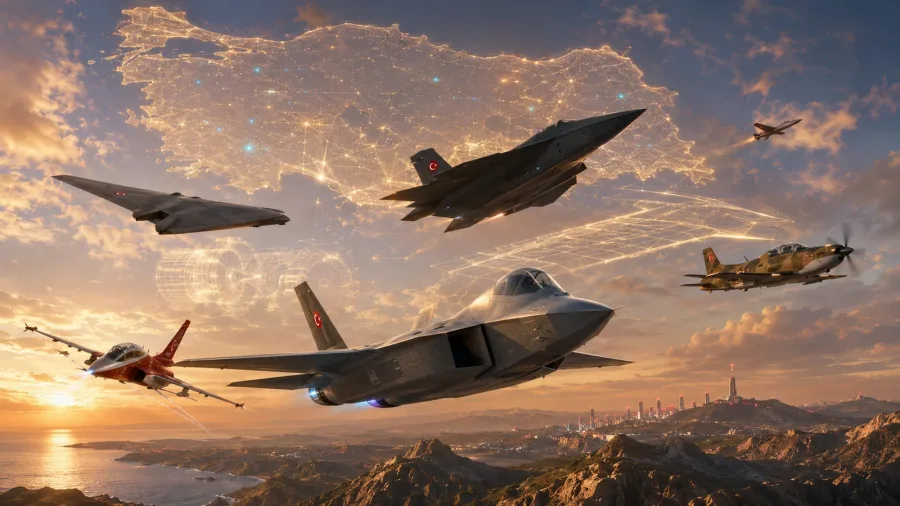
On a clear June morning in 2026, a formation of indigenously developed aircraft roared over the Turkish Aerospace Industries (TUSAS) facility near Ankara, marking a paradigm shift in the nation's defense posture. The flypast included the KAAN fifth-generation stealth fighter, the HÜRJET advanced jet trainer, and the delta-winged ANKA-3 unmanned combat aerial vehicle—a trio that encapsulates Turkey's ambitious journey from a mere arms importer to a formidable aerospace power. This transformation, deeply rooted in the political will that emerged after the 2000s, has now yielded a comprehensive family of air vehicles that are reshaping the security architecture of the Eastern Mediterranean and beyond.
By mid-2026, Turkey's defense aviation portfolio has reached a critical mass, boasting an average domestic content ratio exceeding 80 percent according to the Presidency of Defense Industries (SSB). This figure reflects not just the assembly of foreign parts, but the mastery over complex subsystems like mission computers, electronic warfare suites, and active electronically scanned array (AESA) radars. The successful supersonic tests of the KAAN's third prototype in May 2026, coupled with the operational deployment of the KIZILELMA unmanned fighter from the amphibious assault ship TCG Anadolu, have sent a clear signal to global arms manufacturers: Turkey is no longer just a market; it is a competitor. The ripple effects are being felt from NATO headquarters in Brussels to the procurement offices of potential client states in Asia and Africa.
KAAN: Emerging as a formidable fifth-generation contender in the global arena
The KAAN National Combat Aircraft stands as the crown jewel of Turkey's aerospace ambitions, positioning itself as a direct rival to the American F-35 and the Russian Su-57. Since the maiden flight of its second prototype in 2025, the program has accelerated dramatically in 2026, with the third prototype initiating supersonic flight tests earlier this year. Designed with a low radar cross-section, internal weapon bays capable of housing domestically produced GÖKDOĞAN and BOZDOĞAN missiles, and an advanced sensor fusion suite, KAAN represents a generational leap for the Turkish Air Force. Temel Kotil, the former CEO of TUSAS, famously described the project as 'the embodiment of a century-old aviation dream,' a sentiment that carries significant weight as the aircraft approaches its 2028 initial delivery deadline.
The most critical technological hurdle for KAAN remains its powerplant. While the prototypes currently fly with General Electric F110 engines, a parallel national effort led by TRMotor and TEI (TUSAS Engine Industries) is racing to finalize the indigenous turbofan engine. In 2026, core engine testing has reached an advanced stage, with engineers focusing on single-crystal turbine blade technology—a highly guarded industrial secret globally. Achieving propulsion independence is not merely a technical milestone; it is a geopolitical necessity. It would free the program from potential U.S. export control restrictions (ITAR) and ensure that the aircraft can be exported without Washington's veto. The transition plan foresees the first batch of KAAN aircraft replacing the aging F-16 fleet by the early 2030s, fundamentally altering the balance of air power over the Aegean Sea.
Strategic implications of Turkey's stealth capability in NATO context
The introduction of a non-American stealth fighter within a NATO member's inventory creates a unique dynamic. Unlike the F-35, which operates within a tightly controlled US-led logistics and data network, KAAN offers Turkey a sovereign air superiority option. This autonomy allows Ankara to conduct operations independently of allied approval, a strategic imperative sharpened by the recent geopolitical tensions in the Eastern Mediterranean. With Greece's F-35 delivery timeline facing potential delays, the early operational capability of KAAN could provide Turkey with a distinct tactical advantage in the contested airspace over the Aegean Sea by the end of this decade.
The drone revolution: KIZILELMA and ANKA-3 redefining carrier warfare and deep strike
Turkey's global reputation in unmanned aerial vehicles (UAVs) was cemented by the Bayraktar TB2, but the 2026 landscape is dominated by far more sophisticated platforms. The Baykar-developed KIZILELMA has made history as the world's first operational jet-powered unmanned combat aerial vehicle capable of short-runway landing and takeoff from a naval platform. The successful trials conducted on the TCG Anadolu in 2026 have effectively transformed the vessel from a standard amphibious assault ship into a 'drone carrier,' a concept that major navies like the US and China are still testing. This innovation allows Turkey to project air power without risking pilot lives in high-threat environments, a game-changer for power projection in the Mediterranean and the Black Sea.
Complementing KIZILELMA is the TUSAS-built ANKA-3, a flying-wing deep-strike UCAV designed for penetrating enemy air defenses. Having completed its first live ammunition drop in late 2025, the ANKA-3 is on track for initial operational capability in 2026. Its low-observable design and high subsonic speed make it an ideal platform for Suppression of Enemy Air Defenses (SEAD) missions. Turkish defense planners envision a 'loyal wingman' concept where multiple ANKA-3 drones fly in networked coordination with a manned KAAN fighter, overwhelming adversary defenses with a combination of human decision-making and artificial intelligence-driven swarm tactics. This concept places Turkey at the forefront of the next generation of air combat doctrine.
From TB2 to KIZILELMA: The export potential and battlefield impact
The combat-proven success of Turkish drones in Syria, Libya, and Ukraine has created a massive global demand. In 2026, the shift is towards high-end, jet-powered platforms. KIZILELMA and ANKA-3 are attracting interest from Gulf states and Asian countries looking for asymmetric capabilities against larger, more expensive air forces. The ability to operate these stealthy drones from short runways or naval platforms offers a cost-effective alternative to traditional, billion-dollar fighter jet programs, further solidifying Turkey's position as a leading drone exporter.
Building the foundation: HÜRKUŞ and HÜRJET training the pilots of tomorrow
A modern air force is only as good as its training pipeline, and Turkey has invested heavily in creating a fully indigenous solution. The HÜRKUŞ basic trainer, the starting point for all Turkish pilots, has evolved into a mature platform with a proven export record. By 2026, the HÜRKUŞ-B variant is in active service, featuring a glass cockpit and night-vision compatibility that allows student pilots to train in realistic combat scenarios from day one. Its rugged design has proven popular in Africa, with deliveries to Chad and Niger completed in late 2025, demonstrating that the aircraft can withstand harsh operational environments far from Turkey's temperate climate.
For advanced training and light attack roles, the HÜRJET has emerged as a star performer. Developed entirely with TUSAS's own equity, the HÜRJET achieved a major publicity coup in 2026 by becoming the official aircraft of the Turkish Stars aerobatic team. Beyond the airshows, its supersonic performance and modern mission computer make it a lethal light combat aircraft. The ongoing negotiations with the Spanish Air Force, which began in late 2025 and intensified in 2026, could mark the first sale of a Turkish jet trainer to a NATO ally. This potential deal validates the technical maturity of the platform and breaks the psychological barrier often associated with exporting complex jet aircraft to Western markets. The ŞİMŞEK high-speed target drone further enriches this ecosystem by providing realistic threat simulation for air defense training, with Azerbaijan and Qatar remaining key export customers.
The Spanish deal and the future of NATO cooperation in defense procurement
The potential sale of HÜRJET to Spain represents more than a commercial transaction; it signals a shift in intra-NATO defense procurement dynamics. It proves that Turkey can not only compete with traditional American and European defense giants but can also integrate its products into the logistical frameworks of allied air forces. This cooperation could pave the way for joint training exercises and a deeper technological partnership, reinforcing the alliance's collective defense capabilities while acknowledging Turkey's new status as a prime defense manufacturer.
The economic and geopolitical weight of Turkey's aerospace ecosystem in 2026
The indigenous aircraft program is not just a military matter; it is a massive economic driver. The aerospace ecosystem, anchored by TUSAS, Baykar, TEI, and hundreds of sub-contractors, has created a high-tech employment base that spans from precision engineering to advanced software development. In 2026, the export contracts for platforms like HÜRKUŞ, ŞİMŞEK, and the TB2 family have surpassed the $2 billion mark, a figure that is projected to multiply once KAAN and KIZILELMA enter the export market. This revenue stream provides critical foreign currency inflow and reduces Turkey's historic dependency on energy imports by balancing the trade deficit with high-value-added technology exports.
Geopolitically, the ability to produce a fifth-generation fighter and a carrier-capable drone changes Turkey's role within NATO and its relationships with non-aligned nations. It grants Ankara significant leverage in diplomatic negotiations, as access to these advanced but cost-effective platforms becomes a tool of foreign policy. Countries seeking to diversify their arms supplies away from China or Russia now view Turkey as a viable and politically palatable alternative. As 2026 progresses, the roar of Turkish-made jet engines is not just a sound of national pride; it is the audible signal of a new global power dynamic taking flight, one where Turkey holds the technological sovereignty to defend its interests and shape the future of aerial warfare.
