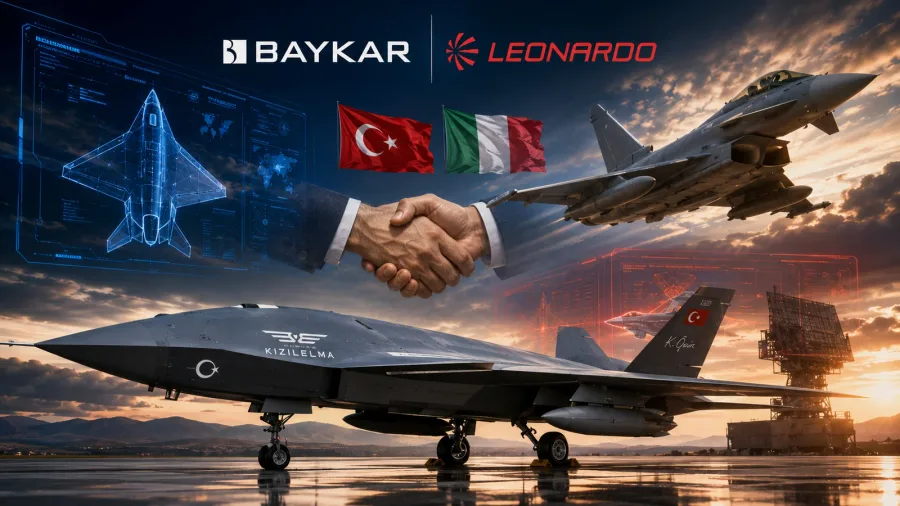
A landmark agreement signed in July 2026 between Turkey's drone champion Baykar and Italian defense giant Leonardo is poised to redefine how future air wars are fought. The strategic Memorandum of Understanding (MoU) focuses on integrating unmanned combat aerial vehicles (UCAVs) with manned fighter jets, a concept known as Manned-Unmanned Teaming (MUM-T). This partnership is not just a bilateral business deal; it represents a tectonic shift in the transatlantic defense industrial base, merging Turkey's proven battlefield drone dominance with Italy's advanced combat electronics and sensor technology.
While initial talks began in late 2025, the finalized 2026 framework targets the seamless operation of Baykar's KIZILELMA — a stealthy, supersonic unmanned fighter jet — alongside crewed platforms like the Eurofighter Typhoon and future sixth-generation aircraft. The core objective is to create a 'loyal wingman' architecture where a pilot can command a swarm of unmanned jets to penetrate contested airspace, conduct electronic warfare, and strike high-value targets without exposing the manned asset to lethal risk. This development comes as NATO allies scramble to adapt their defense postures to the realities of modern drone warfare observed in Ukraine and the Indo-Pacific.
Technical Blueprint for the Digital Wingman of the Future
At the heart of the Baykar-Leonardo deal is a complex technical integration challenge that could set a new NATO standard. Baykar's KIZILELMA, currently transitioning to serial production in 2026, is a low-observable platform capable of near-supersonic speeds without afterburners. It has so far been tested with indigenous Turkish AESA radar and munitions. Leonardo's role is to inject its high-end sensor and networking architecture into this platform. The Italian firm is adapting its advanced frequency-hopping, jam-resistant data links — originally designed for the Eurofighter Typhoon's ECRS Mk2 radar suite — to fit the compact airframe of the Turkish drone. This will allow for millisecond-latency data transfer between the cockpit and the unmanned wingman, ensuring that the situational awareness picture is fused and coherent even in GPS-denied environments.
Furthermore, the collaboration extends to sensor fusion. Leonardo's PIRATE Infrared Search and Track (IRST) system and electronic warfare expertise are being miniaturized for the KIZILELMA. The goal is to grant the unmanned jet the ability to autonomously detect, classify, and potentially engage threats based on the rules of engagement set by the human mission commander. This capability is particularly crucial for Suppression of Enemy Air Defenses (SEAD) missions, where a swarm of loyal wingmen can saturate and blind integrated air defense systems before the manned strike package arrives. Engineers are currently working on bridging the software architectures of the two distinct ecosystems into a unified 'combat cloud' that can be operated by both NATO and non-NATO users.
AI Ethics and the Autonomous Decision-Making Conundrum
The integration of Italian and Turkish artificial intelligence (AI) algorithms raises profound questions about the future of autonomous warfare. Both companies emphasize a 'human-on-the-loop' policy, where the final decision to deploy lethal force rests with a human pilot. However, the operational reality of high-intensity conflict, where communication links may be severed by jamming, necessitates a robust autonomous behavior protocol. In 2026, NATO's ongoing ethical framework for autonomous systems is directly influencing the coding of these algorithms. The Baykar-Leonardo partnership is, therefore, becoming a live test case for how Western-allied militaries will delegate authority to machines in degraded combat environments, balancing the speed of AI with the moral imperative of human judgment.
Reshaping the Global Defense Market: A New Export Powerhouse
The commercial implications of this partnership are staggering. Baykar, which derived over 90% of its revenue from exports in the past three years, has sold drones to more than 35 countries. Leonardo, with a 2025 revenue exceeding 15 billion euros, brings an unparalleled global logistics and sustainment network. The combined offering — a combat-proven unmanned platform integrated with top-tier European mission systems — creates a unique product category that sidesteps traditional American or Russian dependency. Potential buyers include current Eurofighter operators like Saudi Arabia, Qatar, and Kuwait, as well as Asian nations seeking to rapidly modernize their air forces without the political strings attached to US Foreign Military Sales (FMS).
Analysts project that this joint venture could unlock an economic volume exceeding $10 billion by 2030. The business model extends beyond hardware sales to include data link leasing, AI-driven software-as-a-service (SaaS) for fleet management, and continuous capability upgrades. This represents a shift from selling platforms to selling mission outcomes. For Italy, it is a masterstroke to remain relevant in the combat air sector at a time when the Global Combat Air Programme (GCAP) is still a decade away from service. For Turkey, it is a leapfrog moment that bypasses traditional barriers to Western sensor technology, potentially allowing Turkish drones to operate seamlessly within the highest-tier NATO mission networks.
NATO Standardization and the Interoperability Imperative
Strategically, the deal aligns perfectly with NATO's Allied Future Surveillance and Control (AFSC) initiative, which envisions a network-centric, mixed-fleet air command structure post-2035. The Baykar-Leonardo architecture could become a de facto standard for allied unmanned wingmen. If successful, this would mark the first time a Turkish defense product becomes a defining element of a NATO combat cloud standard, effectively making any future political embargoes or exclusion attempts technologically unfeasible. The partnership is a tangible step toward the alliance's goal of achieving seamless 'plug-and-fight' interoperability between member states' air forces.
Geopolitical Ripples: Rome, Ankara, and the European Equation
Beyond the hangar, the Baykar-Leonardo pact is a masterclass in defense diplomacy. Italian Prime Minister Giorgia Meloni's government has prioritized a pragmatic reset with Turkey, focusing on mutual economic and security interests rather than ideological friction. By greenlighting a state-controlled entity like Leonardo to partner with Baykar, Rome is signaling to the European Union that isolating Ankara on defense matters is counterproductive. This move comes despite lingering tensions in the Eastern Mediterranean, proving that defense industrial logic can transcend political disputes.
For Turkish President Recep Tayyip Erdoğan, the deal is a vindication of his 'Century of Turkey' vision, which emphasizes technological self-reliance without decoupling from the West. A domestically developed platform being chosen by a Western legacy giant reverses the narrative of Turkey's defense dependency. Announced just months before a crucial NATO summit in late 2026, the agreement provides Ankara with significant leverage to push for deeper inclusion in European defense programs, including the PESCO framework, from which it has often been excluded. It is a clear message that Turkey's defense sector is no longer a junior partner but a technology setter.
The Eastern Mediterranean Security Nexus
The collaboration also carries weight for energy security in the volatile Eastern Mediterranean. While Turkey and Italy have occasionally found themselves on opposite sides of the maritime jurisdiction debate, their joint defense projects create a mutual interest in regional stability. Leonardo's expertise in anti-submarine warfare and maritime patrol aircraft, combined with Baykar's navalized drones like the TB3 and the maritime variant of KIZILELMA, could form a protective umbrella for critical offshore gas infrastructure. Experts suggest this could directly impact the security calculus of proposed natural gas pipelines stretching from the Levant to Europe, ensuring that energy flows remain uninterrupted by asymmetric threats.
As 2026 progresses, the Baykar-Leonardo alliance stands as a testament to the changing dynamics of global power. It is a fusion of Silicon Valley-style agility from Turkey's drone ecosystem with the industrial heft of Italy's defense establishment. More than just a contract, it is a blueprint for how allied nations can pool sovereignty to master the age of autonomous combat, ensuring that the Western alliance retains its technological edge in the skies of tomorrow.
