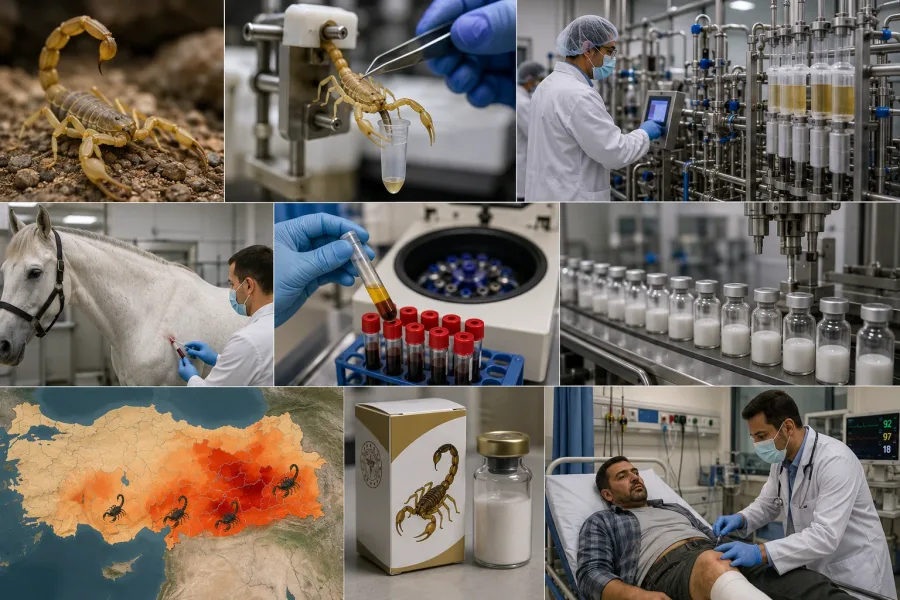
In the arid plains of southeastern Turkey, a farmer's encounter with a deathstalker scorpion used to be a race against time with uncertain odds. Now, thanks to a sophisticated domestic antivenom program run by the Turkish Ministry of Health, that race is almost always won. As of mid-2026, Turkey has not only secured self-sufficiency in scorpion antivenom but has scaled its production to a robust 10,000 doses per year, turning a once-fatal rural hazard into a medically manageable event. This achievement places the country at the forefront of a niche but critical pharmaceutical field.
From Venom Extraction to Life-Saving Vial: Inside Turkey's Antivenom Laboratory
The process begins in a highly secure, climate-controlled facility in Ankara, home to thousands of scorpions belonging to the most dangerous species native to Turkey, primarily Androctonus crassicauda and Leiurus abdullahbayrami. These arachnids are kept in individual containers and are subjected to a delicate 'milking' process. Technicians use micro-electrical stimulation to trigger the release of venom, a harmless procedure for the scorpion that yields only a few microliters of the precious, milky white toxin each month. This raw venom, a potent cocktail of neurotoxins, is then purified and detoxified through a series of advanced chromatographic techniques.
The detoxified venom is injected into large mammals, primarily horses, in gradually increasing doses over several months. This stimulates the horses' immune systems to produce powerful antibodies without causing them harm. The hyper-immune plasma is then harvested, and the antibodies are extracted and refined into the final antivenom product. The entire cycle, from scorpion milking to a ready-to-use vial, takes nearly a year. A significant modernization completed in early 2026 introduced new purification units, boosting production efficiency by 40% and allowing the lab to hit its 10,000-dose annual target consistently, a critical buffer for the summer months when scorpion stings peak.
Adhering to Stringent Quality and Safety Protocols
Every batch of antivenom produced in the Ankara facility undergoes rigorous quality control testing. This includes sterility tests, pyrogen tests to ensure it doesn't induce fever, and potency tests on laboratory mice to confirm its neutralizing power against the target venoms. The facility operates under Good Manufacturing Practices (GMP) certified to European Medicines Agency (EMA) standards, a testament to the product's high quality. In 2026, the laboratory expanded its international accreditation scope, a strategic move aimed at facilitating future exports. This commitment to quality ensures that a patient in a remote district hospital in Mardin receives the same standard of care as one in a major European city.
A Public Health Shield for Rural Anatolia and Beyond
Scorpion envenomation is a stark reality in Turkey's rural landscape. The Ministry of Health recorded over 12,000 stings during the summer of 2025, with approximately 15% classified as severe, requiring immediate antivenom administration. Children under ten and the elderly are at the highest risk of fatal complications. The free and widespread availability of the domestically produced antivenom at all state hospitals has fundamentally changed the prognosis. A 2026 internal audit by the Ministry showed that the mortality rate from scorpion stings has dropped by over 95% in the last decade, directly correlating with the scaling up of domestic antivenom production.
The program's success is also a story of strategic autonomy. Before domestic production was fully established, Turkey relied on expensive imports from foreign laboratories, with a single dose costing up to $1,200 and subject to complex cold-chain logistics and potential supply chain disruptions. The locally produced antivenom costs approximately $150 per dose to manufacture, representing an annual saving of over $8 million for the Turkish healthcare system. This financial efficiency allows the Ministry of Health to allocate more resources to other critical areas, including primary care and preventive health services in the very regions most affected by scorpion stings.
Climate Change and the Shifting Geography of Risk
Health authorities are observing a worrying trend linked to climate change. The geographical range of dangerous scorpion species is expanding northward and westward into regions of Central and Western Anatolia where stings were previously rare. The hotter, drier summers of 2025 and 2026 have been linked to a measurable increase in reported stings in provinces like Ankara and Eskişehir. This shifting risk map is forcing the Ministry of Health to expand its public awareness campaigns and ensure that hospital emergency departments in previously low-risk areas are now trained and equipped to handle envenomation cases. The 10,000-dose annual production capacity is no longer just a stockpile for the Southeast; it is becoming a national safety net.
Turkey's Emerging Role in Global Health Diplomacy
Beyond its borders, Turkey is leveraging its antivenom capability as a tool of soft power and humanitarian aid. The World Health Organization (WHO) has long classified scorpion stings as a neglected tropical disease, with a chronic global shortage of antivenom, especially in sub-Saharan Africa and parts of the Middle East. In 2025, the WHO issued a stark warning about a global antivenom crisis. Turkey has stepped into this gap. Through the Turkish Cooperation and Coordination Agency (TİKA), the country donates thousands of doses annually to allied and partner nations in need, including Azerbaijan, Libya, and Somalia.
This is not just philanthropy; it is a strategic pillar of Turkey's health diplomacy. By providing a critical, life-saving pharmaceutical that is in short supply globally, Turkey strengthens its bilateral ties and enhances its prestige as a regional leader in pharmaceutical science. As of mid-2026, feasibility studies are underway for the commercial export of the antivenom to markets in the Middle East and North Africa, where scorpion-related mortality is high. This could transform the Ankara laboratory from a cost center into a revenue-generating, global public health asset, setting a precedent for other middle-income countries seeking pharmaceutical independence.
Beyond Antivenom: The Untapped Potential of Scorpion Venom
The Ankara laboratory's work is part of a broader, exciting field of venom-based drug discovery. Researchers at Hacettepe University, in collaboration with the Ministry of Health, are investigating specific peptides in scorpion venom for applications far beyond treating stings. One such compound, chlorotoxin, found in the venom of Androctonus species, has shown a remarkable ability to bind selectively to brain tumor cells, offering a potential pathway for targeted cancer imaging and therapy. Preclinical studies accelerated in 2026, exploring how these ancient toxins, refined by millions of years of evolution, can be repurposed to treat some of modern medicine's most intractable diseases, from glioblastoma to autoimmune disorders. The scorpion, a symbol of danger, is slowly revealing itself as a microscopic pharmacy.
Turkey's journey with scorpion antivenom is a compelling narrative of scientific perseverance and strategic foresight. It has turned a biological threat into a biotechnological opportunity, ensuring that a farmer in Şanlıurfa can face the fields with less fear, knowing a life-saving antidote is within reach. This program stands as a powerful example of how targeted investment in public health infrastructure can yield dividends in human life, economic savings, and international standing.
