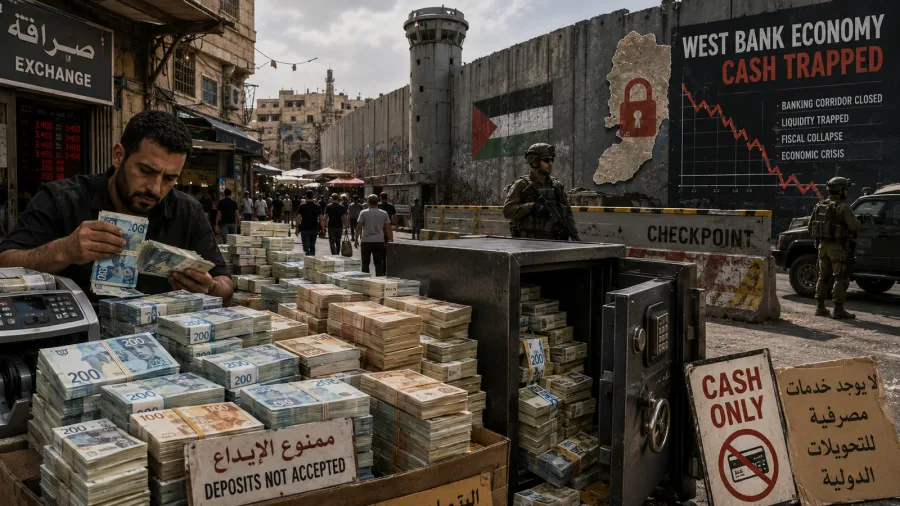
In the heart of Bethlehem, a currency exchange employee meticulously counts stacks of worn Israeli shekels, his desk overflowing with more cash than the bureau can safely store. It is July 2026, and the West Bank is drowning in banknotes—a paradoxical crisis where an excess of physical currency is not a sign of wealth, but a symptom of a collapsing financial system under Israeli occupation.
The Collapse of Correspondent Banking and Its Domino Effect
The economic anomaly gripping the West Bank stems from a near-total severance of correspondent banking ties between Palestinian and Israeli financial institutions. Since early 2026, Israeli banks have refused to process excess shekel liquidity from their Palestinian counterparts, effectively trapping billions of shekels inside the occupied territory. This blockade means that Palestinian banks cannot return surplus cash to the Bank of Israel, forcing them to reject new deposits and, in some cases, charge customers for the privilege of storing money.
The immediate consequence has been a liquidity glut with nowhere to go. Businesses in commercial hubs like Ramallah and Hebron are unable to deposit daily earnings, forcing them to hoard cash in insecure locations. The traditional banking functions of lending and credit creation have ground to a halt, as banks cannot manage their reserve requirements without access to Israel's central bank. The International Monetary Fund warned in a June 2026 report that the Palestinian Authority's fiscal collapse was imminent unless the banking corridor was restored, highlighting the systemic risk posed by this artificial cash trap.
Political Maneuvering Behind the Financial Blockade
Israeli Finance Minister Bezalel Smotrich has been the primary architect of this financial stranglehold, framing the banking restrictions as a national security imperative. Smotrich has linked the renewal of banking agreements to the Palestinian Authority's actions at the International Criminal Court and its response to settler violence. Despite intense pressure from the U.S. Treasury and European Union throughout 2026, the Israeli government has maintained the blockade, using its control over the financial infrastructure as a geopolitical lever against Palestinian state-building efforts.
How Exchange Bureaus Became the West Bank's De Facto Banks
With formal banking channels paralyzed, a sprawling network of currency exchange bureaus and money changers has emerged as the backbone of the West Bank's financial system. These establishments, particularly concentrated in Bethlehem and Nablus, now perform functions far beyond currency conversion. They facilitate large-scale money transfers, clear checks, and even act as escrow agents for real estate transactions, operating almost entirely outside the purview of financial regulators.
However, this informal system is buckling under the weight of a massive cash surplus. Exchange bureau owners report that their safes are overflowing far beyond insurance and security limits, making them prime targets for theft and armed robbery. The physical risk of holding millions of shekels on-premises has skyrocketed, and the cost of private security is eroding their already thin margins. The situation has created a two-tier economy where those with access to digital or foreign accounts can operate normally, while the vast majority of Palestinians are trapped in a precarious, cash-only existence.
The Perils of Physical Cash Transport in a Conflict Zone
Transporting cash between West Bank cities has become a life-threatening endeavor in 2026. With armored vehicle services unreliable due to Israeli military checkpoints and settler roadblocks, businesses often resort to civilian couriers carrying duffel bags of banknotes. This has led to a spike in violent robberies and interceptions by both criminal gangs and extremist settlers. The Palestinian Authority's security forces, constrained by Israeli restrictions on their movement and armament, have proven incapable of securing these cash corridors, adding a layer of physical danger to the financial chaos.
The Shekel Dependency Trap: A Currency as a Weapon
The West Bank's economy operates under a unique colonial-era framework where it lacks a sovereign currency and is entirely dependent on the Israeli shekel. While this arrangement once facilitated trade with Israel, it has now become a tool of economic warfare. Israel controls the supply of shekels, and by severing the banking link, it has effectively weaponized the currency. The excess cash in the West Bank represents liquidity that should be circulating within the broader Israeli economy, and its entrapment is creating distortions that even the Bank of Israel is struggling to model in its monetary policy decisions.
This forced cash economy has eviscerated the Palestinian Authority's tax collection capabilities. With most transactions occurring off the books, public revenues have plummeted, leaving the government in Ramallah unable to pay full salaries to its 150,000 employees for much of 2026. The digital payment infrastructure, reliant on Israeli processing centers, remains fragile and subject to frequent disruptions, pushing the population deeper into cash dependency. The World Bank has proposed digital alternatives like mobile money, but these solutions remain non-starters given Israel's control over the West Bank's telecommunications spectrum and 3G/4G infrastructure.
Global Implications and the Risk of Financial Contagion
The crisis in the West Bank is not occurring in a vacuum. International financial watchdogs, including the Financial Action Task Force (FATF), have expressed concern that the breakdown of formal banking creates a haven for money laundering and illicit finance. Moreover, the precedent of using correspondent banking as a political weapon has alarmed central bankers globally, who fear it could destabilize other regions with asymmetric currency arrangements. The U.S. and EU continue to push for a diplomatic resolution, but as the second half of 2026 unfolds, the West Bank's cash paradox deepens, threatening to spill over into broader regional instability.
