The Unstoppable Rise of Tesla: From Niche Startup to Global Powerhouse
Roadster to Cybertruck: Milestones of the Revolution
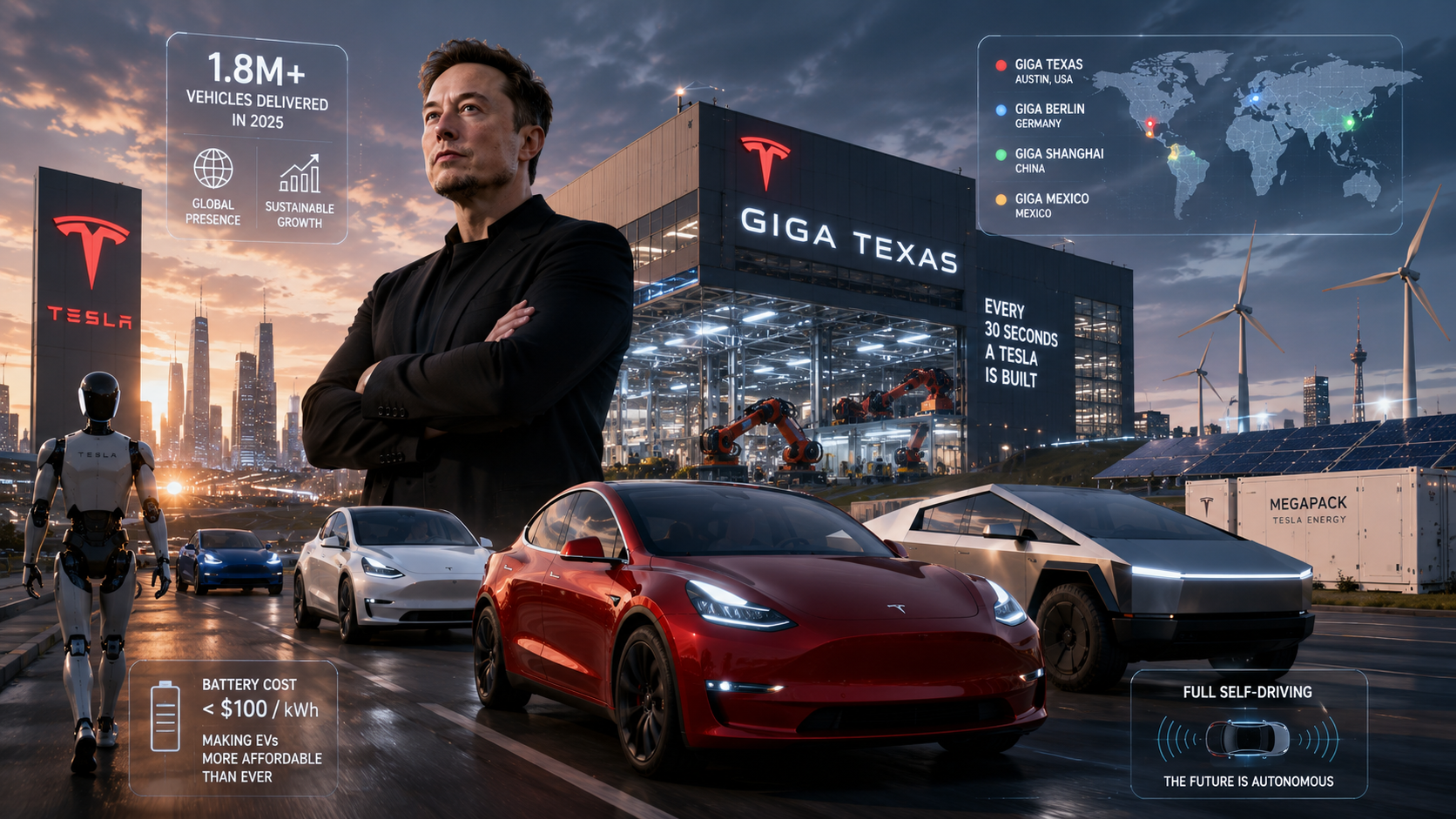
When Tesla delivered its first Roadster in 2008, few believed an electric car could rival gasoline. Fast forward to June 2026, and Tesla has become the world’s most valuable automaker, shipping over 1.8 million vehicles globally in 2025 alone. The product line now covers every major segment: the Model 3 and Model Y dominate mass-market sales, while the Cybertruck, launched in 2023, has redefined utility vehicles. The upcoming Model 2, expected to hit roads later this year, aims to conquer the sub-$30,000 market, a move that could permanently disrupt legacy automakers still struggling to electrify their fleets.
Tesla’s direct-to-consumer sales model and over-the-air updates have set an industry standard that competitors are only now trying to match. Its headquarters, relocated to Austin, Texas in 2021, sits on a 2,500-acre campus that employs over 20,000 workers, churning out a car every 30 seconds at peak capacity. This factory, known as Giga Texas, is a microcosm of Tesla’s scale and ambition.
Elon Musk: The Man Behind the Wheel
The Twitter Factor: How Musk’s Social Media Activity Moves Markets
Elon Musk’s leadership is as polarizing as it is visionary. As of mid-2026, Musk remains Tesla’s largest shareholder and CEO, though his time is increasingly divided between Tesla, SpaceX, X (formerly Twitter), and his AI venture xAI. His tweets—whether announcing a new battery technology or mocking a rival—can send Tesla’s stock soaring or plummeting within hours. Last year, a single emoji posted late on a Friday night added $15 billion to the company’s market cap before a clarifying statement erased the gains.
Despite the noise, Musk’s ability to attract top talent and push engineering limits is undeniable. Under his watch, Tesla has achieved industry-leading battery costs below $100 per kWh, a critical milestone that makes EVs cheaper to produce than combustion equivalents. Yet, his controversial statements have also sparked a brain drain in senior management; 2025 saw the departure of three key executives, raising questions about succession planning.
The Gigafactory Blueprint: Manufacturing at Unprecedented Scale
Giga Texas: The Heart of Tesla’s Production Network
Tesla’s global manufacturing footprint now spans four continents with six operational Gigafactories and two more under construction. Giga Texas, the largest of them all, produces the Model Y and Cybertruck and houses a cathode plant for in-house battery cell production. By the end of this year, the factory is projected to reach an annual run rate of 750,000 vehicles, cementing its role as the backbone of Tesla’s North American operations.
Simultaneously, Giga Shanghai has been expanded to supply Asia-Pacific markets, while Giga Berlin and Giga Mexico (online since 2025) are ramping up to meet surging European and Latin American demand. This distributed model insulates Tesla from regional trade wars and supply chain disruptions, a strategy that paid off when a semiconductor shortage in 2023 barely slowed its output compared to competitors.
Beyond Cars: Autonomy, Energy, and the 2030 Horizon
Will Full Self-Driving Finally Deliver in 2026?
Tesla’s Full Self-Driving (FSD) software has been in "beta" for years, but 2026 might finally be the breakthrough year. The latest FSD v13, rolled out in March, uses a neural network trained on billions of miles of real-world driving data. Early data shows a 45% reduction in driver interventions compared to the previous version. Regulatory approvals in Texas and Nevada now allow Tesla to operate a limited robotaxi service with safety drivers, signaling a future where a car might earn its owner income while parked.
On the energy front, Tesla Energy’s Megapack deployments hit a record 15 GWh last year, and its solar roof installations are gaining traction in markets with generous government incentives. Musk frequently reminds investors that Tesla’s ultimate mission is to accelerate the world’s transition to sustainable energy—electric cars are only one piece. The company’s AI-powered grid management software, dubbed "Autobidder," is already helping utilities balance renewable loads in California and Australia.
In a world where every automaker is finally betting on EVs, Tesla faces fiercer competition than ever. But with a brand that commands cult-like loyalty, a self-reinforcing data advantage, and a CEO who treats the impossible as a routine challenge, Tesla in 2026 is not just a car company—it’s a play on energy, software, and artificial intelligence. The question investors and consumers alike should ask is not whether Tesla will succeed, but how far its influence will reach by 2030.
What role do you think Tesla will play in your daily life five years from now? Share your vision with us.
