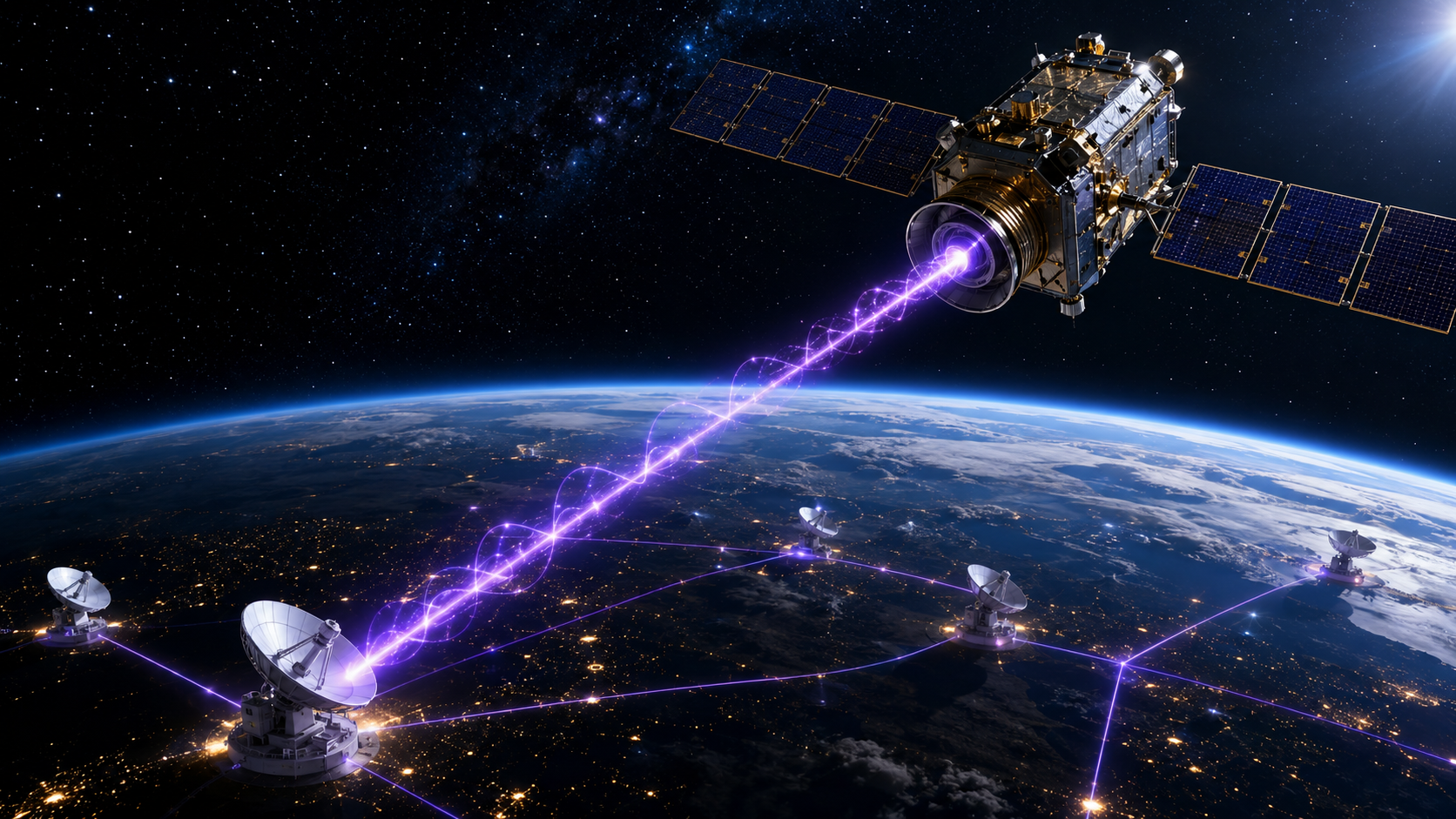
As of 2026, the world still relies heavily on fiber optic cables snaking across ocean floors. But Boeing's announcement this week proves that the internet's future isn't buried in the seabed — it's unfolding among the stars. The company has successfully completed its most critical test yet for a space-based quantum communication network, paving the way for the upcoming Q4S (Quantum for Space) mission. The system demonstrated it can operate flawlessly in orbit for an entire year. If the timeline holds, the first operational quantum node will be active in space before 2027 arrives.
Why Current Internet Infrastructure Is Falling Short
In 2025, global internet traffic surpassed 150 terabytes per second. More than 99% of this massive data flow traveled through undersea cables spanning a total length of 1.4 million kilometers. Yet these cables suffer an average of 150 damage incidents per year — caused by fishing vessels, ship anchors, and geological movements. Moreover, traditional fiber optic signals require amplifiers every 100 kilometers, adding latency. For instance, the theoretical minimum latency between London and New York is 35 milliseconds; with an entanglement-based quantum connection, that delay approaches zero. Because information isn't traveling through a physical medium — it's shared instantaneously via the quantum states of particles.
The speed and security advantage of quantum internet
What makes quantum networks truly revolutionary isn't just speed — it's absolute security. By 2026, encryption standards are approaching levels that quantum computers could crack by 2030. In contrast, with Quantum Key Distribution (QKD), any third party attempting to intercept a message inevitably disturbs the photons' quantum state, instantly revealing the intrusion. The system Boeing tested in Q4S generates 10 million entangled photon pairs per second, enabling secure key transmission over distances up to 1,200 kilometers. That means an unhackable communication channel between ground stations.
Boeing's Q4S Mission and the Critical Test Details
The test, conducted at Boeing's facility in Aurora, Colorado, meticulously simulated the harsh conditions of space. The quantum communication module operated inside a vacuum chamber for 365 days, enduring temperature cycles ranging from minus 150 to plus 120 degrees Celsius — all while maintaining zero-error data transmission. The heart of the system, an entangled photon source, was built on a chip specially shielded against space radiation. Boeing engineers confirm this chip can function without degradation even when passing through Earth's Van Allen radiation belts. The mission's next phase involves integrating the system into a small satellite for launch into low Earth orbit.
The engineering behind the one-year durability requirement
The test's most crucial success criterion was maintaining sub-micron precision in the optical alignment system for a full year. A satellite in space travels at 7.8 kilometers per second, requiring continuous mirror adjustments to aim photons precisely at their target. Boeing's adaptive optics system solves this by making 1,000 corrections per second. During the test, the system's total power consumption measured just 85 watts — less than what a typical laptop uses.
How Quantum Internet Could Reshape Global Power Dynamics
Space-based quantum networks represent not just a technological leap, but a geopolitical chess move. China plans to deploy a constellation of 12 quantum satellites by 2030, while the European Union allocated 2.4 billion Euros to its EuroQCI project in 2025. The United States, pursuing a hybrid model through private companies like Boeing and SpaceX, targets an operational network by 2028. The financial sector alone is poised to invest 15 billion dollars annually in this technology. After all, Wall Street's daily trading volume reached 700 billion dollars in 2026 — and the security of those transactions cannot be guaranteed with existing systems.
Satellite costs are dropping, opportunities multiplying
The cost of quantum communication satellites has fallen by 60% over the past five years. In 2021, a single satellite launch cost around 500 million dollars; by 2026, that figure has dropped to 200 million. Thanks to SpaceX's Starship program and reusable rocket technologies, launching 10 quantum satellites in a single mission will be feasible by 2028. Boeing has set its Q4S launch window for November 21, 2026. If successful, the system will begin transmitting data in the first quarter of 2027.
2026 and Beyond: What Lies Ahead
Over the next five years, space-based quantum internet will establish itself in disaster communications, military coordination, and global finance. With Boeing's latest test, the timeline is now clear: the first operational node in 2027, a basic six-satellite network by 2029, and full global coverage with 24 satellites by 2032. But the real question remains: Will this technology become a public utility accessible to all — like GPS — or an exclusive layer available only to certain nations and corporations? In 2026, that answer is still uncertain.
How this will affect life on the ground
While quantum internet won't directly reach everyday users in 2026, its indirect effects are already being felt. Google and Microsoft spent a combined 40 billion dollars in 2025 on next-generation data centers compatible with quantum networks. The first consumer quantum modems, expected to hit the market in 2028, will start at 5,000 dollars. That price may seem astronomical now, but we saw a similar curve during the transition from 4G to 5G. Are you ready? We're about to step into a world where the internet breaks free from cables, and information flows faster than the speed of light.
