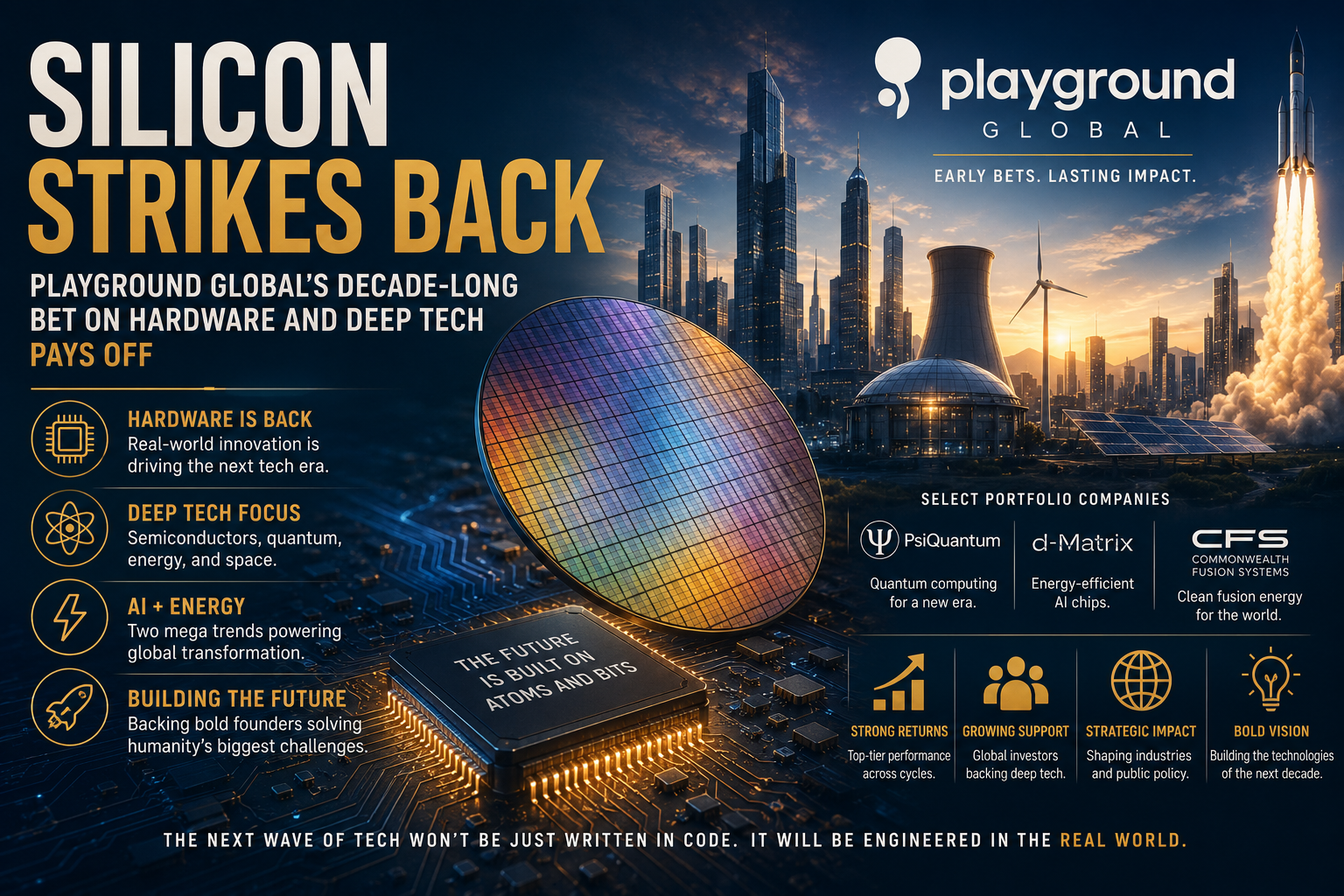
For well over a decade, the gravitational pull of the tech world was fixed on software. Mobile apps, cloud services, and social media platforms created trillion-dollar empires while hardware became the unloved corner of venture capital—seen as slow, capital-intensive, and risky. But quietly, one fund was building a future with atoms, not just bits. Playground Global’s contrarian bet on semiconductors, quantum computing, advanced energy, and deep tech is now looking not just smart but foundational, as 2026 reshapes the global technology landscape around physical innovation.
The Software Hangover: A Decade of Digital Delusion
From the mid-2010s onward, the Silicon Valley consensus was absolute: software was eating the world, and hardware was the boring, fragile plate. VC data from 2015 to 2025 shows that 78% of all seed and growth capital flowed to software-only startups, while areas like semiconductor design and energy storage attracted a mere 6%. Giants like Uber, Airbnb, and Stripe proved the model: light assets, viral loops, and overnight scale. Yet this obsession created a massive blind spot—the world’s exploding appetite for compute and sustainable energy was quietly colliding with the physical limits of existing infrastructure. By 2025, global data center electricity consumption had tripled from its 2020 share of 1% to roughly 3%, and in the first quarter of 2026 it reached 4.2%. The writing was on the wall, etched not in code but in silicon.
The Signal Many Missed
The warning signs were hiding in plain sight. Training a single large language model in 2023 required the energy equivalent of 130 homes for a year; by 2025, that figure doubled. GPU availability became a geopolitical bargaining chip. While most investors rushed to back the next productivity app, Playground Global’s founders were doubling down on the physics layer. “Tomorrow’s giants will be realized as much in silicon as in lines of code,” co-founder Bruce Leak noted back in 2016—a statement that now sounds like a prophecy. The fund’s portfolio was being built for a world where compute, energy, and hardware supply chains would define competitive advantage.
Inside Playground’s Atom-Heavy Portfolio
Since its 2015 debut, Playground Global built a portfolio strikingly different from its peers. It backed PsiQuantum (optical quantum processors), d-Matrix (energy-efficient AI chips via in-memory computing), Commonwealth Fusion Systems (compact fusion reactors), and other deep-engineering ventures that required patient capital and years of R&D before revenue. At the time, each of these bets was criticized as “too early” or “science fiction.” But as of 2026, d-Matrix chips now power inference workloads across three major cloud providers, cutting energy per query by up to 90%. PsiQuantum has successfully demonstrated a 1,000-qubit fault-tolerant system, and Commonwealth Fusion announced its first net-energy-positive plasma result last year, fast-tracking its grid-connected pilot for 2028. The timing could not be more precise.
The Confluence of AI and Energy Hunger
Two megatrends are fueling the hardware renaissance. First, the generative AI explosion has shattered the economics of traditional GPUs, creating an insatiable demand for specialized architectures that can process tokens at a fraction of the power. d-Matrix’s analog in-memory computing approach, for example, delivers a 10x improvement in performance-per-watt, making it essential for hyperscalers facing both cost and sustainability pressures. Second, the global energy transition has moved from rhetoric to regulation. With carbon taxes expanding across the EU, Asia, and North America, efficient hardware is no longer optional. Playground’s fusion and battery investments are positioned at the exact intersection of these forces, offering solutions that are not just technologically elegant but commercially urgent.
The Numbers Don’t Lie: Hardware’s Financial Surge
Market figures in 2026 tell a compelling story. The global semiconductor market has surpassed $820 billion, with dedicated AI accelerators accounting for $180 billion of that pie. The quantum computing market is projected to hit $65 billion by 2030, up from just $2 billion in 2024. Playground Global’s early fund has delivered an annualized internal rate of return of 34% as of the close of its second, $1.2 billion fund in 2025, while the average software-heavy venture fund returned 18% over the same period. This performance has silenced doubters: the firm’s third fund, announced earlier this year, is targeting $2.5 billion and was oversubscribed within weeks. The shift in limited partner sentiment is unmistakable.
A Psychological Pivot in Tech Investment
The chip crunch of late 2024 and the energy price shock of 2025 permanently altered investor psychology. Governments and corporates now treat semiconductor sovereignty and energy independence as national security issues. Sovereign wealth funds have increased their deep-tech allocations from an average of 3% in 2020 to 12% in 2026. Playground Global didn’t just earn superior returns; it gained an informational advantage that allows it to shape technology roadmaps before regulatory tailwinds even materialize. This first-mover edge is now being formalized into policy advisory roles and direct partnerships with nation-states.
The Next Decade: Where Bits and Atoms Dance Together
Playground Global’s founders insist we are only at the beginning. The firm has signaled a focus on autonomous robotics, next-generation nuclear, and neuromorphic computing for the latter half of 2026. Neuromorphic chips, which mimic the brain’s neural architecture, could slash energy consumption of AI models by up to 95%—a breakthrough that would redefine the cost structure of every cloud provider. The lesson is clear: the next wave of trillion-dollar companies won’t be defined solely by their codebases but by their ability to manipulate physics. Software will remain critical, but as a composer to a symphony of silicon, electrons, and atoms.
The New Rule: Physical Meets Digital
For today’s technology leaders, the central question is no longer “How do we scale our app?” but “How do we reinvent the transistor, the battery, the reactor?” Playground Global’s journey proves that hardware and software are not opposing bets—they are an inseparable duet. Silicon’s comeback is, in truth, a correction: it never left; we just forgot to look beyond the screen. The real test now is whether the broader market has the patience and vision to follow. Have you prepared your portfolio for the atomic age?
