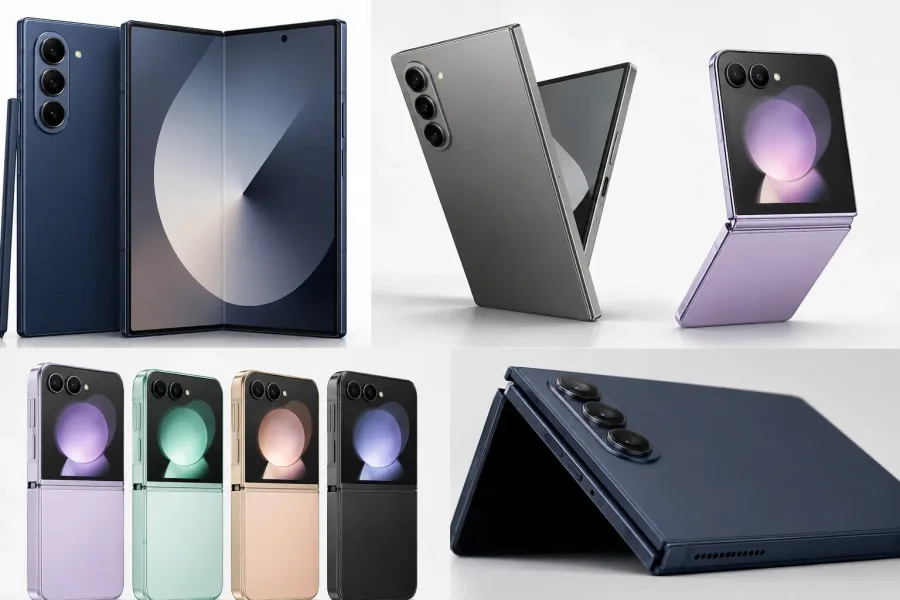
Samsung's upcoming foldable lineup has been completely exposed just days ahead of its highly anticipated Unpacked event. Official marketing renders, detailed camera configurations, and battery specifications for the Galaxy Z Fold 8, Z Fold 8 Ultra, and Galaxy Z Flip 8 have surfaced online, confirming a generational leap in hardware refinement and user experience. The leaks, originating from multiple reliable sources in the Asian supply chain, paint a picture of devices that are thinner, more durable, and significantly more powerful than their predecessors. As the global foldable market heats up with increasing competition from Chinese manufacturers like Huawei and Xiaomi, Samsung's 2026 portfolio appears laser-focused on maintaining its dominance through polished engineering rather than radical reinvention.
Samsung's strategic defense against the rising Chinese competition
The global foldable smartphone market has undergone a seismic shift in 2026, with Chinese brands aggressively expanding their footprint in Europe and Southeast Asia. Huawei's Mate X6 and Xiaomi's Mix Fold 4 have been chipping away at Samsung's market share, particularly in the premium ultra-thin segment. Against this backdrop, the Galaxy Z Fold 8 Ultra emerges as Samsung's counterpunch—a no-compromise device designed to reclaim technological leadership. According to the leaked specifications, the Ultra variant features a titanium alloy frame, a first for Samsung's foldable line, which reduces weight by nearly 15 grams compared to the standard Fold 8 while increasing structural rigidity. This material choice directly mirrors Apple's strategy with its iPhone Pro models, signaling Samsung's intent to position the Ultra as the definitive luxury foldable.
The standard Galaxy Z Fold 8, meanwhile, focuses on mainstream appeal with a refined form factor. At just 5.5mm when unfolded, it surpasses the slimness of most competing book-style foldables. The leaked marketing materials emphasize a new 'Flex Hinge' mechanism that eliminates the gap between the two halves when closed, a design feature that Chinese competitors have offered for over a year. Samsung's implementation, however, integrates enhanced dust protection, achieving an IP58 rating—a first for any foldable phone on the global market. This certification covers immersion in fresh water up to 1.5 meters for 30 minutes, addressing one of the most persistent criticisms of foldable devices: their vulnerability to environmental particles. For consumers in humid climates like Southeast Asia and Latin America, this durability upgrade represents a significant purchasing incentive.
The Ultra variant and the premium pricing strategy
The introduction of the Fold 8 Ultra marks Samsung's first foray into tiering its foldable lineup. Leaked pricing suggests the Ultra will command a $2,399 price tag in the United States, while the standard Fold 8 starts at $1,899. This two-pronged approach allows Samsung to capture both the luxury early adopter and the pragmatic professional upgrading from an older model. Industry analysts note that this strategy mirrors the successful segmentation seen in the Galaxy S series, and could pressure competitors to similarly differentiate their offerings.
A 200-megapixel leap: the camera hardware that changes everything
The most significant upgrade revealed in the leaked renders centers on the camera systems. The Galaxy Z Fold 8 and Fold 8 Ultra both feature a 200-megapixel main sensor, a massive jump from the 108-megapixel unit found in the Fold 7. This is not merely a numbers game; the new sensor employs an advanced pixel-binning technology that combines 16 pixels into one, resulting in 12.5-megapixel images with exceptional dynamic range and low-light sensitivity. The periscope telephoto lens, previously reserved for the Galaxy S Ultra series, finally makes its way to the Fold lineup, offering 10x optical zoom. This addition transforms the Fold 8 into a legitimate photography tool, capable of capturing detailed architectural shots or wildlife photos that were previously impossible with a foldable device.
The Galaxy Z Flip 8, while more constrained by its compact form factor, receives a substantial upgrade to a 50-megapixel main camera. The expanded 4-inch cover display, which Samsung markets as the 'Flex Window,' now serves as a full-featured viewfinder for high-quality selfies using the main camera array. Leaked software features indicate a new 'Auto Framing' mode that detects faces and adjusts the crop accordingly, keeping subjects perfectly centered without manual intervention. This software-driven approach to photography, powered by Samsung's ProVisual Engine, compensates for the hardware limitations inherent in the clamshell design. Video capabilities have also been enhanced across the board, with all three devices supporting 8K recording at 30 frames per second and a new 'Director's View' mode that simultaneously captures footage from multiple cameras—a feature likely to appeal to content creators and vloggers worldwide.
Computational photography and night mode breakthroughs
Samsung's AI-powered image processing has been overhauled for the 2026 lineup. The leaked technical documents describe a 'Nightography 3.0' algorithm that leverages the Snapdragon 8 Gen 4's neural processing unit to reduce noise in near-total darkness. Sample images included in the leak show night scenes with dramatically improved shadow detail and color accuracy compared to the previous generation. This computational prowess places the Fold 8 series in direct competition with dedicated camera phones from Google and Apple, erasing one of the last remaining compromises of the foldable form factor.
Battery endurance that finally matches flagship expectations
Battery anxiety has long plagued foldable phone users, but Samsung appears to have decisively addressed this issue in 2026. The Galaxy Z Fold 8 packs a 4,800 mAh dual-cell battery, while the Fold 8 Ultra pushes this to a massive 5,200 mAh—the largest ever in a Samsung foldable. The Flip 8, despite its diminutive size, manages a 4,200 mAh capacity, a 15% increase over its predecessor. These raw numbers translate into real-world endurance gains: leaked marketing materials claim up to 27 hours of continuous video playback for the Fold 8, a figure that would outlast most traditional flagship smartphones. The combination of a more efficient 3nm chipset and Samsung's adaptive refresh rate technology, which scales down to 1Hz for static content, contributes to these impressive figures.
Charging speeds have also seen a welcome boost. The Fold 8 series supports 65W wired charging, capable of delivering an 80% charge in just 35 minutes. This represents a 30% improvement over the Fold 7's 45W charging and brings Samsung's foldables closer to the ultra-fast charging standards set by Chinese manufacturers. Wireless charging remains at 25W, with the continued inclusion of Wireless PowerShare for topping up accessories like the Galaxy Buds or Watch. For international travelers and business professionals who rely on their devices throughout long workdays, this combination of endurance and rapid refueling eliminates one of the most significant barriers to foldable adoption. The thermal management system, which uses a vapor chamber 40% larger than the previous generation, ensures that these high charging speeds do not lead to excessive heat buildup or battery degradation over time.
Real-world usage patterns and longevity testing
Leaked internal testing data suggests that Samsung has engineered the Fold 8's battery to retain 85% of its original capacity after 1,000 charge cycles, exceeding industry standards. This focus on long-term reliability, combined with the company's extended software update policy of seven years of security patches, positions the device as a durable investment rather than a fragile novelty. For consumers in markets where the Fold 8 represents a significant financial outlay—such as India, Brazil, and Turkey—this longevity promise is a crucial selling point.
One UI 7.0 and the maturing foldable ecosystem
The hardware revelations are complemented by significant software advancements visible in the leaked renders. The Galaxy Z Fold 8 and Flip 8 will debut with One UI 7.0, built on Android 16, which introduces a redesigned taskbar capable of holding up to twelve apps and a new split-screen gesture system. The leaks confirm that Samsung DeX, the desktop-like experience triggered by connecting to an external monitor, now supports wireless 4K output, transforming the Fold 8 into a portable workstation. For the Flip 8, the larger cover screen finally supports a full QWERTY keyboard and a broader range of widgets, including Google Maps navigation and Spotify controls, reducing the need to open the device for quick interactions.
Samsung's ecosystem integration has also deepened. The leaked materials show seamless continuity features between the Fold 8 and the Galaxy Tab series, as well as enhanced multi-device clipboard sharing with Galaxy Book laptops. This ecosystem approach, which Apple has long championed as a competitive advantage, is now a cornerstone of Samsung's strategy to retain high-value customers. The Galaxy Z Flip 8, with its fashion-forward design and new color options—including a striking 'Mint Green' and 'Golden Pink'—targets a younger demographic that values self-expression as much as technical specifications. Samsung's collaboration with luxury brands for limited-edition Flip 8 cases, hinted at in the leaked marketing assets, further underscores the device's positioning as a lifestyle accessory rather than a mere communication tool.
Enterprise-grade security and the seven-year commitment
Samsung Knox, the defense-grade security platform embedded in all Galaxy devices, receives an update tailored to the foldable form factor. The leaked technical briefs describe a new 'Flex Mode Authentication' that allows biometric verification to persist when the device is partially folded, a feature particularly useful for contactless payments. Samsung's commitment to seven years of Android OS updates and security patches, announced in 2025 and reaffirmed for the 2026 lineup, provides enterprise customers with the assurance needed for large-scale deployments. As foldables increasingly penetrate the corporate sector, this long-term support distinguishes Samsung from competitors who typically offer shorter update lifecycles.
