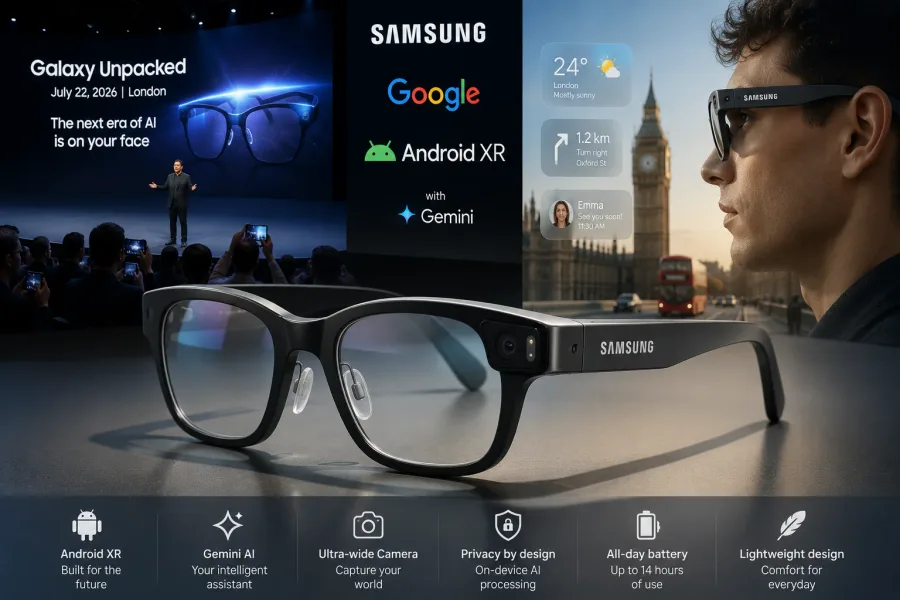
South Korean electronics giant Samsung is set to unveil its most ambitious wearable device yet — a pair of AI-powered smart glasses developed in close partnership with Google — at the Galaxy Unpacked event in London on July 22, 2026. The device, running on Google's Android XR platform and featuring the Gemini AI assistant, represents a direct challenge to Meta's dominant position in the smart eyewear market and marks Samsung's official entry into the extended reality (XR) arms race that has been reshaping the consumer technology landscape.
The London unveiling comes after nearly three years of speculation and strategic maneuvering. Samsung first teased its XR ambitions in early 2024, when it announced a tripartite partnership with Google and Qualcomm to develop a new generation of mixed reality devices. Throughout 2025, industry insiders tracked the project's evolution from a bulky mixed reality headset — codenamed 'Project Moohan' — toward a sleeker, everyday-wearable smart glasses form factor. The shift in strategy reflected market realities: Meta's Ray-Ban smart glasses, developed in partnership with EssilorLuxottica, had sold over 2 million units by early 2026, proving that consumers were ready for AI-enhanced eyewear that prioritized style and comfort over immersive AR displays.
The timing of Samsung's entry is particularly significant. Apple's Vision Pro, launched in 2024 at a premium $3,500 price point, demonstrated the technological possibilities of spatial computing but failed to achieve mass-market adoption due to its cost and bulk. Meta, meanwhile, has been iterating rapidly with its Ray-Ban line, adding multimodal AI capabilities and gradually introducing limited AR display features in its third-generation model released in early 2026. Samsung and Google are now positioning themselves as the 'open platform' alternative — much as Android did against iOS in the smartphone era — with a device that promises seamless integration with the vast ecosystem of Android apps and services while maintaining an accessible price point.
The Gemini advantage: How Google's AI could redefine smart eyewear
At the heart of Samsung's new smart glasses lies Google's Gemini AI assistant, which represents a significant leap forward from the voice assistants that powered earlier generations of wearables. Unlike the limited command-response patterns of Google Assistant or Siri, Gemini offers true multimodal understanding — the ability to process and reason about text, images, audio, and video simultaneously. For smart glasses users, this translates into capabilities that were previously the stuff of science fiction: real-time language translation displayed in the user's field of view, object identification with contextual information, and proactive assistance based on what the wearer is looking at or doing.
Google has been aggressively expanding Gemini's capabilities throughout 2025 and 2026, integrating it across its product ecosystem from Search to Workspace to Android. The Android XR platform was specifically designed to leverage Gemini's strengths in spatial contexts. During the platform's initial reveal in late 2024, Google demonstrated how Gemini could understand a user's physical environment, remember the location of objects, and provide guidance for complex real-world tasks. The Samsung glasses are expected to be the first consumer device to fully realize this vision, with on-device AI processing powered by Qualcomm's Snapdragon AR2 Gen 2 chip ensuring that many AI functions work even without a constant internet connection.
The strategic implications of Google's deep involvement cannot be overstated. By making Android XR the software foundation for Samsung's hardware, Google is replicating the playbook that made Android the world's most widely used mobile operating system. The platform will be available to other hardware manufacturers, potentially creating an ecosystem of interoperable XR devices. This open approach contrasts sharply with Apple's walled-garden strategy for Vision Pro and positions Google to dominate the XR software layer regardless of which hardware brand ultimately wins the consumer market.
On-device AI processing and the privacy equation
The decision to prioritize on-device AI processing through Qualcomm's dedicated XR chipset addresses one of the most persistent concerns surrounding smart glasses: privacy. Google Glass failed spectacularly in 2013 partly because of public backlash against its always-present camera. Samsung and Google appear to have learned from this history. By processing visual data locally on the device rather than streaming it to cloud servers, the glasses can offer AI features such as object recognition and scene understanding without creating a permanent record of everything the wearer sees. A visible LED indicator will illuminate whenever the camera is active, providing transparency to those around the wearer.
This privacy-first architecture could prove to be a decisive competitive advantage, particularly in privacy-conscious markets such as the European Union, where GDPR regulations impose strict requirements on biometric data processing. Samsung's Knox security platform, already a trusted solution in enterprise environments, will extend to the smart glasses, offering hardware-level encryption and secure boot processes. For business users — a key target demographic — these security features could make the difference between adoption and rejection, especially in sectors such as healthcare, legal services, and finance where data confidentiality is paramount.
The Meta challenge: How Samsung plans to compete in a Meta-dominated market
Meta's early-mover advantage in the smart glasses market presents both a challenge and an opportunity for Samsung. The Ray-Ban Meta glasses, now in their third generation as of early 2026, have established a strong brand presence and a loyal user base. Meta's integration with Instagram, WhatsApp, and Facebook gives its glasses a unique social media ecosystem that Samsung cannot directly replicate. However, Samsung brings its own formidable advantages: a massive installed base of Galaxy smartphone users (over 1 billion active devices globally), deep relationships with mobile carriers worldwide, and manufacturing expertise that allows for aggressive pricing while maintaining premium build quality.
The competitive dynamics will likely hinge on three key factors. First, AI assistant capabilities: Gemini versus Meta AI (powered by Llama models). Google's search dominance and vast training data could give Gemini an edge in real-world usefulness. Second, ecosystem integration: Samsung's glasses will seamlessly connect with Galaxy phones, watches, and earbuds, creating a cohesive experience that Meta cannot match for Android users. Third, developer support: Android XR's open platform could attract a broader range of third-party applications compared to Meta's more controlled environment. Analysts project that the smart glasses market could reach 5 million units annually by the end of 2026, with Samsung capturing 20-25% of that volume within its first year.
Pricing strategy and the path to mass adoption
Samsung is expected to price its smart glasses in the $299 to $349 range, directly matching Meta's Ray-Ban lineup. This pricing strategy reflects a deliberate choice to compete on value rather than undercutting on price. At $299, the glasses occupy a sweet spot — expensive enough to signal quality and capability, but accessible enough for mainstream consumers, especially when bundled with smartphone purchases or carrier contracts. Industry sources suggest that Samsung may offer aggressive trade-in deals for existing Galaxy device owners, effectively lowering the entry price to $199 or less for loyal customers.
The path to mass adoption, however, extends beyond pricing. Samsung must convince consumers that smart glasses offer meaningful daily utility beyond novelty. The company's marketing is expected to emphasize practical use cases: hands-free video calls for remote workers, real-time translation for travelers, navigation cues for cyclists and pedestrians, and quick photo capture for parents and pet owners. By positioning the glasses as a productivity tool rather than a futuristic gadget, Samsung hopes to broaden the appeal beyond early adopters and technology enthusiasts. The success of this approach will ultimately determine whether smart glasses follow the trajectory of smartwatches — initially niche, eventually mainstream — or remain a niche product category.
Technical architecture: What we know about the hardware
Based on supply chain reports and developer documentation for the Android XR platform, a detailed picture of Samsung's smart glasses hardware is emerging. The device will be built around Qualcomm's Snapdragon AR2 Gen 2 platform, a chipset specifically designed for distributed XR processing. Unlike the all-in-one approach of Meta's Quest headsets, the AR2 architecture splits processing between the glasses themselves and a companion device (typically a smartphone), enabling a lighter, more comfortable form factor. The glasses are expected to weigh under 50 grams — comparable to premium traditional eyewear — with titanium frames and prescription lens options available through partnerships with established optical retailers.
Battery life remains the critical constraint for any wearable device, and Samsung appears to have made significant engineering investments in this area. The glasses are expected to deliver 6 to 8 hours of active use on a single charge, with a magnetic charging case extending total usage to 24 hours. The open-ear audio system, which uses directional speakers embedded in the temples, allows users to hear both digital audio and environmental sounds simultaneously — a crucial safety feature for outdoor use. A six-microphone array with beamforming technology ensures clear voice pickup even in noisy environments, while bone conduction sensors can detect when the wearer is speaking, improving the accuracy of voice commands.
Display technology and the augmented reality roadmap
The first-generation Samsung smart glasses will notably lack a full augmented reality display, instead relying on audio cues, haptic feedback, and a minimalist LED indicator for notifications. This decision has drawn both criticism and praise from industry analysts. Critics argue that without a visual AR overlay, the glasses are little more than wireless earbuds in a glasses form factor. Supporters counter that the current state of waveguide display technology — the transparent optics needed for AR glasses — remains too power-hungry and expensive for mass-market devices, and that Samsung's pragmatic approach will result in a more polished, reliable product.
Samsung's long-term AR roadmap reportedly includes a second-generation model with a monochrome heads-up display projected onto the lens, expected in late 2027 or early 2028. Full-color, wide-field-of-view AR glasses with true spatial computing capabilities are projected for the 2029-2030 timeframe, by which time the underlying display and battery technologies should have matured sufficiently. This incremental approach mirrors the evolution of smartwatches, which started as notification devices before gradually acquiring health sensors, cellular connectivity, and standalone app capabilities. By establishing a presence in the market now with a focused, well-executed product, Samsung is laying the groundwork for more ambitious devices in the future.
Global market implications and the XR platform wars
The Samsung-Google smart glasses launch represents more than a new product category for two tech giants — it signals the opening of a new front in the platform wars that have defined the technology industry for decades. Just as the smartphone era was shaped by the competition between iOS and Android, the emerging XR era will be defined by competing visions of how humans interact with digital information in physical space. Apple's visionOS represents a closed, premium-first approach; Meta's Horizon OS is a middle-ground platform with strong social integration; and Android XR positions itself as the open, accessible alternative that any manufacturer can adopt.
For the broader technology ecosystem, the implications are significant. A successful Android XR platform could accelerate the development of spatial computing applications across industries: healthcare (surgical guidance and remote consultation), manufacturing (hands-free assembly instructions and quality inspection), education (immersive learning experiences), and retail (virtual try-ons and in-store navigation). Google's extensive developer relations infrastructure and the familiarity of Android development tools lower the barrier to entry for creating XR applications, potentially leading to an explosion of innovation similar to what occurred in the early days of the smartphone app economy.
As of mid-2026, the global smart glasses market stands at a pivotal inflection point. The technology has matured beyond the experimental phase, consumer awareness is growing, and major platform players are committing significant resources. Samsung's London event on July 22 will be closely watched not just for the product itself, but for the signal it sends about the industry's direction. If Samsung and Google can deliver a compelling vision of AI-enhanced everyday eyewear at an accessible price, 2026 may be remembered as the year smart glasses transitioned from niche curiosity to mainstream technology — much as 2007 marked the smartphone's arrival as an indispensable part of modern life.
