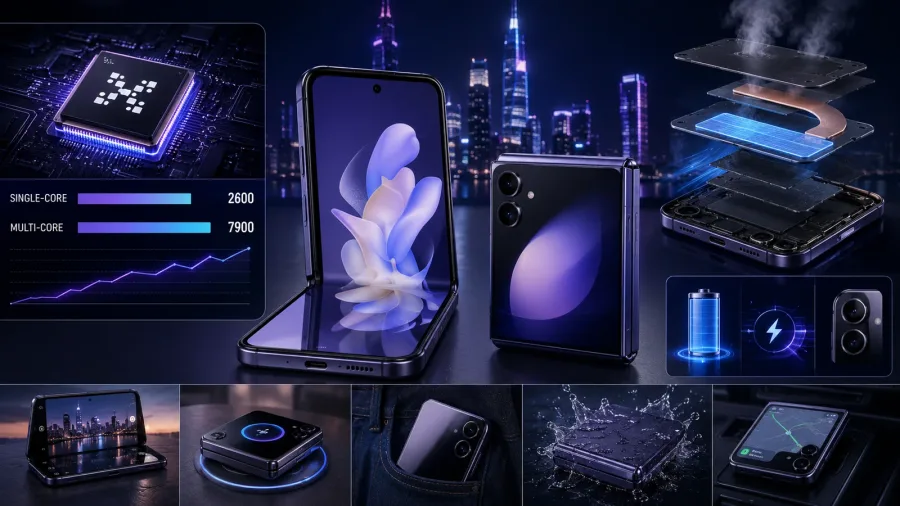
A significant benchmark leak has pulled back the curtain on Samsung's next-generation clamshell foldable, the Galaxy Z Flip 8, revealing a powerful 10-core Exynos 2500 processor and a substantially upgraded cooling system. The device, expected to be officially unveiled at the upcoming Galaxy Unpacked event in Seoul, South Korea, marks a pivotal moment in the foldable smartphone race as competition intensifies globally in 2026.
The leaked Geekbench listing, identified by model number SM-F751B, showcases Samsung's determination to close the performance gap between its foldable lineup and traditional slab flagships. With a single-core score of 2,600 and a multi-core score reaching 7,900, the Galaxy Z Flip 8 demonstrates roughly a 15 to 20 percent improvement over its predecessor. This generational leap places the compact foldable in direct competition with devices like the iPhone 17 Pro and the Google Pixel 10, signaling Samsung's ambition to make foldables the default choice for premium smartphone buyers worldwide.
Exynos 2500 architecture: A 10-core powerhouse with AMD graphics
The Exynos 2500 chipset represents Samsung's most aggressive mobile processor design to date. The deca-core configuration includes a single prime core clocked at 3.3 GHz, two high-performance cores running at 2.75 GHz, five mid-tier cores at 2.36 GHz, and two efficiency cores operating at 1.8 GHz. This complex tri-cluster architecture is designed to balance peak performance with battery longevity, dynamically allocating tasks based on workload intensity. The integrated Xclipse 530 GPU, co-developed with AMD, brings hardware-accelerated ray tracing capabilities to the foldable form factor for the first time.
Samsung's foundry division manufactured the Exynos 2500 on an enhanced 3-nanometer Gate-All-Around (GAA) process, which promises improved transistor density and reduced power leakage compared to the previous 4nm node. Industry analysts note that this fabrication advancement is critical for a foldable device, where thermal constraints and battery space are inherently limited by the compact chassis. The Geekbench listing confirms the test unit was equipped with 12 GB of RAM and ran Android 15 with Samsung's One UI 7.1 overlay, suggesting a near-final software build.
Samsung's unified chipset strategy and what it means for global markets
Historically, Samsung has employed a bifurcated processor strategy, shipping Snapdragon-powered devices to North America and China while reserving Exynos variants for Europe, the Middle East, and Asia-Pacific markets. However, 2026 appears to be the year this divide disappears entirely. Multiple supply chain reports indicate that the Galaxy Z Flip 8 will feature the Exynos 2500 across all global regions, eliminating the long-standing performance and efficiency discrepancies that frustrated international consumers. This unification streamlines Samsung's manufacturing pipeline and ensures consistent user experiences from Seoul to San Francisco to Istanbul.
Thermal management breakthrough: Larger vapor chamber and graphite layering
Foldable phones face unique thermal challenges due to their split-body design and limited internal volume. Samsung has addressed this with a significantly enlarged vapor chamber cooling system in the Galaxy Z Flip 8, according to the leaked specifications. The new thermal solution spans a greater surface area across the device's lower half, where the processor and 5G modem generate the most heat. This engineering choice directly targets the thermal throttling issues that plagued earlier Z Flip models during extended gaming sessions and 4K video recording.
Complementing the vapor chamber is a specialized graphite thermal interface material applied around the hinge mechanism. This material efficiently conducts heat away from the folding zone, preventing the uncomfortable hot spots that users of previous generations reported during prolonged use. The combination of these two cooling technologies allows the Exynos 2500 to sustain peak clock speeds for longer durations, a critical advantage for power users who demand consistent performance from their devices. Early thermal imaging leaks suggest a 4 to 6 degree Celsius reduction in surface temperatures compared to the Galaxy Z Flip 7 under identical workloads.
Battery capacity and charging speeds finally catch up
The Galaxy Z Flip 8 is expected to ship with a 4,000 mAh battery, a meaningful upgrade from the 3,700 mAh cell found in its predecessor. Combined with the efficiency gains from the 3nm Exynos 2500 processor, this capacity increase should translate to noticeably longer screen-on time. Wired charging receives a boost to 45W, enabling a 65 percent charge in approximately 30 minutes, while wireless charging remains at 15W. For international travelers and business professionals who rely on their phones throughout the day, these improvements address one of the most persistent criticisms of the Z Flip lineup.
Camera system overhaul: 50-megapixel main sensor closes the gap
Samsung is equipping the Galaxy Z Flip 8 with a 50-megapixel primary camera, a dramatic upgrade from the 12-megapixel sensor used in the previous two generations. The new sensor, believed to be the ISOCELL GN5, features an F/1.8 aperture and advanced pixel-binning technology that merges 1.0-micron pixels into larger 2.0-micron equivalents for superior low-light performance. This hardware leap brings the Z Flip series closer to parity with Samsung's Galaxy S25 Ultra, narrowing the photography gap that previously forced serious mobile photographers toward traditional slab flagships.
The ultra-wide camera retains a 12-megapixel resolution but gains a wider 123-degree field of view, enabling more dramatic landscape and architecture shots. On the software side, Samsung is introducing AI-powered scene optimization specifically tuned for the Flex Mode shooting experience. When the phone is partially folded, the AI automatically adjusts framing, exposure, and color balance based on the detected subject, whether it is a group of friends at a dinner table or a solo vlogger recording in a busy city street. This feature positions the Z Flip 8 as an ideal tool for content creators who value hands-free recording flexibility.
Flex Mode AI enhancements and content creation capabilities
The Galaxy Z Flip 8 leverages its unique form factor with enhanced Flex Mode capabilities powered by on-device artificial intelligence. A new Auto Framing feature tracks subjects in real-time, keeping them centered in the frame even as they move, effectively turning the phone into a personal camera operator. For vloggers and live streamers, this eliminates the need for external gimbals or tripods in many shooting scenarios. The cover display also receives software upgrades, allowing users to preview and adjust camera settings without unfolding the device, streamlining the shooting workflow significantly.
Foldable market dynamics in 2026: Competition, pricing, and Samsung's strategic position
The foldable smartphone landscape in 2026 is more crowded and competitive than ever. Huawei's Mate X6, Motorola's Razr 60 Ultra, and Google's Pixel Fold 2 have all launched compelling alternatives, each with distinct strengths. Huawei leads in camera hardware, Motorola offers aggressive pricing, and Google integrates unmatched AI software features. Samsung's counter-strategy with the Galaxy Z Flip 8 relies on a combination of IPX8 water resistance, a refined hinge mechanism tested for over 400,000 folds, and the mature One UI software ecosystem that now supports over 3,000 optimized foldable applications.
Global pricing for the Galaxy Z Flip 8 is expected to start at $1,099 for the 256 GB variant, maintaining parity with the previous generation despite significant hardware upgrades. In emerging markets, Samsung is likely to offer aggressive trade-in programs and financing options to accelerate foldable adoption. The company has set an ambitious global sales target of 10 million units for the Z Flip 8, banking on the device's improved durability, camera capabilities, and thermal performance to convert traditional smartphone users to the foldable form factor. The official unveiling is scheduled for late July 2026, with retail availability across major markets, including Europe, North America, and Asia-Pacific, beginning in early August.
