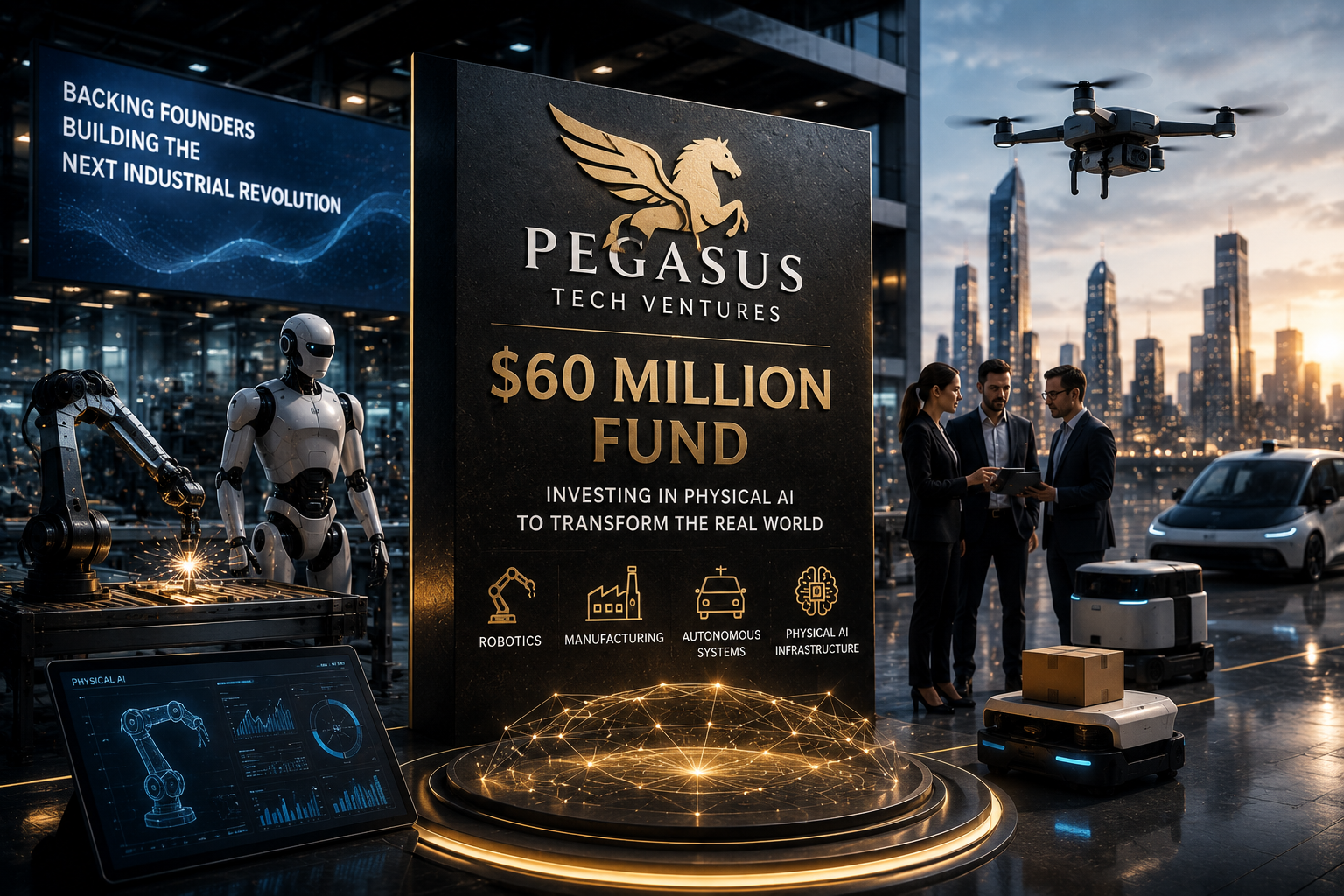
In an era where digital giants pour billions into virtual assistants and generative models, Pegasus Tech Ventures is turning its gaze toward the concrete. Officially unveiled on June 18, 2026, its new fund aims to grow startups where artificial intelligence is embodied not just in code, but in steel, circuits, and sensors. This $60 million vehicle will invest in early-stage companies operating in the realm of 'physical AI,' reshaping everything from factory floors to surgical suites.
By moving hand-in-hand with corporate partners worldwide, Pegasus offers more than capital — it provides market access and open innovation bridges. The move comes as physical AI investments surged 67% in 2025 to $4.3 billion, signaling a massive appetite for machines that read, touch, and transform the real world.
The Rise of Physical AI: Beyond the Screen
Throughout 2025, generative AI pushed boundaries in text and image creation, but the true revolution will come from those who can merge that intelligence with atoms. Physical AI spans a range from robotic control systems and autonomous vehicles to smart factories and wearable medical devices. A McKinsey study last year projected that physical AI applications could add $2.6 trillion to the global economy by 2030. Pegasus's new fund sits precisely at this intersection.
According to managing partner Anis Uzzaman, 'Large language models learned to think; now it's time for action. This fund will help AI gain muscle and bone.' Indeed, in Q1 2026 alone, venture capital flowing into robotics startups hit $1.2 billion. Pegasus's strategy targets hardware-software holistic solutions intertwined with sensor fusion, edge computing, and materials science, rather than pure software plays.
New Muscle Memory in Robotics: Machines That Learn
Collaborative robots (cobots) capable of flexible manufacturing are among the most tangible examples of physical AI. The startups Pegasus intends to add to its portfolio are developing systems that can self-define tasks through deep reinforcement learning, eschewing traditional programming. For instance, a cobot startup that entered mass production in late 2025 managed to accelerate assembly lines by 40% just by mimicking human movements in three repetitions. Such breakthroughs explain why the $60M fund is seeking teams building physical intelligence from the ground up.
Inside the $60M Fund Strategy
Pegasus Tech Ventures plans to invest in 15–20 seed and Series A stage startups with this new fund. Average checks of $2–4 million per startup will be used not only for product development but also to accelerate integration into Pegasus's global corporate network. The fund's unique structure is that its limited partners (LPs) are not just financial investors, but multinational industrial giants eager to pilot the technology within their own operations.
This model shortens the 'valley of death' by offering startups live testing environments and a potential customer base from day one. A similar model deployed by a $45 million fund last year resulted in 70% of portfolio startups signing commercial contracts within 18 months. Pegasus’s 2026 version prioritizes medical robotics, logistics automation, and sustainable manufacturing technologies. The presence of automotive, healthcare, and e-commerce titans among corporate partners already signals where physical AI will add the most value.
The New Formula for Corporate Open Innovation
Unlike traditional corporate venture capital, Pegasus acts as an 'innovation orchestrator' between portfolio companies and enterprise clients. While startups validate business models through Pegasus's mentorship program, industrial partners feed real end-user feedback directly into product roadmaps. In 2025, a German logistics firm applying this approach boosted warehouse robot efficiency by 33%. Now the fund is in place to scale such success stories.
Implications for the Global Tech Landscape
Though not colossal in size, the $60 million fund marks a turning point through its strategic positioning. As big tech players race to embed their own AI models into hardware, the independent startups backed by Pegasus could gain speed and specialization advantages in niche areas. In a 2026 reality where surgical robots can autonomously suture with sub-millimeter precision and drones equipped with hyperspectral cameras perform real-time crop analysis, physical AI is rapidly democratizing.
Accepting applications simultaneously from startup ecosystems in the US, Europe, and Asia, the fund actively promotes geographic diversity. Last year, 40% of physical AI patents originated in Asia; Pegasus’s corporate bridges into these regions could accelerate Western startups' access to Asian markets and Asian startups' entry into Western manufacturing facilities. Thus, the fund has the potential to influence not just companies but the direction of global innovation.
Touching with Data: New Horizons in Sensor Fusion
The most critical component of physical AI is sensor technology that makes sense of the environment. The startups Pegasus is courting combine LIDAR, thermal cameras, and tactile sensors to give machines a grasp close to human intuition. A prototype electronic skin launched in 2025 revolutionized prosthetic hands by processing pressure and temperature in 0.1 milliseconds. The new fund aims to cover the manufacturability costs essential for such breakthroughs to reach mass production.
Ultimately, the $60 million Pegasus fund that debuted on June 18, 2026, is not just an investment vehicle — it's a declaration that artificial intelligence is stepping out of the virtual world to weave itself into the fabric of life. For entrepreneurs, engineers, and industry leaders, the question is: Are you ready to shape this era of physical intelligence?
