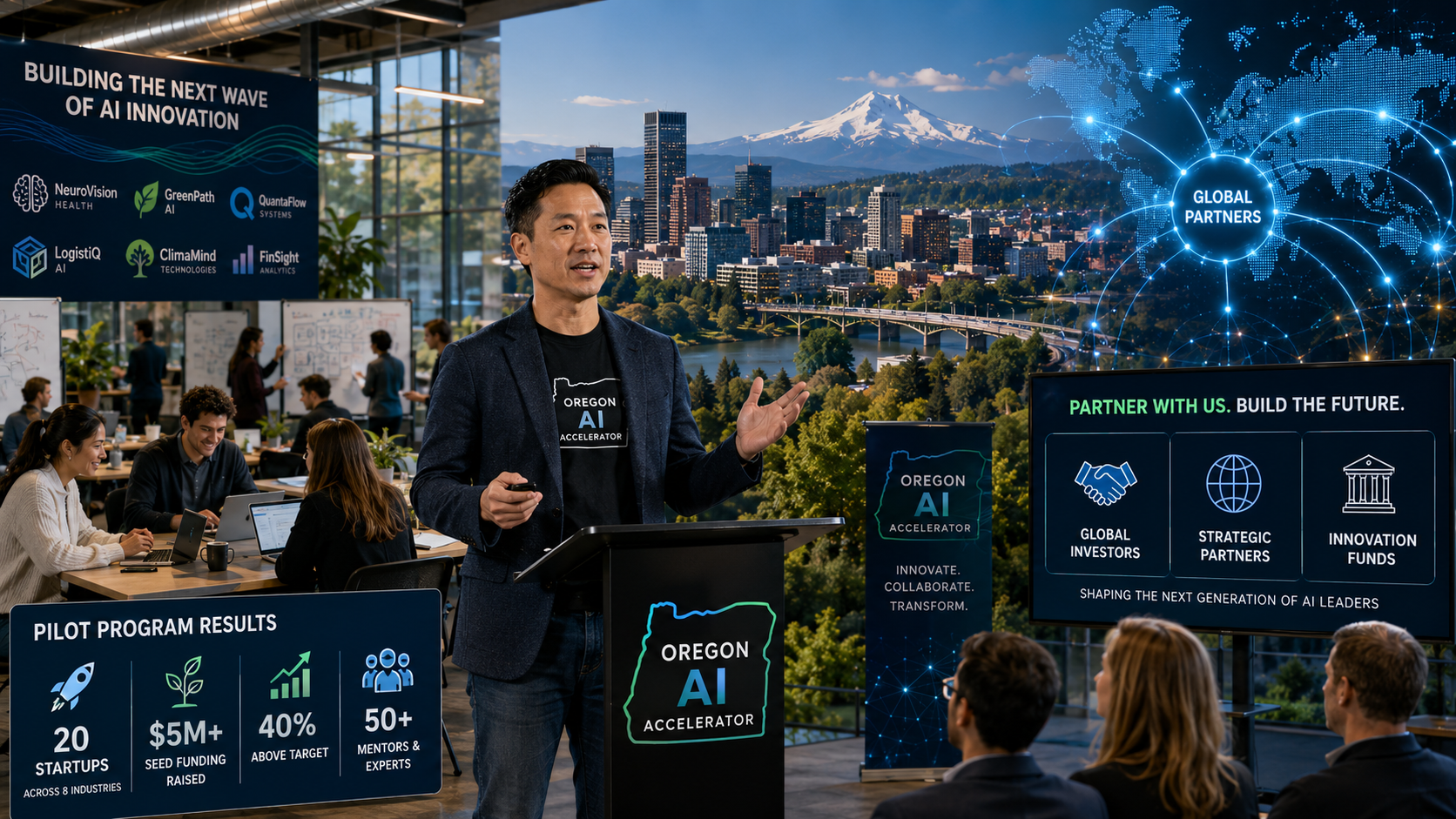
June 21, 2026 marks a turning point for AI entrepreneurship beyond traditional hubs. Oregon’s first-ever artificial intelligence accelerator has just completed its pilot cohort, successfully graduating 20 startups that spanned healthcare, logistics, climate tech, and finance. Now, director Jack Phan is on a mission to lock in global funding partners, a move that could define the next chapter of decentralized AI innovation. The pilot’s results have already surpassed expectations, drawing attention from investors in Silicon Valley, Europe, and Asia who see potentia l in a region long overshadowed by coastal tech giants.
Oregon’s Groundbreaking AI Pilot Program
The Oregon AI Accelerator launched in early 2026 with a rigorous 12-week curriculum designed to propel early-stage ventures from prototype to market-ready product. The 20 selected startups were chosen from over 400 applications, reflecting a hidden well of talent in the Pacific Northwest. During the program, founders received mentorship from industry veterans like Dr. Ayesha Chen, former AI lead at a major tech firm, and participated in mock board meetings with venture capitalists. By the end of the pilot, the cohort had collectively raised over $5 million in seed funding—40% above the initial target—and several startups had already secured commercial contracts with Fortune 500 companies.
A Cohort of 20 Startups Redefining AI Innovation
What set this pilot apart was not just the technology, but the speed of business validation. A logistics startup specializing in autonomous route optimization signed with three major e-commerce players during the program. A health-tech team using AI for early cancer detection fast-tracked its clinical validation phase, moving closer to FDA approval. These outcomes demonstrate that when given the right mentorship and network, startups outside Silicon Valley can match—and sometimes outpace—their counterparts in traditional hubs. The accelerator’s hands-on approach, combining technical sprints with market access workshops, proved to be a winning formula.
The Funding Challenge: Why Jack Phan Is Seeking Partners
Despite the pilot’s clear success, the accelerator’s future hangs in the balance without sustained funding. Phan has been candid: current resources can cover operational costs for only a few more months. In 2025, global investment in AI accelerators surged by 30%, yet many programs still struggle to transition from pilot to permanent fixture. The Oregon model aims to blend venture capital with public innovation grants and corporate sponsorships. “If we don’t act now to secure the next wave of funding, we risk losing top-tier teams to regions with deeper pockets,” Phan warned in a recent interview. The accelerator is now in active discussions with sovereign wealth funds, tech corporations, and regional development agencies.
Sustainable Models for AI Acceleration
Experts argue that hybrid funding structures are essential for long-term viability. Successful accelerators often return a portion of equity gains from alumni startups back into the program, creating a self-sustaining cycle. Oregon’s leadership is also exploring revenue-based financing, where investors receive a share of future revenues rather than equity. With the pilot cohort’s strong traction, Phan believes the risk-reward ratio is compelling: early backers could see exponential returns if even one graduate reaches unicorn status. The data from the pilot—where each dollar invested generated an average of $7 in economic output—strengthens this pitch significantly.
Beyond the Pilot: The Future of AI in Oregon
The ambition extends far beyond a one-off program. Phan and his team envision Oregon as a permanent node in the global AI network, akin to Austin’s rise as a tech powerhouse in the last decade. The region already boasts a growing tech infrastructure, a lower cost of living than California, and a steady pipeline of talent from universities like Oregon State and the University of Oregon. Plans for future cohorts include a sharper focus on generative AI, autonomous systems, and sustainability—areas where the pilot startups showed exceptional promise. With the right funding, the accelerator could anchor an entire ecosystem, attracting follow-on investment and creating thousands of high-skilled jobs.
Building a Tech Hub Outside Traditional Centers
Decentralizing AI innovation is not just a regional ambition; it’s a strategic necessity. Concentrating resources in a few coastal cities creates supply-chain vulnerabilities and limits the diversity of problem-solving approaches. By nurturing a hub in Oregon, the accelerator offers an alternative model that could be replicated in the Midwest, Southern Europe, or Southeast Asia. The search for global funding partners signals this international scope: Phan is actively courting investors from Berlin, Singapore, and Riyadh, betting that cross-border collaboration will yield stronger, more resilient AI ventures. This approach could turn Oregon into a blueprint for regional tech renaissance worldwide.
Global Implications: What This Means for the AI Ecosystem
The Oregon Accelerator’s pilot success arrives at a pivotal moment. Over the past five years, cities like Bangalore, Tel Aviv, and Helsinki have produced AI unicorns that challenge the dominance of U.S. and Chinese tech giants. Oregon’s emergence adds another dimension, proving that even within the United States, innovation can flourish far from the Bay Area. For investors, this represents a double opportunity: access to high-growth startups at more reasonable valuations, and a chance to shape the narrative of distributed AI development. The coming months will reveal whether Phan’s funding drive succeeds; its outcome could influence where the next generation of AI companies chooses to put down roots.
A Model for Regional AI Innovation Worldwide
Beyond financial returns, the Oregon experiment offers a replicable formula for mid-sized economies. It combines strong academic partnerships, early-stage public support, and private-sector agility to create a launchpad that turns research into revenue. The pilot data suggests that with initial investment as low as a few million dollars, regions can generate significant economic multipliers and retain top-tier talent that might otherwise migrate to mega-hubs. As Jack Phan’s search for partners intensifies, the global investor community faces a clear question: are you ready to bet on the future of AI, even when it’s not in the usual zip codes?
