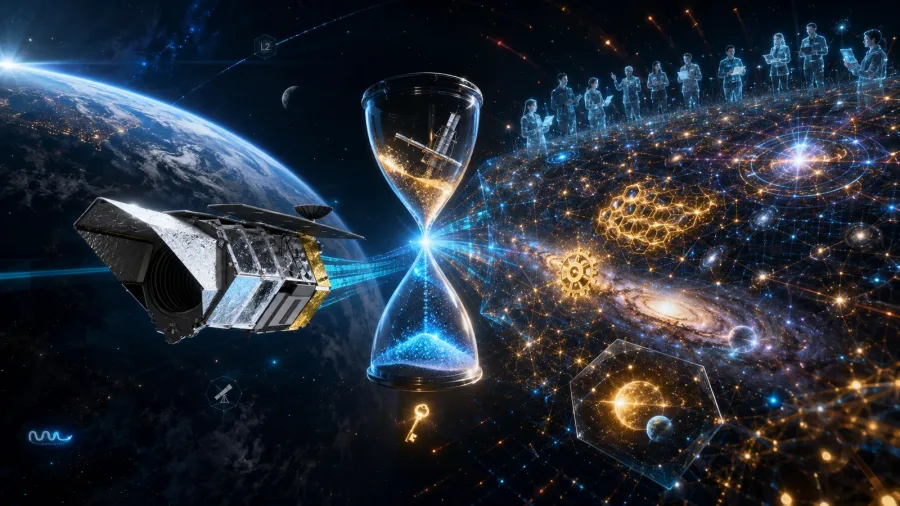
The astronomical community is on the cusp of a transformative era as NASA prepares to launch the Nancy Grace Roman Space Telescope in the summer of 2026. Destined for a gravitationally stable orbit 1 million miles from Earth at the second Lagrange point (L2), this next-generation observatory is engineered to tackle some of the most profound questions in modern astrophysics. From the elusive nature of dark energy that drives the universe's accelerating expansion to the statistical census of planets beyond our solar system, Roman promises to deliver a deluge of data that will keep scientists busy for decades, fundamentally altering our cosmic perspective.
The Technological Leap Beyond Hubble and Webb
While the Hubble Space Telescope revolutionized astronomy with its razor-sharp deep-field images and the James Webb Space Telescope (JWST) peers into the infrared universe with unprecedented sensitivity, the Roman Space Telescope carves out its own unique and complementary niche. Its defining feature is a gigantic field of view, 100 times greater than Hubble's infrared instrument, allowing it to conduct sweeping cosmic surveys at a speed previously unimaginable. The 300-megapixel Wide Field Instrument (WFI) onboard Roman can capture a patch of sky equivalent to the size of two full Moons in a single exposure, a feat that combines Hubble-level angular resolution with a panoramic scale.
This survey-speed capability fundamentally changes the game for time-domain astronomy. A survey that would require decades for Hubble or JWST to complete can be accomplished by Roman in a matter of weeks. This efficiency allows for repeated observations of the same celestial fields, enabling the detection of transient phenomena such as distant supernovae and stellar flares. Furthermore, Roman's sensitivity in the near-infrared spectrum allows it to peer through cosmic dust that obscures visible light, revealing the structure of our own Milky Way galaxy and the faint, distant galaxies formed in the early universe. As of mid-2026, the integration of Roman's data pipeline represents the most ambitious big-data challenge in the history of space-based astronomy.
A Stargate for Direct Exoplanet Imaging
Beyond its survey capabilities, Roman carries a technology demonstration instrument that could define the future of exoplanet science: the Coronagraph Instrument. This advanced system is designed to block the overwhelming glare of a host star, allowing astronomers to directly image the faint light reflected or emitted by orbiting planets. By suppressing starlight by a factor of up to a billion, the coronagraph aims to capture direct images of gas giant exoplanets and potentially even smaller, Neptune-sized worlds. This technology serves as a critical pathfinder for future flagship missions like the Habitable Worlds Observatory (HWO), which will attempt to directly image Earth-like planets and search their atmospheres for biosignatures.
Mapping the Dark Universe and Cosmic Acceleration
One of Roman's primary science drivers is to unravel the mystery of dark energy, the enigmatic force constituting roughly 68% of the total energy density of the universe. Building on the legacy of ground-based surveys like the Dark Energy Survey, Roman will employ a three-pronged approach to measure cosmic acceleration with unparalleled precision. By charting the distribution of millions of galaxies across cosmic time through weak gravitational lensing, measuring the clustering of galaxies in the early universe via baryon acoustic oscillations, and discovering thousands of Type Ia supernovae as standard candles, Roman will map the expansion history of the universe stretching back over 10 billion years.
The High Latitude Wide Area Survey, a core component of Roman's mission, will image over 2,000 square degrees of the sky—an area vastly larger than the Hubble Ultra Deep Field. This survey will generate a three-dimensional map of the dark matter scaffolding that underlies the visible universe. By observing how this structure evolved, cosmologists can test Albert Einstein's theory of general relativity on the largest scales and potentially identify a breakdown in our understanding of gravity. The data gathered is expected to resolve, or at least substantially clarify, the current 'Hubble tension'—a significant discrepancy between different methods of measuring the universe's current expansion rate that hints at new physics beyond the Standard Model.
Resolving the Hubble Tension
The Hubble tension has emerged as one of the most compelling crises in modern cosmology. Measurements derived from the cosmic microwave background (the relic radiation from the Big Bang) predict a slower expansion rate than what is observed in the local universe using Cepheid variable stars and supernovae. Roman's infrared vision will cut through the dust that complicates optical measurements of Cepheids, providing a definitive, high-precision calibration of the cosmic distance ladder. If the tension persists under Roman's sharper gaze, it would strongly imply that the standard Lambda-CDM model of cosmology is incomplete, potentially ushering in a new era of theoretical physics in the late 2020s.
The Galactic Census of Free-Floating Worlds
In a groundbreaking statistical survey of the inner Milky Way, Roman will use gravitational microlensing to conduct a census of exoplanets unlike any before. This technique relies on the chance alignment of a foreground star passing in front of a distant background star; the foreground star's gravity acts as a lens, temporarily magnifying the background light. If the lensing star hosts a planet, the planet's own gravity creates a characteristic blip in the magnification signal. Roman's ability to monitor hundreds of millions of stars continuously will allow it to detect these rare and fleeting events, revealing planets with orbits wider than Mars and even rogue planets—worlds that drift through the galaxy alone, unbound to any star.
Current models suggest that planetary systems are dynamic and often violent places, with gravitational interactions ejecting many planets into interstellar space during the chaotic early stages of formation. Roman is expected to detect thousands of such microlensing events, providing the first robust statistical sample of these dark, isolated worlds. By determining the mass distribution and frequency of free-floating planets down to the size of Mars, Roman will supply crucial empirical constraints to theories of planet formation and migration. This data, streaming back to Earth starting in 2026, will fundamentally rewrite our understanding of how typical—or atypical—our own solar system's architecture truly is.
A Synergistic Triad with Webb and Rubin
The 2026 launch positions Roman perfectly to work in concert with two other revolutionary observatories: the JWST and the ground-based Vera C. Rubin Observatory. While Rubin will scan the entire southern sky from Chile every few nights in optical light, Roman will provide the infrared counterpart from space, free from the distortion of Earth's atmosphere. When Roman discovers a transient event or a particularly interesting exoplanet candidate, JWST can be pointed at the target to conduct deep, high-resolution spectroscopic follow-up. This triad of survey, discovery, and characterization telescopes creates a multi-wavelength ecosystem that maximizes the scientific return of each facility, promising a golden age of discovery in the latter half of the 2020s.
The Global Impact and Data Deluge of 2026
Roman is not just a NASA mission; it is a global asset. The petabyte-scale archive of high-level science products will be publicly available, enabling astronomers worldwide—from the European Space Agency's member states to research universities in Japan, India, and South America—to mine the data for discoveries. This open-access policy democratizes cutting-edge astrophysics, allowing a student at a small university to potentially identify a gravitational lens or a new dwarf galaxy in Roman's vast imagery. The mission is expected to generate a paradigm shift in how astronomy is conducted, moving from a model of individual principal investigators targeting specific objects to a community-driven model of surveying the entire sky and sharing massive data sets.
The sheer volume of data—over 20 petabytes expected over the five-year primary mission—necessitates a heavy reliance on artificial intelligence, machine learning, and cloud-based computing platforms. Algorithms must be trained to sift through the nightly stream of images to identify transient objects, classify galaxies, and flag anomalies in real-time. This technological imperative is accelerating the field of astroinformatics, creating a new generation of data-savvy astronomers. As Roman begins its journey in the summer of 2026, it brings with it not just a new telescope, but a new way of exploring the universe, where human curiosity is augmented by machine speed to unlock the deepest mysteries of the cosmos.
A Pathfinder for the Habitable Worlds Observatory
Looking further into the future, Roman's legacy will be cemented by its role as a technological stepping stone. The performance of its Coronagraph Instrument in the harsh environment of space will directly inform the engineering requirements for NASA's Habitable Worlds Observatory, a mega-project targeted for the 2040s that aims to image Earth-sized planets in the habitable zones of nearby stars. By demonstrating that starlight can be suppressed to the required contrast ratios, Roman de-risks the technology for this next grand challenge. Thus, the telescope launching in 2026 is not an end-point but a crucial evolutionary link in humanity's quest to answer the age-old question: Are we alone?
