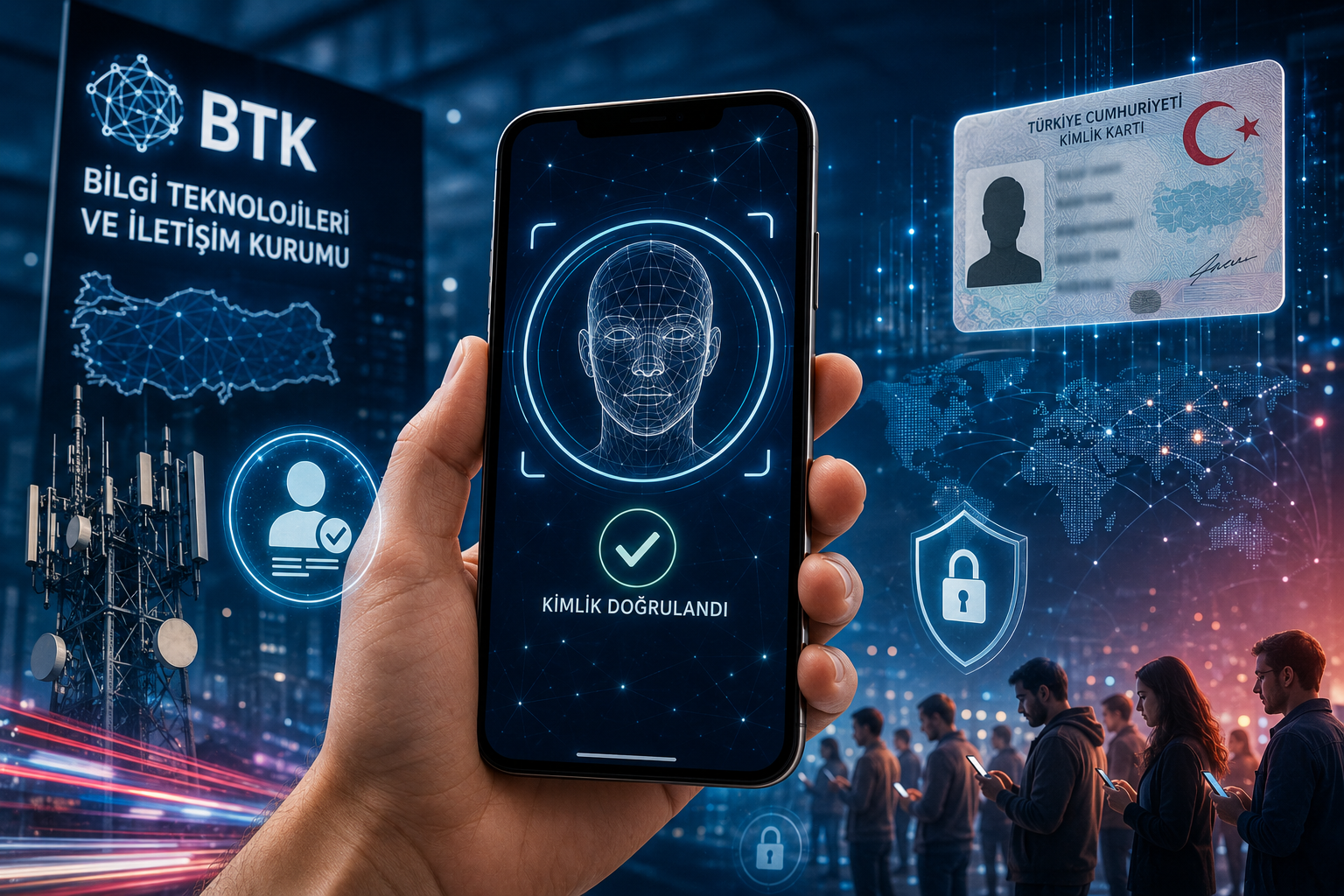
As of June 19, 2026, your mobile phone could unexpectedly go silent one morning. The new regulation announced by the Information and Communication Technologies Authority (BTK) last year and enforced strictly this year makes biometric identity verification mandatory for all mobile lines. The era of 'restrict first, terminate later' has officially begun for unverified accounts.
What Does BTK's 2026 Regulation Entail?
The regulatory amendment published in the last quarter of last year was gradually rolled out in early 2026 and is now fully operational as of June. The mandate requires mobile operators to instantly match subscription records with the MERNIS (Central Civil Registration System) database. This process goes beyond merely verifying the Turkish ID number; it now requires biometric photo matching and a two-factor authentication mechanism via e-Government (e-Devlet) integration.
The primary goal is to curb the explosion of fraudulent lines and scams witnessed between 2024 and 2025. According to BTK's 2025 annual report, roughly 5% of active mobile lines in Turkey were registered with incomplete or mismatched identity records. This implied that approximately 4 million lines posed a potential security vulnerability.
The Phased Sanction Timeline
BTK implemented a three-stage transition calendar to minimize grievances. In the first phase, starting March 1, 2026, operators sent warnings via SMS and call centers. The second phase, which began on June 1, 2026, imposed a 'one-way restriction' on users who still haven't verified their identity; these users can no longer make calls or send SMS. As the final stage, September 1, 2026, marks the deadline for the complete disconnection of all remaining unverified lines.
Who Faces the Greatest Risk?
This regulation directly impacts millions of users who purchased their lines from unregistered dealers or whose subscriptions are registered under someone else's name. Prepaid lines sold without proper ID verification, often referred to as 'open lines' in the past, are the primary targets. Similarly, corporate line users who transitioned to personal use, or long-time subscribers who haven't visited an operator store in years, are also in the danger zone.
BTK data indicates that approximately 1.2 million mobile subscribers received identity verification warnings in the first half of 2026. About 350,000 of these users had their lines restricted by mid-June 2026 due to failing to complete the required biometric check. Authorities warn that if these lines, often used for banking transactions and e-Government access, fall into the wrong hands, they could cause irreparable financial losses.
The Social Cost of Unregistered Subscriptions
Unverified lines were used as tools in over 40% of fraud cases in Turkey in 2025. In prosecutorial investigations, detecting cybercrimes committed via lines registered under someone else's name took months, and often the real culprit could not be identified. The new regulation aims to eliminate the concept of 'ghost users' through biometric validation.
How to Verify Your Line Step by Step
There are three main methods to verify your mobile line in 2026. The fastest method is to use your operator's official mobile app to take a live biometric photo and match your identity using facial recognition technology. The second method is to log into the e-Devlet portal and use the 'Mobile Line Inquiry and Verification' service, which lists all lines registered to your name and allows one-click confirmation.
The third, traditional method requires you to physically visit any operator store with your new chip-enabled ID card. A critical detail to note here is that your ID must have an up-to-date biometric photo. Old-style paper IDs or cards with outdated photos cause matching errors in the MERNIS system, leading to the rejection of the verification process.
What to Do If Your Line Gets Disconnected?
If you fail to verify by September 1, 2026, your line will be terminated, and your number may be reclaimed. However, you have the right to recover your number within 90 days of the full disconnection by personally visiting the nearest operator store and completing your biometric verification. Since there is no risk of the number being sold to someone else during this grace period, users are advised to act swiftly but without panic.
The Mobile Security Landscape for 2026 and Beyond
This mandate isn't just a sanction; it's part of Turkey's broader digital identity strategy. With eSIM technology rapidly expanding in 2026, the reliance on physical SIM cards is decreasing, but the importance of remote identity verification (Remote KYC) is growing exponentially. BTK's move prepares a legal framework that allows responsibility to be traced back to real individuals in the event of a cyberattack or a large-scale data breach.
As mobile phone numbers are used as the primary verification tool for everything from bank account openings to social media confirmations, this biometric layer raises the cybersecurity bar in Turkey. Experts predict that by 2027, the entire prepaid market will transition to mandatory biometric verification, making unregistered line sales virtually impossible.
A Global Comparison: Where Does Turkey Stand?
Turkey's move parallels mandatory biometric SIM registration practices in countries like Germany and India. Specifically, India's model of integrating mobile verification with the Aadhaar system served as an inspiration for BTK's 2026 regulation. With this step, Turkey has positioned itself as one of the countries with the strictest biometric verification infrastructure in the Middle East and Europe.
Check the current status of your line immediately via e-Devlet or your operator's app. Remember, your deadline is September 1, 2026, and time is running out. Do you think these strict regulations will be enough to stop the rise of digital fraud?
