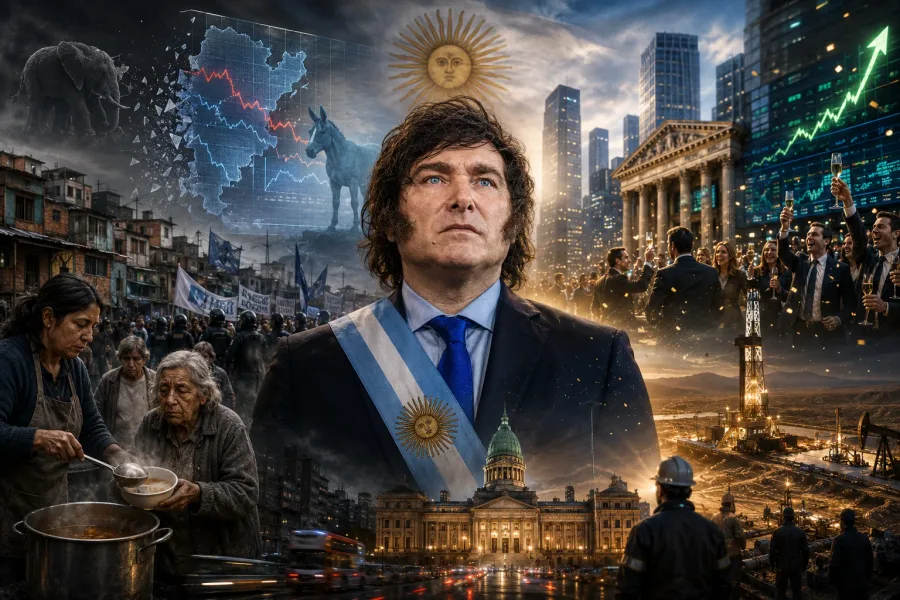
On the 20th floor of a gleaming tower in Buenos Aires' financial district, foreign investors toast another record close on the Merval stock index. A short drive away in the barrios populares, soup kitchens are serving double the number of families they did a year ago. This is Argentina in mid-2026 — a nation cleaved in two by President Javier Milei's radical economic experiment. The self-described 'anarcho-capitalist' leader has delivered on his promise to take a chainsaw to the state, and the macroeconomic numbers are finally turning green. Yet for nearly half the population still mired in poverty, the recovery remains a rumor whispered in the corridors of power, not a reality felt in the grocery store aisle.
Milei's ascent to power in late 2023 was a desperate gamble by an electorate battered by 160% annual inflation and a crumbling peso. His prescription — a brutal fiscal adjustment, a 50% currency devaluation, and the dismantling of price controls — was designed to shock the system back to life. By the second quarter of 2026, the patient is showing vital signs: monthly inflation has cooled from a peak of 25% to below 3%, sovereign risk has plummeted, and the International Monetary Fund (IMF) has signed off on the latest tranche of its $44 billion loan program. But the cure has been almost as painful as the disease. Utility bills have soared by over 300% as subsidies vanished, real wages are still down roughly 20% from their 2023 levels, and consumer spending remains stubbornly depressed despite the official narrative of recovery.
Wall Street vs. Main Street: decoding Argentina's recovery mirage
The numbers tell two completely different stories depending on where you stand. For global capital, Argentina is the trade of the decade. The country's sovereign bonds have returned over 80% since Milei took office, and the Merval index has more than doubled in dollar terms. In June 2026, JPMorgan upgraded Argentina's outlook, citing the government's 'unwavering commitment to fiscal discipline.' Foreign direct investment, particularly in the vast Vaca Muerta shale oil and gas formation in Patagonia, is pouring in at levels not seen since the early 2010s. Argentina is on track to become a net energy exporter by 2027, a structural shift that could finally solve its chronic dollar shortage. 'The macro fundamentals are aligning in a way we haven't seen in a generation,' noted Dr. Elena Vasquez, chief Latin America strategist at a leading New York investment bank. 'The question is whether the political system can hold long enough for these gains to trickle down.'
On the ground, however, the trickle is barely a drip. INDEC, the national statistics agency, reported that supermarket sales fell 8% year-on-year in the first half of 2026, even as the economy technically exited recession. The poverty rate, which spiked to a staggering 52% in early 2025, has barely budged, hovering around 48% according to independent estimates from the Catholic University of Argentina. Pensioners, who saw the real value of their payments slashed by Milei's initial austerity drive, continue to rely on community kitchens and family support to survive. The government insists that the disinflation process will eventually restore purchasing power, pointing to modest real wage gains in the formal private sector during the second quarter of 2026. But for the 40% of the workforce trapped in the informal economy — street vendors, domestic workers, day laborers — such statistical improvements are meaningless. Their incomes, denominated in a strengthening peso but without any formal adjustment mechanism, have been eviscerated.
The political clock is ticking louder in Buenos Aires
Milei's entire economic strategy is a race against the political calendar. The 2027 presidential election looms, and history is not on the incumbent's side. Argentine voters have a long memory of austerity, and they have rarely rewarded it at the ballot box. The 2025 midterm elections delivered a warning shot: Milei's La Libertad Avanza coalition lost ground in Congress, forcing the president into uncomfortable alliances with the traditional center-right to pass his reform agenda. His approval rating, while still relatively robust at 45% in mid-2026, is propped up largely by the absence of a credible opposition alternative rather than genuine enthusiasm for his policies. Peronism, the once-dominant political movement, remains fractured and leaderless, still reeling from its disastrous management of the economy during the Alberto Fernández years.
The president's bet is that by late 2026 or early 2027, the combination of single-digit inflation, a booming energy sector, and the lifting of capital controls will create a feel-good factor strong enough to override memories of the painful adjustment. He has promised to dismantle the 'cepo cambiario' — the web of currency restrictions that has strangled business for years — before the election, a move that would be a massive confidence boost if executed without triggering a run on the peso. The Vaca Muerta windfall is central to this plan. With pipeline capacity expanding and global energy prices firm, Argentina's energy trade balance is swinging from a $5 billion deficit in 2022 to a projected $4 billion surplus in 2026. This influx of dollars is the lubricant that could allow Milei to unify the exchange rate without a devaluation shock. But it is a high-wire act with no safety net.
The social fabric under strain: protests, poverty, and public order
The streets of Buenos Aires have become a barometer of the government's fragile legitimacy. Throughout 2026, labor unions, student groups, and social movements have staged rolling protests against the austerity measures. The government's response has been a controversial 'public order protocol' that imposes severe penalties for roadblocks and disruptive demonstrations. Milei frames these measures as essential to protect the 'silent majority' from 'violent minorities' who want to derail the recovery. Human rights organizations, including Amnesty International and the Inter-American Commission on Human Rights, have expressed alarm at what they see as a crackdown on the right to peaceful protest. The tension between Milei's libertarian rhetoric and his administration's increasingly heavy-handed policing is a contradiction that critics are eager to exploit.
Yet, the social unrest has not coalesced into a unified political threat. The opposition's weakness is Milei's greatest asset. The Peronist movement, traditionally the voice of the working class, is discredited by the economic meltdown that occurred on its watch. The center-right PRO party, led by former President Mauricio Macri, is an uneasy ally of the government, supporting the broad direction of reforms while criticizing the social costs. This fragmented landscape gives Milei a window to push through changes that would have been unthinkable a decade ago. He has privatized state companies, slashed public sector employment by 15%, and is pushing for labor market flexibilization. Each reform chips away at the old corporatist state, but also deepens the divide between those equipped to thrive in a free-market Argentina and those left behind.
A global experiment in austerity with regional implications
Argentina's two-speed economy is being watched closely far beyond Latin America. In an era of rising global debt and stubborn inflation, Milei's experiment is a test case for radical fiscal consolidation. If he succeeds — if he can bring inflation to heel, reignite growth, and win reelection — his model could embolden libertarian and right-wing movements from Europe to Asia. If he fails, it will serve as a cautionary tale about the political limits of shock therapy. For Argentina's neighbors, particularly Brazil and Chile, the stakes are high. A stable and growing Argentina would boost regional trade and investment; a collapse back into crisis could send shockwaves through Mercosur and beyond. In 2026, the jury is still out. The macroeconomic dashboard is flashing green, but the human cost is painted in shades of gray. Argentina is once again the world's most fascinating — and precarious — economic laboratory.
