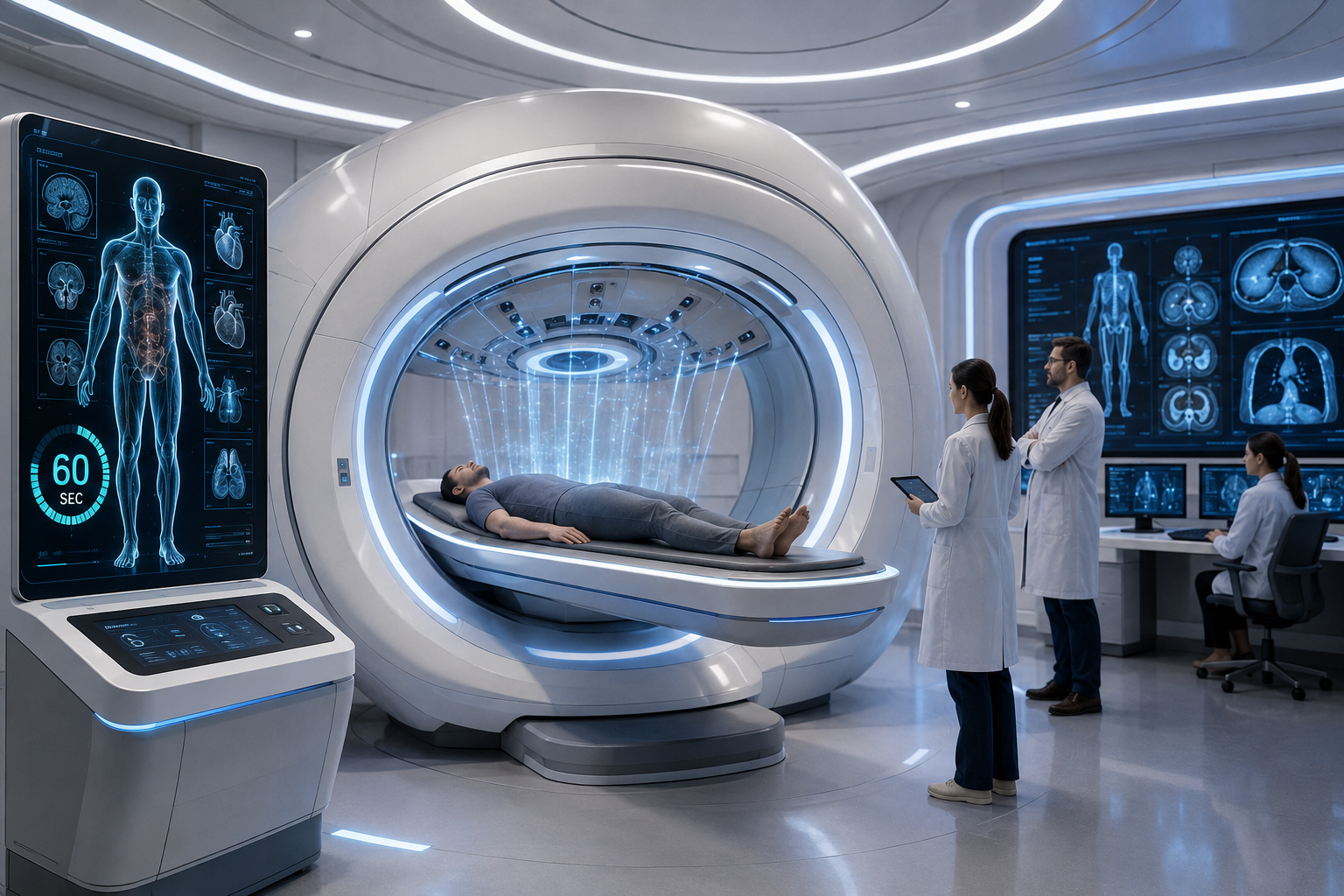
The biggest technology surprise of 2026 came from an entirely unexpected source. Midjourney, the company that revolutionized AI-driven visual generation, has now donned the white coat and stepped onto the stage with a hardware product aimed squarely at the healthcare industry. At a launch event in San Francisco on June 18, 2026, the company unveiled a prototype ultrasound-based device capable of scanning the entire human body in just 60 seconds. Dubbed the 'Midjourney VitaScan,' this device merges with an AI-driven image processing engine to produce radiation-free, three-dimensional anatomical maps. CEO David Holz emphasized accessibility during the presentation, stating, "We have opened a window into the human body—and this window will be available to everyone."
This move represents the first fruit of Midjourney's clandestine initiative, code-named 'Project Aesculapius,' which began in 2025. Conducted over the past year in partnership with Johns Hopkins University and the MIT Media Lab, the project explored how diffusion models could be applied to medical imaging. The result was not merely software but an integrated hardware solution. The device's most striking feature is that, unlike traditional ultrasound probes, it requires no physical contact with the body. While the patient lies on a platform, 128 micro-electromechanical ultrasound transducers operate simultaneously, capturing cross-sections at a resolution of 0.3 millimeters.
How VitaScan Works and Why It Stands Apart
Existing full-body scanning methods either involve high doses of radiation (CT scans) or are extremely expensive and time-consuming (MRI). Midjourney's VitaScan operates on an entirely different physical principle: quantitative ultrasound tomography. During the 60-second scan, the device collects roughly 3,500 cross-sectional images and processes this data instantly through a proprietary cloud-based diffusion model. This model can detect not only anatomical structures but also tissue elasticity, blood flow velocity, and even the metabolic heat signatures of early-stage tumors. According to the technical documentation published by the company, the device can identify lesions as small as 2 millimeters in diameter with an accuracy rate of 94.7%.
AI-Powered Anomaly Hunting: How Diffusion Models Assist Diagnosis
Midjourney's true strength lies in its image processing engine. The raw ultrasound data acquired during the scan is fed into a proprietary diffusion model called 'MedDiffuse.' This model was trained throughout 2025 on 2.1 million anonymized medical images. The system compares the scanned individual's anatomy against a reference 'healthy body model,' flagging even millimeter-scale deviations. This allows the radiologist to focus on the AI-prioritized 'areas of interest' rather than inspecting hundreds of slices manually. Dr. Sarah Lin, Chair of Radiology at Johns Hopkins, speaking at the launch, clarified the technology's role: "This device ushers in an era where the machine catches what the human eye might miss. However, the final decision must always reside with the physician."
Seismic Impact on the Healthcare Sector and the Pricing Strategy
Midjourney's announcement triggered an immediate dip in the stock prices of health technology giants. GE HealthCare shares fell 4.2% on launch day, while Siemens Healthineers declined 3.8%. Market analysts believe this reaction is not an overstatement. The greatest disruptive potential of the VitaScan lies in its price tag: Midjourney plans to sell the hospital-grade version of the device for $85,000, far below the industry average (a fully equipped MRI machine costs between $1 million and $3 million). Moreover, the company will introduce a 'clinic subscription' model in the first quarter of 2027. For a monthly fee of $2,900, clinics can lease the device, with software updates and AI diagnostic assistance included. This model specifically targets rural clinics in developing nations.
Regulatory Hurdles and the FDA Approval Process
Like any medical device, VitaScan faces significant regulatory barriers. Midjourney submitted its 510(k) application to the FDA in March 2026. However, the device's 'AI-assisted diagnostic' feature could clash with the 'AI/ML-Based Medical Devices Guideline' that the FDA tightened in 2025. This guideline mandates explainability reports for AI systems that aid in diagnosis. Midjourney CTO Jessica Wang addressed this: "Our MedDiffuse model provides a 14-layer reasoning chain for each detection. The physician can see, step-by-step, why the AI flagged a particular region." FDA approval is expected in the fourth quarter of 2026. Meanwhile, the CE marking process is running concurrently in Europe.
What Do Physicians Say? First-Hand Evaluations
Fifty physicians invited to the launch event had the chance to test the device in a live demo. Dr. Alexei Petrov, an internist at the Mayo Clinic, remarked, "Sixty seconds was indeed a very bold claim. But the patient lay down on the platform, the scan started, and by the time it stopped, I was still gathering my notes. The output quality was surprisingly high, and the soft tissue contrast, in particular, exceeded my expectations." However, some radiologists remain cautious. Prof. Dr. Mehmet Ozkan from Stanford Radiology noted, "It is difficult for an ultrasound-based system to replace CT for lung and bone tissue. This device will be a powerful complement to CT and MRI, not an alternative. The real revolution lies in how it changes annual check-up protocols." Indeed, Midjourney positions the device as a 'primary care screening tool'; confirmatory diagnosis will still require advanced imaging.
Insurance Companies and Reimbursement Models
The success of VitaScan will largely hinge on whether insurance companies include the scan in their reimbursement plans. Currently, full-body scans in the U.S. are typically considered 'elective procedures' and are paid out-of-pocket (averaging $1,500–$3,000). Midjourney has already begun talks with major insurers. The company's Director of Health Policy stated, "If an annual $200 VitaScan can reduce late-stage cancer diagnoses by 20%, we are painting a compelling cost-effectiveness picture for insurance companies." UnitedHealth Group's 'preventive screening pilot program,' launched in early 2026, is being interpreted as a signal in this direction.
Midjourney's move marks a new chapter in the integration of technology companies into the healthcare sector. In a field where Apple, Google, and Amazon have been trying to make inroads for years, an AI company specialized in image generation releasing a direct hardware product is being interpreted as the transplantation of Silicon Valley's 'move fast and break things' philosophy into medicine. Clinical trials for VitaScan are set to begin in 12 major hospitals in the coming months. If the results confirm the claims made at the launch, 2027 could herald the dawn of a new era in healthcare services. So, are you ready for a 60-second scan to replace your annual doctor's visit?
