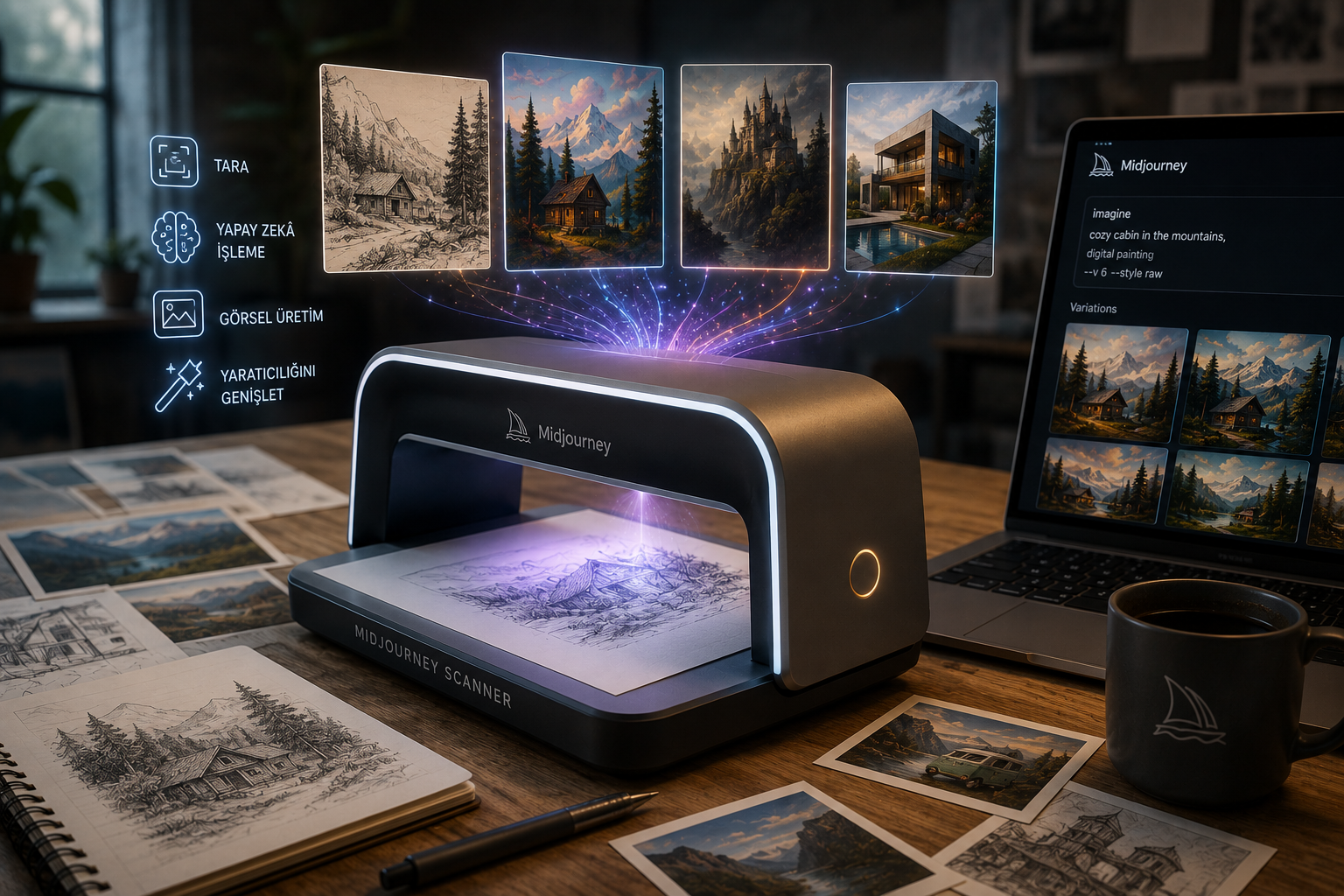
Midjourney, known solely for its text-to-image generative AI since its debut in 2022, has officially entered the hardware market with its first physical product, the Midjourney Scanner, announced on June 18, 2026. Is this device just another 3D scanner, or a tool poised to fundamentally reshape creative workflows? As the company's most surprising move yet, the Scanner captures physical objects in three dimensions and feeds them directly into Midjourney’s AI ecosystem. Users can instantly transform scanned items into different artistic styles, convert them into animations, or use them in spatial design projects, all within seconds.
What Is the Midjourney Scanner and What Does It Do?
At first glance, the Midjourney Scanner looks more like an elegant home decor piece than a piece of professional hardware. Under the hood, however, it houses highly advanced sensing and processing units. Its core purpose is to scan any physical object with extreme accuracy, turn it into a digital asset, and merge that asset with Midjourney’s generative AI engine. A ceramic artist, for instance, can place a handmade vase in front of the Scanner, and the device captures the geometry, texture, and color with remarkable fidelity. The user can then say, “reimagine this vase in 1920s art deco style,” and receive a completely new design. The entire pipeline reduces processes that previously took hours of modeling and rendering down to mere minutes.
Seamless Transition from Physical World to Digital Creation
The Scanner’s defining feature is the frictionless bridge between scanning and AI processing. Conventional 3D scanners typically output raw point cloud data that requires additional software to become usable. The Midjourney Scanner, by contrast, runs a lightweight neural network on-device to optimize data in real time, intelligently reducing polygon counts and translating the model directly into a format the Midjourney platform understands. As a result, three seconds after completing a scan, a user can prompt, “imagine this chair as a gothic throne,” and see the result on screen instantly.
The Technology Behind the Scanner: How Does It Work?
Midjourney developed a proprietary multi-sensing technology called “FusionSense” specifically for the Scanner. It fuses LiDAR, structured light, photogrammetry, and thermal sensors simultaneously to deliver sub-millimeter precision. Prototypes tested behind closed doors in 2025 achieved a 99.7% accuracy rate. The real innovation lies in the hardware-software integration: Midjourney’s cloud-based AI understands the context of scanned objects. When the Scanner captures a chair, the AI recognizes it as “something meant to be sat on” and generates variations without compromising that functionality.
Pushing the Boundaries of Hardware-Software Integration
FusionSense’s most impressive capability is real-time compensation of ambient light and shadows while faithfully copying material surface properties such as glossiness, roughness, and translucency. The device can also perform basic scanning and preprocessing without an internet connection. Once connected to the cloud, it accesses Midjourney’s enormous model archive, instantly comparing the scanned object with millions of similar references to spark creative suggestions. The company claims this hybrid architecture keeps latency below 40 milliseconds—a critical threshold for preserving the creative flow.
A Game-Changer for Creative Professionals?
The Midjourney Scanner has the potential to rewrite the rules for industrial designers, architects, game developers, and filmmakers. A furniture designer could scan a wooden workshop prototype and present a client with three era-specific visualizations—Bauhaus, Victorian, Minimalist—right in the middle of a meeting. Game studios can transfer real-world textures and objects directly into game engines, slashing asset production timelines from weeks to hours. Among the 200 creative professionals who participated in alpha tests in 2025, 84% reported a “permanent shift” in their workflow after using the Scanner.
Early Reactions and Use Cases from the Industry
Renowned concept artist Elena Vashchenko shared her first impressions: “In my 20-year career, I’ve never seen a tool this intuitive; the distance between what I imagine and what appears on screen practically disappeared.” The fashion industry is also showing strong interest, with fabric and texture scanning expected to unlock a new era in virtual runway shows and digital garment design. At the launch event, Midjourney CEO David Holz emphasized that the Scanner is “not just hardware—it’s AI’s doorway into the physical world.”
Price, Release Date, and Market Competition
Midjourney plans a limited release of the Scanner in autumn 2026. While no official price has been confirmed, sources close to the company suggest a price tag of approximately $2,500. That figure is highly competitive compared to professional 3D scanners, especially given the integrated AI capabilities. At the same time, Midjourney is preparing to compete directly with hardware giants like Apple, Meta, and NVIDIA. Meta’s Orion AR glasses, announced in 2025, and Apple’s Vision Pro both offer spatial content creation approaches, but none have positioned themselves as “creation-centric” in the way the Midjourney Scanner has.
How Will Midjourney’s Hardware Move Reshape the Industry?
Midjourney’s entry into the hardware market is the clearest evidence yet that AI companies will no longer be confined to software. Analysts predict this move will force traditional creative software titans like Adobe and Autodesk to rethink their own hardware strategies. If the Scanner succeeds, we may well see AI-powered drawing tablets, smart cameras, and even holographic displays hitting the market in the next few years. 2026 may be remembered as the year artificial intelligence truly merged with hardware.
The Midjourney Scanner could become the bridge that strengthens AI’s connection to the physical world. How do you think this device will transform creative industries? We’d love to hear your thoughts.
