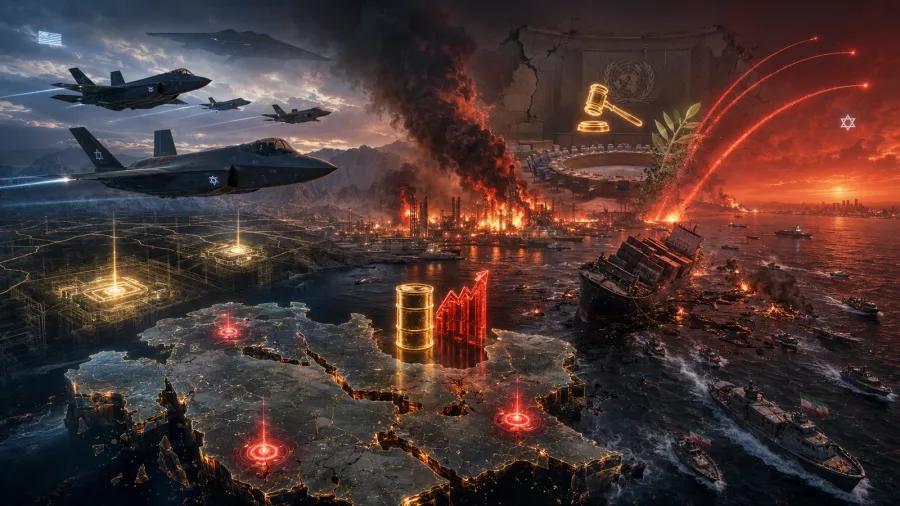
What began as a precision strike on Iran's underground nuclear facilities in the early hours of February 28, 2026, has metastasized into the most consequential military confrontation in the Middle East since the 2003 Iraq War — one that has drawn in proxy armies, disrupted global oil flows, and pushed the international order to a breaking point. Four months into the conflict, the 2026 Iran war has fundamentally altered the strategic calculus from the Strait of Hormuz to the halls of the United Nations Security Council.
The operation, code-named 'Operation Shield' by US Central Command and 'Days of Repentance' by the Israel Defense Forces, was triggered by Tehran's expulsion of International Atomic Energy Agency (IAEA) inspectors in January 2026 and subsequent confirmation by Western intelligence agencies that Iran had crossed the 90% uranium enrichment threshold — weapons-grade level. Despite last-minute diplomatic efforts led by Oman and Qatar, the administration in Washington concluded that the window for a negotiated settlement had permanently closed. On February 28, at 02:47 local time, the first wave of F-35 Lightning II jets crossed into Iranian airspace, marking the beginning of a campaign that military planners had gamed out for over two decades.
The initial 72-hour air campaign succeeded in degrading approximately 70% of Iran's known air defense infrastructure, according to Pentagon briefings, but the Iranian retaliation proved far more sophisticated than pre-war assessments had anticipated. Iran's Islamic Revolutionary Guard Corps (IRGC) Aerospace Force launched a coordinated salvo of over 300 ballistic missiles — including Shahab-3 and Ghadr-110 variants — targeting Israel's Haifa petrochemical complex, the Dimona nuclear research facility, and the US Navy's Fifth Fleet headquarters in Bahrain. The sheer volume of the barrage temporarily overwhelmed Israel's Iron Dome and David's Sling systems, resulting in the first successful mass-penetration strikes on Israeli territory since the 1991 Gulf War.
The nuclear target set: How the coalition dismantled Iran's breakout capability
Penetrating the Fordo mountain fortress and Natanz underground halls
The centerpiece of the opening salvo was the systematic destruction of Iran's nuclear fuel cycle infrastructure — a target set that had been refined through two decades of Mossad and CIA intelligence gathering. The Natanz Fuel Enrichment Plant, located near Isfahan, was struck by 30,000-pound GBU-57 Massive Ordnance Penetrators (MOP) dropped from B-2 Spirit stealth bombers that had flown non-stop from Whiteman Air Force Base in Missouri. These bunker-buster bombs, specifically designed to destroy hardened underground facilities, penetrated the 80-meter-deep centrifuge halls and triggered secondary explosions that Iranian state media initially attempted to conceal.
The Fordo Fuel Enrichment Plant, carved into a mountain near Qom and considered the most heavily fortified nuclear facility in Iran, presented a significantly greater challenge. Israeli F-35I Adir jets, equipped with indigenously developed Rafael Spice 2000 guided bombs, required three successive waves to achieve mission success. Satellite imagery analyzed by the Center for Strategic and International Studies (CSIS) confirmed the total destruction of Fordo's centrifuge cascades by March 3. However, the Bushehr Nuclear Power Plant — a Russian-built light-water reactor on the Persian Gulf coast — was deliberately excluded from the target list to avoid a Chernobyl-scale environmental catastrophe, a decision that drew rare praise from Moscow even as US-Russia relations deteriorated elsewhere.
Strait of Hormuz closure: The energy shock that rattled the global economy
Brent crude at $148 and the scramble for alternative supply routes
On March 1, the IRGC Navy made good on its long-standing threat to close the Strait of Hormuz, deploying a combination of naval mines, coastal anti-ship cruise missiles, and swarming fast-attack craft to choke off the 21-nautical-mile-wide chokepoint. The immediate consequence was a supply shock of historic proportions: roughly 20 million barrels per day of crude oil and liquefied natural gas — nearly 20% of global consumption — vanished from international markets overnight. Brent crude futures spiked to $148 per barrel by March 4, surpassing the 2008 record in inflation-adjusted terms, while European natural gas prices at the TTF hub tripled within a single trading week.
The US Department of Energy authorized an emergency drawdown of 2 million barrels per day from the Strategic Petroleum Reserve (SPR), and the International Energy Agency (IEA) coordinated a collective release among member states. Yet these measures failed to calm markets, as the insurance premiums for tankers transiting the region skyrocketed by 1,500% and shipping companies diverted vessels around the Cape of Good Hope — a detour that adds 15 to 20 days to Asia-Europe voyages and strains an already fragile global supply chain. China, which imported approximately 1.5 million barrels per day from Iran before the conflict despite secondary sanctions, faced a severe refining crunch that forced Beijing to impose fuel rationing in several coastal provinces for the first time since the 1970s.
The proxy war expands: From Hezbollah's northern front to Houthi maritime attacks
How Iran's axis of resistance opened multiple fronts against US and Israeli assets
Within hours of the first strikes on Iranian soil, the 'Axis of Resistance' — Iran's network of state and non-state allies across the Middle East — activated on multiple fronts, transforming a bilateral strike operation into a region-wide conflagration. Hezbollah, the Lebanese Shia militia armed with an estimated 150,000 rockets and precision-guided missiles, launched its most intense bombardment of northern Israel since the 2006 Lebanon War. The daily barrage of 1,500 projectiles overwhelmed Israel's Iron Dome interceptors, and several Fateh-110 precision-guided missiles struck the Haifa Bay petrochemical complex, sending toxic plumes across the Mediterranean coastline and triggering a mass evacuation of Israel's third-largest city.
In Syria, Iran-backed militias intensified drone and rocket attacks against the US garrison at Al-Tanf and the Conoco gas field in Deir ez-Zor province, wounding 14 American service members in a single coordinated strike on March 5. Yemen's Houthi movement, which controls the country's Red Sea coastline, expanded its campaign against commercial shipping, effectively closing the Bab el-Mandeb Strait to all but military convoys. In Iraq, Kata'ib Hezbollah and other Popular Mobilization Forces (PMF) factions launched repeated attacks on the Ain al-Asad Airbase, ignoring the Iraqi government's pleas for restraint. By mid-March, the conflict had effectively severed two of the world's three critical maritime chokepoints — Hormuz and Bab el-Mandeb — with only the Suez Canal remaining operational, albeit under heavy naval escort.
The diplomatic impasse: Why ceasefire efforts have failed so far
Turkey, China, and Russia's failed mediation and the UN Security Council paralysis
Despite an intense flurry of diplomatic activity, no viable ceasefire framework has emerged after four months of hostilities. Turkey's President launched the 'Istanbul Process' in mid-March, positioning Ankara as a mediator between Tehran and Washington. However, the initiative collapsed when Iran demanded an immediate and unconditional halt to all coalition military operations plus reparations for nuclear infrastructure damage — conditions the White House dismissed as 'non-starters from a regime intoxicated by its own defiance.' Turkey's delicate balancing act between its NATO obligations and its energy dependence on Iranian natural gas further complicated its mediator role.
China's alternative peace plan, presented within the Shanghai Cooperation Organization (SCO) framework, proposed a phased de-escalation monitored by SCO peacekeepers — a concept Israel rejected outright, citing Beijing's longstanding strategic partnership with Tehran. Russian President Vladimir Putin hosted a trilateral summit in Moscow with Iranian and Turkish counterparts, which succeeded only in establishing a temporary humanitarian corridor for medical evacuations. At the United Nations Security Council, the permanent members remain deeply divided: the US and UK demand Iran's unconditional surrender of its nuclear program, while China and Russia insist on linking any resolution to broader Middle East security guarantees, including Israel's undeclared nuclear arsenal. As of July 2026, the conflict grinds on at a controlled intensity, with analysts at the International Crisis Group warning that the absence of a diplomatic off-ramp risks transforming the Iran war into a protracted attrition campaign with no clear endpoint.
