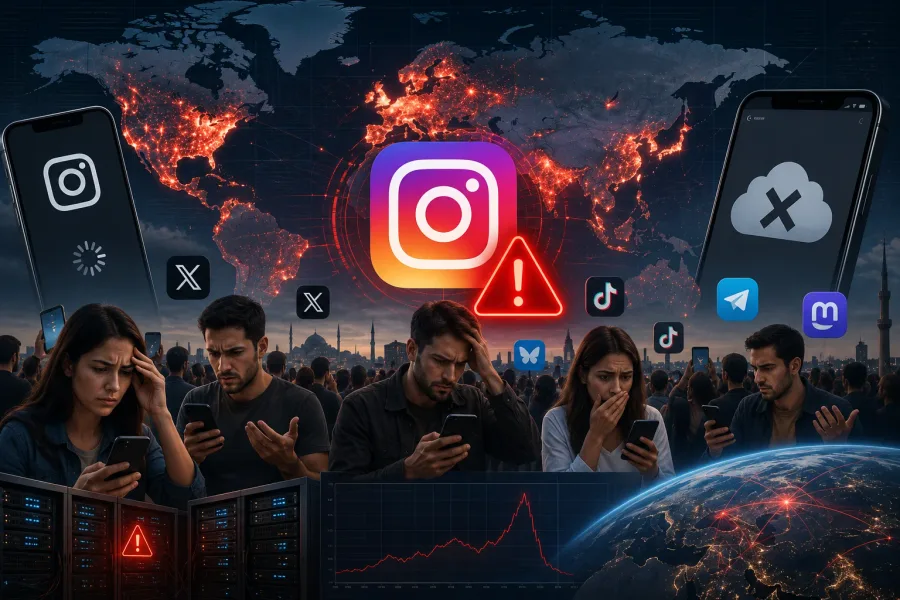
On the morning of July 19, 2026, a severe outage struck Instagram, leaving hundreds of millions of users worldwide unable to access their feeds, send messages, or upload content. The disruption, which began around 06:30 UTC, quickly became one of the most significant service interruptions for Meta's photo-sharing platform since the massive outage of 2025 that took down Facebook, Instagram, and WhatsApp simultaneously for nearly seven hours. According to Downdetector, user reports spiked dramatically within minutes, with particularly high concentrations of complaints emerging from Turkey, Germany, the United Kingdom, and the eastern United States.
The timing of the outage could not have been worse for Meta, which has spent much of 2026 attempting to rebuild user trust after a series of privacy scandals and antitrust investigations. With over 2.4 billion monthly active users globally, Instagram has evolved from a simple photo-sharing app into a critical infrastructure for digital commerce, influencer marketing, and even political communication. The immediate economic impact is staggering: analysts estimate that every hour of downtime costs Meta approximately $25 million in direct advertising revenue, while the broader ecosystem of creators and businesses that depend on the platform faces losses potentially ten times that amount.
Global scale of the disruption and Meta's infrastructure challenges
The outage on July 19, 2026, appears to have originated from a configuration error in Meta's backbone network infrastructure. Early analysis from network monitoring firms suggests a Border Gateway Protocol (BGP) routing issue—remarkably similar to the catastrophic failure that occurred in October 2025. During that incident, a faulty configuration update effectively removed Facebook's DNS routes from the global internet, making it impossible for users to reach any of the company's services. While the 2026 Instagram outage is currently limited to a single platform rather than the entire Meta ecosystem, the pattern is troubling for a company that pledged to invest $10 billion in infrastructure hardening after the 2025 disaster.
Network engineers tracking the incident noted that Instagram's servers were still operational but unreachable due to the routing problem. 'This is essentially a repeat of what we saw last year, but isolated to Instagram's content delivery network,' explained Dr. Sarah Chen, a network architecture researcher at MIT. 'The fact that this can still happen after all their promised fixes suggests a fundamental architectural vulnerability in how Meta manages its autonomous systems.' The incident has reignited debates about the centralization of internet infrastructure and whether a single company should control platforms used by nearly half the world's population.
European regulatory response and DSA implications
Under the European Union's Digital Services Act (DSA), which came into full effect in early 2026, Meta is classified as a 'Very Large Online Platform' (VLOP) and is subject to stringent requirements regarding service reliability and transparency. The European Commission has already signaled that it will investigate whether the Instagram outage constitutes a violation of the DSA's provisions on systemic risk management. If found in breach, Meta could face fines of up to 6% of its global annual turnover—potentially exceeding $8 billion based on the company's 2025 revenue figures. Thierry Breton, the EU Commissioner for Internal Market, issued a statement demanding a full incident report within 72 hours.
The regulatory scrutiny extends beyond Europe. In the United States, the Federal Trade Commission (FTC) has been monitoring Meta's infrastructure stability as part of its broader antitrust review. Meanwhile, Turkey's Information and Communication Technologies Authority (BTK) and Competition Authority have both opened preliminary inquiries into how the outage affects Turkish consumers and businesses. This multi-jurisdictional pressure creates a complex compliance landscape for Meta, which must now navigate simultaneous investigations while attempting to restore service and prevent future incidents.
Turkey's digital economy takes a direct hit
Turkey, with its 50 million-plus Instagram users and a thriving social commerce ecosystem, has been disproportionately affected by the outage. The country ranks among the top five globally in terms of Instagram engagement rates, and the platform has become the primary sales channel for an estimated 2.5 million small businesses and individual entrepreneurs. From Istanbul's fashion boutiques to Anatolian artisan food producers, a vast network of micro-enterprises relies almost exclusively on Instagram for customer acquisition and order management. The July 19 outage, which began during peak morning shopping hours in Turkey, has caused immediate and measurable economic damage.
Professor Emre Yılmaz, an e-commerce researcher at Boğaziçi University in Istanbul, estimated that Turkey's Instagram-based economy generates approximately 500 million Turkish lira (about $15 million) in daily transaction volume. 'Each hour of downtime translates to roughly 20 million lira in lost revenue for small businesses,' Yılmaz told reporters. 'If this continues through the afternoon, we are looking at losses exceeding 150 million lira in a single day. For micro-entrepreneurs operating on thin margins, this is not just an inconvenience—it is a genuine financial crisis.' The Istanbul Chamber of Commerce has already called for emergency support measures for affected businesses.
The Turkish creator economy faces algorithmic uncertainty
Beyond direct sales, Turkey's influencer marketing industry—valued at over 2 billion lira in 2026—has been thrown into disarray. Content creators who depend on carefully timed posts to maximize engagement and satisfy brand partnership agreements have seen their content calendars collapse. 'Algorithm momentum is everything in this business,' explained Canan Özdemir, a digital marketing strategist based in Istanbul. 'When you miss your posting window, the algorithm penalizes you, and it can take days or even weeks to recover your reach. For creators with contractual obligations to brands, this creates a nightmare scenario of potential breach of contract claims.'
The outage has also accelerated a trend that was already gaining momentum in Turkey: diversification away from Meta's platforms. Following the 2025 WhatsApp outage that drove a 40% surge in Telegram adoption in Turkey, many businesses had already begun establishing presences on alternative platforms. The current Instagram crisis is expected to further boost Turkish adoption of platforms like TikTok Shop, which has been aggressively expanding its e-commerce features in the Turkish market throughout 2026, as well as domestic alternatives developed by Turkish tech companies.
User migration and the fragmentation of social media
Each major platform outage triggers a measurable migration of users to competing services, and the July 19 Instagram disruption is no exception. Within the first hour of the outage, X (formerly Twitter) reported a 35% spike in global active users, while TikTok saw engagement metrics surge by approximately 28%. More significantly, decentralized platforms like Mastodon and Bluesky—which have been steadily gaining traction throughout 2026 as users seek alternatives to centralized Big Tech platforms—reported record new account registrations during the outage window. Mastodon's founder, Eugen Rochko, confirmed that the platform's servers handled the increased load without significant degradation, highlighting the resilience advantages of federated architectures.
This fragmentation poses a strategic challenge for Meta, which has historically benefited from network effects that make leaving its platforms costly for users. However, as users increasingly maintain presences across multiple platforms, the switching costs are declining. A June 2026 survey by the Pew Research Center found that 58% of social media users aged 18-34 now actively use four or more platforms, up from 42% in 2024. This multi-platform behavior means that outages on any single service are less disruptive to individual users, but they also weaken the lock-in that has been Meta's most powerful competitive moat. For advertisers, this fragmentation complicates campaign planning but also creates opportunities for more diversified media strategies.
Investor confidence and the stock market reaction
Wall Street's reaction to the Instagram outage was swift and negative. Meta's stock (NASDAQ: META) fell 3.2% in pre-market trading on July 19, 2026, as analysts revised their revenue forecasts for the third quarter. J.P. Morgan issued a note warning that 'recurring infrastructure failures at Meta are becoming a pattern that could erode advertiser confidence and accelerate the shift of digital ad spending to more reliable platforms.' The note specifically cited TikTok and Amazon's advertising business as potential beneficiaries of Meta's reliability issues. With Instagram accounting for approximately 55% of Meta's total advertising revenue in 2026, any threat to the platform's stability is an existential concern for the company's financial performance.
Looking ahead, the July 2026 outage will likely accelerate several trends that were already reshaping the social media landscape. Regulatory pressure on Meta to improve infrastructure resilience will intensify, particularly in jurisdictions like the EU and Turkey where the economic impact of outages is most severe. At the same time, the incident serves as a powerful reminder that the digital economy's foundations remain surprisingly fragile. As we approach the second half of 2026, the question is not whether another major outage will occur, but whether the ecosystem—users, businesses, regulators, and investors—can adapt to a reality where such disruptions are increasingly common.
