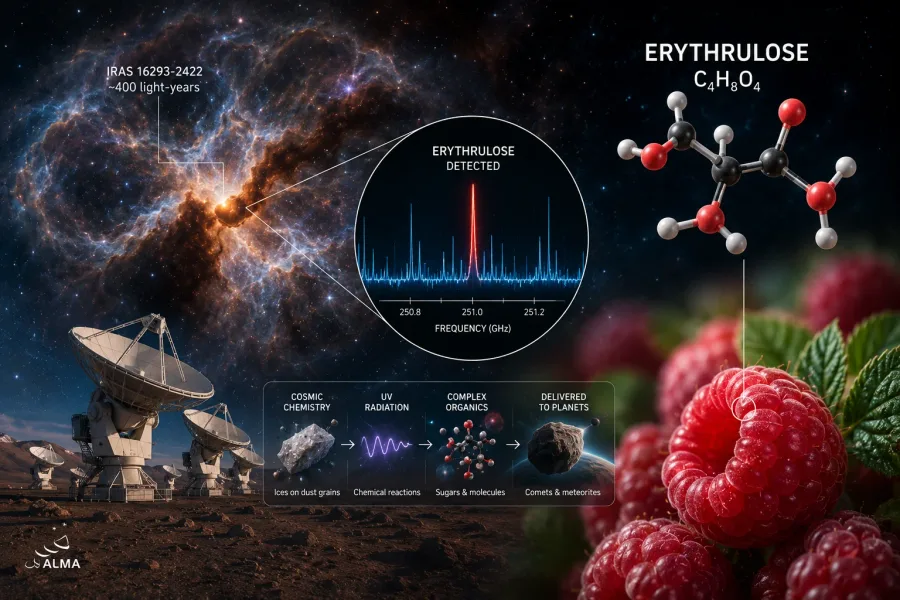
In the vast, cold expanses between stars, where temperatures plummet to near absolute zero and matter exists in a delicate dance of gas and dust, astronomers have uncovered a surprisingly familiar molecule. An international research team announced in mid-2026 the definitive detection of erythrulose — the very sugar that gives raspberries their characteristic sweetness — lurking within a dense interstellar cloud some 400 light-years from Earth. The findings, published after months of rigorous verification, mark a significant leap forward in our understanding of cosmic chemistry and the potential ubiquity of life's precursors throughout the galaxy.
This isn't merely a cosmic curiosity or a whimsical headline about 'raspberry-flavored space.' The presence of a 4-carbon ketose sugar in the interstellar medium carries profound implications for astrobiology and the origins of life. Sugars form the backbone of ribonucleic acid (RNA), the molecule central to the 'RNA world' hypothesis, which posits that self-replicating RNA predated DNA-based life on Earth. Finding erythrulose in star-forming regions suggests that the fundamental ingredients for genetic material are synthesized in space and delivered to nascent planets via comets and meteorites, potentially seeding life across the cosmos.
The technical triumph of detecting erythrulose in deep space
The detection relied on the unparalleled sensitivity of the Atacama Large Millimeter/submillimeter Array (ALMA), a colossal radio observatory perched high in Chile's Atacama Desert and operated by the European Southern Observatory (ESO) alongside international partners. ALMA's 66 precision antennas function as a single, massive virtual telescope, capable of discerning the faint rotational fingerprints of molecules as they tumble through space. The target, a well-studied stellar nursery designated IRAS 16293-2422, has long served as a chemical treasure trove, previously yielding glycolaldehyde — the simplest sugar — and other complex organics.
Dr. Miguel Sanz Novo of Spain's Astrobiology Center (CAB) led the painstaking analysis. 'The spectral lines of erythrulose are incredibly weak and sit in a crowded region of the spectrum, dominated by far more abundant molecules like methanol,' he explained during a press briefing. The team had to first measure erythrulose's rotational spectrum with unprecedented precision in laboratory settings, then match these fingerprints against the ALMA data using advanced computational models. The process, which spanned nearly 18 months from initial observation to confirmed detection, pushed the boundaries of what current radio astronomy can achieve in terms of molecular characterization.
ALMA's evolving capabilities and the spectral analysis breakthrough
ALMA's ability to isolate erythrulose hinged on its Band 6 and Band 7 receivers, operating at frequencies between 211 and 275 gigahertz. In 2026, ongoing upgrades to ALMA's correlator system have further enhanced its spectral resolution, allowing astronomers to distinguish between molecules with increasingly similar signatures. This technical evolution means that sugars like erythrulose, once considered beyond the detection threshold due to their complex, weak signals, are now accessible. The breakthrough also validates theoretical models of grain-surface chemistry, which predict that sugars form when ultraviolet radiation bombards icy mantles coating microscopic dust grains.
Implications for the origins of life and prebiotic chemistry
Erythrulose occupies a pivotal position in metabolic pathways and prebiotic chemistry. As a tetrose sugar, it participates in the pentose phosphate pathway and can act as a precursor for the synthesis of ribose — the 5-carbon sugar forming RNA's structural framework. The discovery in a star-forming cloud implies that such biologically relevant sugars are not rare, planetary anomalies but common constituents of the interstellar medium. 'We are finding that the chemical toolkit for life is assembled in space long before planets even form,' noted Dr. Stefanie Milam, an astrochemist at NASA's Goddard Space Flight Center, commenting on the broader implications.
This finding strengthens the 'cosmic zoo' theory of prebiotic chemistry, which argues that interstellar clouds are vast chemical reactors, synthesizing and distributing organic complexity throughout the galaxy. Meteorites like Murchison and Aguas Zarcas have previously been shown to contain sugars, including ribose and xylose, but linking these extraterrestrial sugars directly to interstellar progenitors has been a challenge. The erythrulose detection provides a direct observational link, showing that the carbon backbone chemistry necessary for life's informational molecules begins in the diffuse, frigid gas between stars, not solely in the warm, wet environments of planetary surfaces.
The RNA world hypothesis and its connection to cosmic sugars
The RNA world hypothesis proposes that RNA, capable of both storing genetic information and catalyzing chemical reactions, was life's original molecular engine. For this scenario to be viable, ribose must have been available on the early Earth. The discovery of erythrulose in space, alongside simpler sugars like glycolaldehyde, suggests a robust interstellar synthesis pathway. By mid-2026, researchers at CAB and collaborating institutions in Japan and the United States are actively searching for ribose itself in the same cloud, using ALMA's most extended configurations to achieve the necessary angular resolution and sensitivity.
A growing inventory of interstellar organic molecules
Erythrulose joins an expanding catalog of over 270 distinct molecules identified in the interstellar medium or circumstellar envelopes, a list that now includes ethers, esters, alcohols, and even complex aromatic hydrocarbons. The progression from diatomic species to molecules with more than ten atoms has accelerated dramatically since 2020, driven by ALMA and supplemented by the James Webb Space Telescope's (JWST) infrared capabilities. Each new addition refines astrochemical models, revealing the dominant reaction pathways operating on icy grain surfaces at temperatures as low as 10 Kelvin.
Professor Yoko Oya of Japan's RIKEN institute, whose team has mapped the distribution of complex organics around protostars, emphasized the significance: 'We are moving from simply detecting molecules to understanding their spatial distribution and chemical relationships. Erythrulose is not isolated; it exists within a rich chemical network that includes its isomers and reduction products. Mapping this network tells us how carbon evolves from simple ices to potentially life-bearing complexity.' The 2026 data suggests erythrulose abundances are surprisingly high relative to its simpler counterparts, hinting at highly efficient formation mechanisms that challenge existing kinetic models.
Future directions with JWST and next-generation observatories
JWST's near-infrared spectrograph (NIRSpec) offers a complementary window into the ice-phase chemistry of these regions. While ALMA probes the gas phase, JWST can directly observe the icy mantles where sugars are thought to form. A major observing program scheduled for late 2026 will target the same IRAS 16293-2422 region, aiming to correlate gas-phase erythrulose with its ice-bound precursors. Looking further ahead, the next-generation Very Large Array (ngVLA) and the proposed Origins Space Telescope promise to extend these studies to even larger, more fragile biomolecules, potentially including amino acids and nucleobases.
The broader context of astrobiology and cosmic exploration in 2026
The erythrulose discovery arrives at a time of renewed vigor in astrobiology. NASA's Perseverance rover continues to cache samples on Mars that may contain signs of ancient microbial life, while the Europa Clipper mission is en route to Jupiter's icy moon, a prime candidate for subsurface habitability. In this landscape, the finding that sugars — essential for life as we know it — are synthesized routinely in interstellar clouds provides a crucial piece of the cosmic puzzle. It suggests that the raw materials for life are not a planetary fluke but a galactic norm, distributed widely and frequently throughout the Milky Way.
For the broader public, the notion of 'raspberry sugar in space' captures the imagination, but for scientists, it represents a paradigm shift. The boundary between the non-living chemistry of space and the living chemistry of Earth grows ever more blurred. As 2026 progresses, astronomers are preparing to probe dozens of additional star-forming regions for sugars and their derivatives, building a statistical sample that will reveal just how common these sweet building blocks truly are. If erythrulose and its biochemical cousins are indeed ubiquitous, then the universe may be far more primed for life than humanity ever dared to hope.
