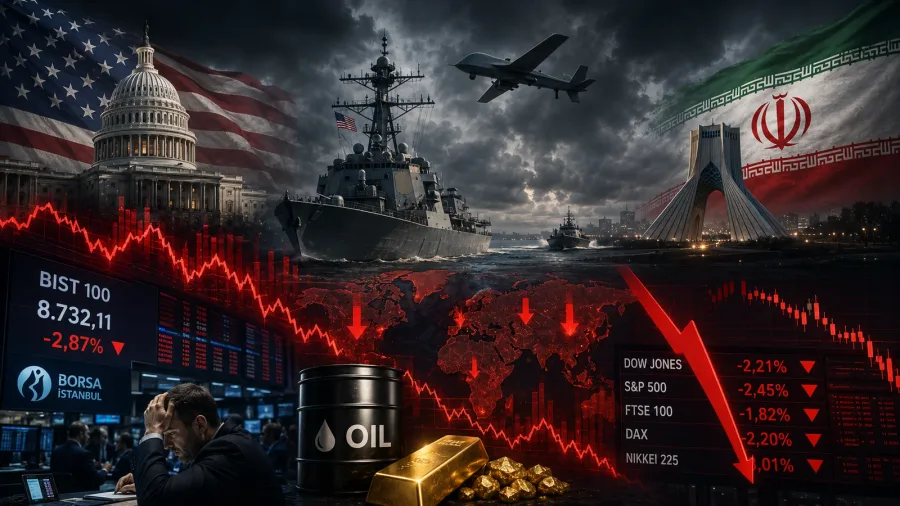
Financial markets across the globe opened sharply lower on Monday, July 20, 2026, as the military confrontation between the United States and Iran in the Strait of Hormuz entered a dangerous new phase. The weekend incident involving an Iranian drone approaching within 50 meters of a U.S. Navy destroyer in the Gulf of Oman sent shockwaves through trading floors from Tokyo to New York, triggering a massive flight to safety that pushed gold to an all-time high and sent crude oil prices soaring past the $100 per barrel mark for the first time since early 2025.
Oil markets in turmoil as Strait of Hormuz chokepoint faces its gravest threat since 2019
The Strait of Hormuz, the narrow waterway through which approximately 20% of the world's petroleum passes daily, has once again become the epicenter of global economic anxiety. Brent crude futures surged 6.8% in early Asian trading to reach $102.40 per barrel, while West Texas Intermediate climbed to $98.75, marking the steepest single-session increase since the Russia-Ukraine conflict erupted in 2022. Shipping insurance premiums for vessels transiting the Gulf region have quadrupled overnight, with Lloyd's of London reporting that war risk coverage for tankers has reached levels not seen since the Tanker War of the 1980s.
Energy analysts at Goldman Sachs issued an urgent note to clients warning that a prolonged disruption could push oil prices to $150 per barrel within weeks. “The market is currently pricing in a 35% probability of a significant supply disruption,” said Damien Courvalin, head of energy research at the investment bank. “If Iran follows through on its threat to mine the Strait or target commercial shipping, we are looking at a scenario that could remove 15-18 million barrels per day from global markets.” The International Energy Agency (IEA) in Paris convened an emergency meeting of member nations to discuss the potential release of strategic petroleum reserves, with the United States, Japan, and South Korea indicating willingness to coordinate a multilateral drawdown.
Defense sector outperforms as markets price in military escalation premium
While most sectors suffered heavy losses, defense contractors emerged as the clear winners of Monday's market rout. Shares of Lockheed Martin jumped 4.2%, Raytheon Technologies gained 3.8%, and Northrop Grumman added 3.5% in pre-market trading on Wall Street. European defense stocks followed suit, with BAE Systems up 4.7% and Thales climbing 3.9%. The Pentagon's announcement that it was deploying an additional carrier strike group to the region, bringing the total U.S. naval presence to three carrier groups, further fueled investor appetite for defense equities.
The broader market picture, however, remained deeply negative. The MSCI All-Country World Index dropped 2.9%, erasing approximately $1.8 trillion in market value within hours of the Asian open. Emerging market currencies came under intense pressure, with the Turkish lira, South African rand, and Indonesian rupiah all hitting multi-month lows against the dollar. The Mexican peso and Brazilian real also suffered significant losses as investors rushed to liquidate riskier positions. “This is a classic risk-off event with a geopolitical trigger,” explained Mark Haefele, chief investment officer at UBS Global Wealth Management. “The playbook is simple: sell equities, buy gold, buy the dollar, buy Treasuries. We're seeing all of that in real time.”
Gold surges to record high above $2,780 as safe-haven demand explodes
Spot gold prices shattered previous records in overnight trading, reaching $2,785 per ounce as investors sought refuge from the escalating geopolitical storm. The precious metal has now gained over 22% in 2026 alone, driven by a combination of central bank buying, Middle East tensions, and growing expectations of Federal Reserve rate cuts later this year. Silver also benefited from the risk-aversion trade, climbing 3.2% to $32.40 per ounce, while platinum added 2.1%. The gold-to-silver ratio, a key metric watched by precious metals traders, widened to 86:1, suggesting gold's outperformance may have further room to run.
Central bank gold purchases, which reached a record 1,137 tonnes in 2025 according to the World Gold Council, have continued at an elevated pace throughout the first half of 2026. The People's Bank of China, which has been the largest sovereign buyer, added another 15 tonnes to its reserves in June, while the Reserve Bank of India and the National Bank of Poland also made significant additions. “What we are witnessing is a structural shift in reserve management,” noted John Reade, chief market strategist at the World Gold Council. “Central banks in the Global South are systematically reducing their dollar exposure and increasing gold allocations. The current geopolitical crisis only accelerates this trend.”
Bond markets rally as traders bet on emergency Fed rate cuts
The U.S. Treasury market experienced its most dramatic rally since the regional banking crisis of 2023, with the yield on the benchmark 10-year note plummeting 28 basis points to 3.62% — the lowest level since June 2023. The two-year yield, which is more sensitive to monetary policy expectations, fell even more sharply to 3.95% as futures markets began pricing in a 60% probability of an emergency inter-meeting rate cut by the Federal Reserve. The inversion of the yield curve, which had been gradually normalizing earlier in 2026, deepened once again to negative 33 basis points.
Fed Chair Jerome Powell, who was scheduled to deliver remarks at the Economic Club of New York later this week, now faces a policy dilemma of extraordinary proportions. Inflation, which had been moderating toward the Fed's 2% target throughout the first half of 2026, could reaccelerate if oil prices remain elevated. Yet the risk of a financial stability shock from a broader Middle East conflict may force the central bank's hand. “The Fed is caught between a rock and a hard place,” said Krishna Guha, vice chairman of Evercore ISI. “Cut rates to stabilize markets and risk embedding an inflation psychology, or hold steady and watch financial conditions tighten to recessionary levels. There are no good options.”
Turkey's economic vulnerability: caught in the geopolitical crossfire
Few countries are as exposed to the current Middle East crisis as Turkey, which imports over 90% of its oil and natural gas needs and shares a 560-kilometer border with Iran. The Turkish lira weakened to a fresh record low of 34.55 against the U.S. dollar in thin trading, forcing the Central Bank of the Republic of Turkey (TCMB) to intervene through state-owned banks with an estimated $1.5 billion in dollar sales. The BIST 100 index, Turkey's benchmark equity gauge, slumped 2.8% at the open, with airline, tourism, and banking stocks bearing the brunt of the sell-off. Turkish Airlines (THY) shares fell 5.2%, while major lenders İş Bankası and Garanti BBVA both declined more than 4%.
Turkey's Tourism sector, which had been projecting a record 65 million visitors and $60 billion in revenues for 2026, now faces a significant threat from regional instability. The Association of Turkish Travel Agencies (TÜRSAB) reported a sharp decline in new bookings from Western European markets over the past 72 hours, with German and British tour operators citing security concerns. Antalya, the crown jewel of Turkey's Mediterranean tourism industry, could see occupancy rates drop by 15-20 percentage points if the crisis persists into August. “The psychological impact on travelers cannot be underestimated,” said Firuz Bağlıkaya, TÜRSAB president. “Even though Turkey is not directly involved in the conflict, the perception of regional instability is enough to alter booking patterns.”
Energy import bill threatens Ankara's disinflation program
The surge in global oil prices poses a direct threat to Turkey's carefully calibrated economic stabilization program. Every $10 increase in the price of Brent crude adds approximately $4.5 billion to Turkey's annual energy import bill, according to calculations by the Turkish Statistical Institute. With oil prices now $20 above the government's budget assumption of $82 per barrel, the additional cost could reach $9 billion annually — equivalent to roughly 0.8% of Turkey's projected GDP for 2026. This deterioration in the current account balance would come at a particularly inopportune moment, just as the TCMB was beginning to see results from its orthodox monetary policy pivot.
Finance Minister Mehmet Şimşek, who has staked his reputation on bringing inflation down from its 2024 peak of 85% to a projected 38% by year-end 2026, now confronts a fresh wave of cost-push pressures. Transportation costs, which account for 16.5% of the consumer price index basket, are particularly sensitive to fuel prices. Independent economists warn that sustained oil prices above $100 could add 3-5 percentage points to headline inflation by the fourth quarter, potentially derailing the entire disinflation timeline. “The mathematics is brutal,” said Selva Demiralp, professor of economics at Koç University in Istanbul. “Turkey has made significant progress in restoring macro stability, but an external shock of this magnitude can overwhelm even the most disciplined policy framework.”
Diplomatic efforts intensify as markets weigh three scenarios for resolution
Behind the scenes, diplomatic channels are working at full capacity to prevent the situation from spiraling into an all-out military confrontation. The United Nations Security Council has scheduled an emergency session for Tuesday, while Oman and Qatar — two Gulf states with diplomatic ties to both Washington and Tehran — have offered to mediate. Chinese Foreign Minister Wang Yi spoke with his Iranian and American counterparts over the weekend, urging restraint and offering Beijing's good offices. European Union foreign policy chief Kaja Kallas is expected to travel to the region later this week as part of a coordinated de-escalation effort.
Market strategists at major investment banks have outlined three broad scenarios for clients. The base case, assigned a 45% probability, envisions a return to the status quo ante within two weeks through diplomatic channels, with oil prices retreating to the $85-90 range. A more pessimistic scenario, given a 35% probability, involves a prolonged standoff with intermittent military skirmishes but no full-scale war, keeping oil in the $100-120 range through year-end. The tail risk scenario — a 20% probability of direct military conflict with significant disruptions to Gulf energy infrastructure — would likely push oil above $150 and trigger a global recession. “We are not in the tail risk scenario yet,” cautioned Ben Laidler, global markets strategist at eToro, “but the probability is higher today than at any point since the 2003 Iraq invasion. Investors need to position accordingly.”
