A new front in transatlantic tensions
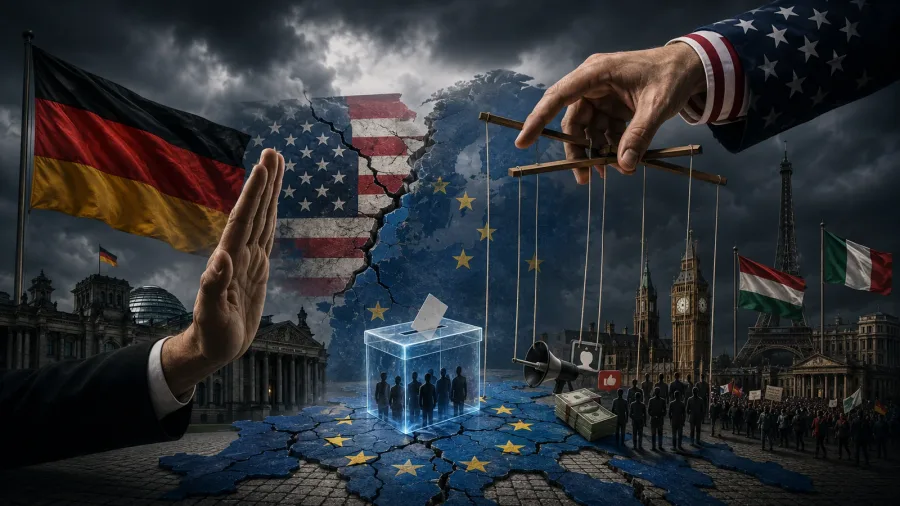
The United States has quietly launched a controversial grant program funneling millions of dollars to Maga-aligned political groups across Europe, triggering an immediate and furious backlash from Germany, which on Wednesday accused Washington of 'unacceptable interference' in its democratic processes. The scheme, officially titled the Democratic Resilience Initiative, marks a dramatic escalation in the increasingly strained relationship between the US and its European allies in mid-2026.
The State Department program, which began disbursing funds in early July 2026, is designed to support organizations working on issues of 'sovereignty, migration, censorship, and lawfare' — the latter a term popularized by former President Donald Trump to describe the alleged weaponization of legal systems against conservative figures. Berlin's foreign ministry issued a statement condemning the initiative as a 'direct challenge to European democratic sovereignty' and warned of potential countermeasures if the funding is not suspended.
What the grants actually fund
According to documents reviewed by multiple European intelligence agencies, the $47 million initial tranche targets think tanks, media outlets, and advocacy groups in Germany, Hungary, Poland, and Italy — all countries where right-wing populist movements have gained significant traction. The grants are structured through intermediary foundations to obscure the direct US government connection, a tactic that European officials describe as 'deliberately evasive.' Recipients include organizations that have previously aligned with Trump's 'America First' ideology and have been critical of the European Union's migration and climate policies.
US officials defend the program as a legitimate effort to promote free speech and combat what they call 'the growing authoritarian creep within EU institutions.' A State Department spokesperson told reporters that 'supporting civil society against censorship is a core American value, regardless of which political party those organizations may sympathize with.' However, the timing — just months before critical state elections in Germany and ahead of France's 2027 presidential race — has raised alarm bells across the continent.
Berlin's red line: sovereignty and electoral integrity
Germany's response has been swift and unusually sharp for a country that has traditionally prioritized transatlantic harmony. Foreign Minister Annalena Baerbock summoned the US ambassador in Berlin for what diplomatic cables described as a 'frank and difficult' exchange, demanding full transparency on all US-funded political activities within German borders. The German domestic intelligence agency, the Bundesverfassungsschutz, had already flagged in its 2025 annual report the growing risk of foreign state funding influencing extremist movements — a warning that now appears prescient.
The core of Berlin's objection lies in the program's framing of 'lawfare' and 'censorship,' terms that German officials argue are being used to undermine the very legal frameworks that protect democratic institutions. 'When a foreign power funds groups that seek to delegitimize our courts and our media, that is not democracy promotion — it is sabotage,' said a senior German interior ministry official who spoke on condition of anonymity due to the sensitivity of the matter. The official confirmed that Berlin is exploring legal avenues under EU law to block or freeze such foreign political financing.
The Russian parallel and European hypocrisy concerns
The controversy has also exposed uncomfortable questions about European consistency on foreign interference. For years, Brussels has condemned Russia for funding far-right and Euroskeptic parties across the continent, imposing sanctions and expelling diplomats. Now, with Washington adopting similar — albeit more sophisticated — tactics, European leaders face accusations of double standards. 'The principle must be the same regardless of whether the interference comes from Moscow or Washington,' argued a European Parliament member from the liberal Renew Europe group during a heated debate in Strasbourg earlier this week.
France has joined Germany in expressing 'deep concern,' with President Emmanuel Macron's office stating that 'the integrity of European democratic processes cannot be subject to foreign financial engineering, no matter the source.' Italy and Spain have also requested urgent briefings from the European Commission on the scope of the US program, signaling that Berlin is far from alone in its outrage.
The broader geopolitical context: a fragmenting West
The grant program did not emerge in a vacuum. Since 2025, transatlantic relations have deteriorated over trade tariffs, NATO burden-sharing disputes, and diverging approaches to China. The US, under its current administration, has increasingly viewed the European Union not as a natural ally but as a regulatory and economic competitor that constrains American interests. Funding Maga-aligned causes in Europe is seen by many analysts as part of a broader strategy to reshape the continent's political landscape in Washington's favor.
This fragmentation comes at a perilous moment for global stability. With the war in Ukraine entering its fourth year and tensions in the South China Sea escalating, the West's ability to present a united front is more critical than ever. 'An ally that funds your domestic opposition is not really an ally,' noted a senior fellow at the European Council on Foreign Relations. 'This is a wake-up call for Europe to develop its own resilience — not just against external threats, but against so-called friends who act like adversaries.'
Economic interdependence as leverage — and as a shield
Despite the heated rhetoric, the dense web of economic ties between the US and Europe acts as a powerful restraint on escalation. Bilateral trade exceeded $1.3 trillion in 2025, and European companies have invested hundreds of billions in American manufacturing and energy projects. Any serious diplomatic rupture would send shockwaves through global markets, a scenario neither side can afford in the current fragile economic environment. This mutual dependency may force a behind-the-scenes compromise, with Washington quietly adjusting the program's scope while Berlin claims a diplomatic victory.
For now, the crisis remains contained to diplomatic channels, but its implications are profound. The episode has shattered any remaining illusions that the post-World War II transatlantic alliance operates on shared values rather than raw interests. As 2026 unfolds, European capitals are scrambling to erect new defenses against foreign political financing — not just from traditional adversaries, but from the other side of the Atlantic.
What comes next: investigations and potential countermeasures
The European Commission is expected to launch a formal inquiry into the US program's compliance with the Digital Services Act and EU political finance regulations by September 2026. Legal experts suggest that Brussels could impose fines on any European entities receiving undeclared foreign political funding, and may even consider designating certain US-based foundations as foreign agents. Such a move would be unprecedented in transatlantic history and would almost certainly trigger retaliatory measures from Washington.
In the meantime, Germany's domestic political scene is bracing for impact. With state elections in Bavaria and Hesse scheduled for late 2026, the revelation of US-funded groups operating within the country has already become a campaign issue. Mainstream parties are calling for stricter transparency laws, while the far-right Alternative für Deutschland (AfD) — widely suspected of being an indirect beneficiary of the grants — has dismissed the controversy as 'elitist hysteria.' The coming months will test whether Europe's democratic institutions can withstand this new form of friendly fire.
A turning point for European sovereignty
Ultimately, the 2026 US grant controversy may prove to be a watershed moment for European strategic autonomy. Just as the COVID-19 pandemic and the Ukraine war exposed Europe's dependencies in health and energy, this episode is revealing its vulnerability in the information and political sphere. Calls for a European Democracy Shield — a comprehensive framework to detect, deter, and counter foreign political interference regardless of its origin — are gaining momentum in Brussels and across major EU capitals.
