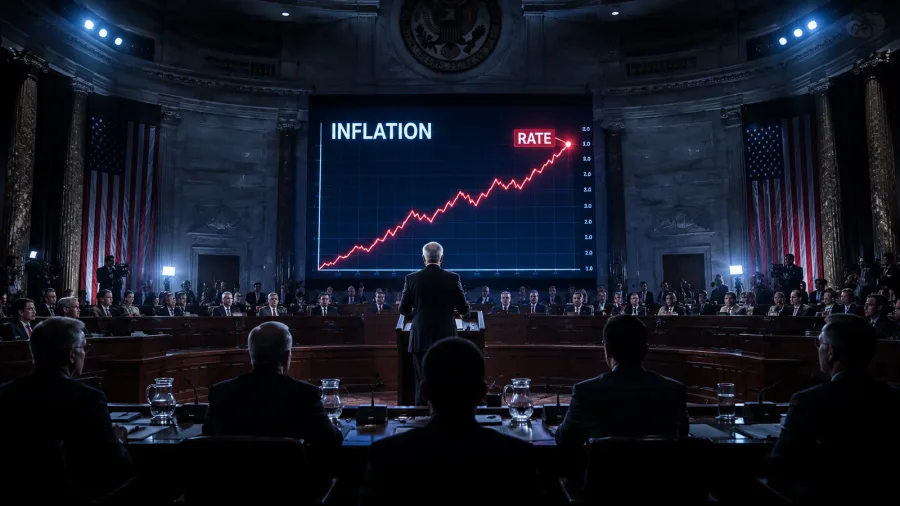
Federal Reserve Chairman Kevin Warsh stepped into the political spotlight on Tuesday, delivering a blunt and unvarnished assessment of the U.S. economy while unveiling a radical blueprint for the central bank's future. In his first testimony before the House Financial Services Committee since assuming the role, the former investment banker and Bush-era economic advisor made it clear that the era of easy money and reactive policymaking is over. His remarks immediately sent ripples through Wall Street, pushing bond yields higher and forcing investors to recalibrate their expectations for interest rates.
A New Framework for Inflation Fighting
Warsh did not mince words about the current inflationary landscape. He argued that the Federal Reserve's approach over the past two years has been too timid, allowing inflation to become entrenched in the services sector and housing market. He declared that the central bank must move from a backward-looking, data-dependent model to a forward-looking, rules-based system. This shift, according to Warsh, is essential to break the psychological grip of inflation on American consumers and businesses. He specifically cited alternative inflation models developed by Stanford University as potential tools for guiding policy, suggesting a move away from traditional metrics that have consistently lagged real-time price changes.
The chairman's hawkish tone was unmistakable. He pushed back aggressively against market speculation of a rate cut in late 2026, signaling that the federal funds rate would likely remain elevated well into 2027. Warsh argued that a period of sustained economic cooling, including a slight uptick in unemployment from its current sub-4% level, was a necessary sacrifice to achieve durable price stability. This stance marks a significant departure from the dual-mandate balancing act of his predecessors, placing an almost singular focus on crushing inflation even at the cost of short-term economic growth.
The Warsh Doctrine and Bond Markets
During the testimony, the yield on the 10-year U.S. Treasury note climbed above 4.5%, a move analysts quickly dubbed the 'Warsh premium.' The chairman detailed an accelerated quantitative tightening program, vowing to offload mortgage-backed securities from the Fed's balance sheet at a pace faster than previously telegraphed. This aggressive liquidity withdrawal is designed to tighten financial conditions further, reinforcing the message that the central bank is serious about restoring its inflation-fighting credibility.
Regulatory Overhaul and Banking Supervision
In a nuanced pivot, Warsh outlined a regulatory agenda that combines stricter oversight for large financial institutions with a lighter touch for smaller community banks. He stressed that the post-2023 regional banking crisis environment requires higher capital buffers for systemically important banks, but he criticized the 'one-size-fits-all' regulatory burden that has stifled smaller lenders. This approach aims to prevent moral hazard at the top while preserving the flow of credit to local economies, a balancing act that drew both support and skepticism from committee members.
Warsh, drawing on his Goldman Sachs background, spoke extensively about accountability. He called for new legislation to make it easier to claw back compensation from executives of failed banks, a proposal that resonated with populist sentiments on both sides of the aisle. He argued that the threat of personal financial loss is the most effective deterrent against reckless risk-taking, signaling a cultural shift from an era of perceived regulatory forbearance to one of strict personal responsibility for banking leaders.
Community Banks and the Real Economy
The chairman emphasized that community banks are the lifeblood of the American economy, particularly in rural areas. He promised a review of Basel III endgame rules to ensure they do not unfairly penalize smaller institutions. This olive branch to Main Street was a key theme of his testimony, positioning the Fed not just as a Wall Street regulator but as a partner in local economic development.
Political Independence and Fiscal Discipline
The most tense exchanges of the day centered on the Fed's political independence. Democratic lawmakers grilled Warsh on his relationship with the administration, given his appointment by former President Trump in early 2026. In a memorable retort, Warsh stated, 'Being a golf buddy of the President does not require me to agree with him,' a line that underscored his intent to assert the central bank's autonomy. However, his pledge to increase communication frequency with Congress raised eyebrows among some who fear it could open the door to short-term political influence over monetary policy.
Warsh also stepped into the fiscal arena, a territory often avoided by Fed chairs. He issued a stark warning about the U.S. fiscal trajectory, calling the current budget deficit-to-GDP ratio unsustainable. He argued that monetary policy alone cannot tame inflation if fiscal policy continues to expand at its current pace, effectively urging the administration and Congress to embrace fiscal restraint. This public call for austerity sets the stage for potential friction between the Eccles Building and the White House in the months ahead.
Global Implications of a Hawkish Fed
Warsh's testimony has profound implications beyond American shores. The signal of a prolonged high-interest-rate environment strengthens the U.S. dollar, creating immediate headwinds for emerging market economies that hold dollar-denominated debt. Countries from Southeast Asia to Latin America are now facing the prospect of capital outflows and increased currency volatility. Central banks in the developing world, which were hoping for a loosening of global financial conditions, may be forced to keep their own rates high to defend their currencies, potentially stifling domestic growth.
For European and Asian economies, the divergence in monetary policy trajectories is becoming starker. While the European Central Bank has been cautiously eyeing rate cuts, a relentlessly hawkish Fed limits their room to maneuver without risking a sharp depreciation against the dollar. The global economy, still recovering from the inflationary shock of the early 2020s, now braces for a period of tighter dollar liquidity. Warsh's first congressional appearance has effectively reset the baseline for global monetary policy, signaling that the world's most powerful central bank is prepared to act alone, even if it creates turmoil in international markets. As 2026 progresses, the ripple effects of this new Fed stance will be the defining narrative for global finance.
