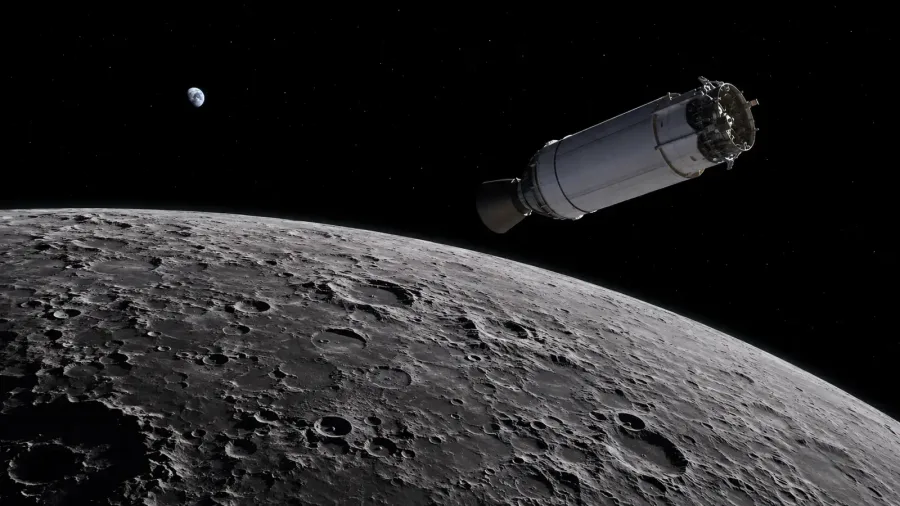
The upper stage of the Falcon 9 rocket that launched two lunar missions on January 15, 2025, is expected to strike the Moon on August 5, 2026, after spending roughly nineteen months in space. Project Pluto, an independent orbital-calculation project, currently predicts an impact on August 5. Its calculation offers a narrow window around a particular minute, but the solution can change as new astrometric observations are added. This article therefore does not present an exact time; the date and location remain a current trajectory estimate.
Which launch left the rocket stage behind?
The stage comes from the Falcon 9 launch that carried Firefly Aerospace's Blue Ghost Mission 1 and a lunar lander from Japanese company ispace. Official releases from Firefly and ispace, both dated January 15, 2025, confirm that the spacecraft launched together from NASA's Kennedy Space Center in Florida. After releasing the payloads, the rocket stage continued on a long path through the Earth-Moon system.
Project Pluto's solution, updated on August 1, points toward an impact near the Moon's western limb as viewed from Earth. Associated Press reported an estimated speed of about 5,400 miles per hour. The event is not expected to pose a danger to Earth. Scientific attention instead centers on the potential crater, its precise location and whether spacecraft already orbiting the Moon can document the result.
Will the impact be visible?
The projected location is close to the lunar far side, so the collision is not expected to be visible to the unaided eye from Earth. Spacecraft around the Moon may have a chance to examine the area afterward. AP identified NASA's Lunar Reconnaissance Orbiter and South Korea's Danuri spacecraft as possible observation platforms. That does not guarantee that either spacecraft will record the event; their orbital positions, lighting conditions and observing schedules will matter.
A previous NASA investigation shows how orbital images can identify a rocket impact after the event. The Lunar Reconnaissance Orbiter later photographed the crater left by an unidentified rocket body that struck the Moon in March 2022. That case provides context for the August 2026 prediction, but the size and shape of any new crater cannot be established before useful images and measurements are collected.
Why the sources serve different roles
Firefly and ispace provide primary records for the launch date, the payloads and the beginning of the mission. Their announcements do not calculate the expected 2026 impact. The current trajectory prediction comes from Project Pluto's processing of independent observations. AP and Space.com report the calculation and explain the possible scientific observations. Keeping those roles separate matters: official mission records establish the object's origin, while updated astronomical measurements support the expected end of its orbit.
What could researchers learn?
Scientists often know more about the mass, construction and approach speed of a human-made object than they do about a natural meteoroid. If orbiters locate a fresh crater by comparing images taken before and after the event, researchers may be able to study how the lunar surface responds to an impact with better constrained initial conditions. Any scientific conclusion will still depend on whether sufficiently clear images and measurements become available.
Project Pluto's page makes clear that the estimate remains open to refinement as observations arrive. August 5 is therefore a well-supported current prediction, while the exact time and location may shift slightly. The verified core of the story is narrower: a spent upper stage associated with the January 2025 dual lunar launch is on a predicted collision course with the Moon, and the event presents no known risk to Earth.
