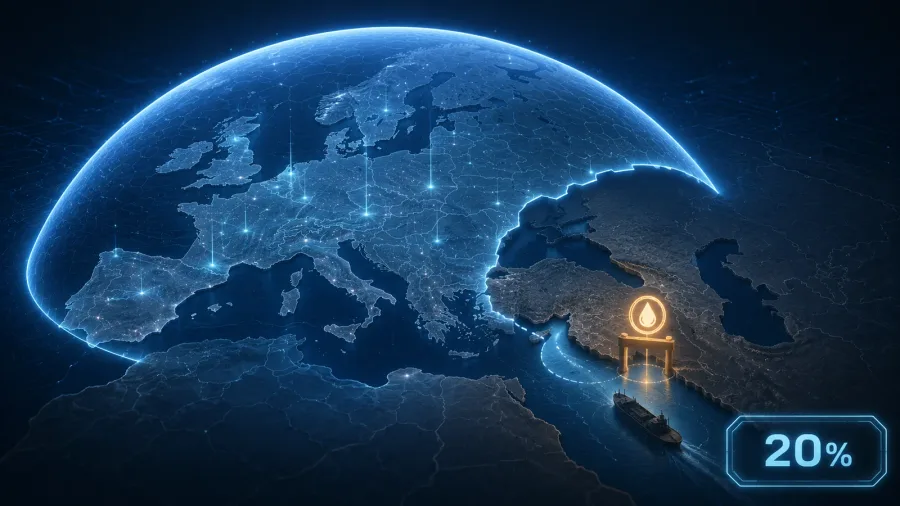
The ink has barely dried on NATO's latest summit communiqué, but the strategic implications are already sending shockwaves through the alliance. A fast-tracked European missile defense initiative, spearheaded by France and excluding Turkey, is reshaping the continent's security architecture. Simultaneously, a groundbreaking proposal to impose a security tax on vessels transiting the Strait of Hormuz threatens to upend global energy markets. For Turkey, a nation straddling two continents and multiple geopolitical fault lines, these twin developments represent a pivotal moment in its increasingly complex relationship with the West in 2026.
A European Shield Without Turkey: The Strategic Divide Widens
The new European Sky Shield Initiative, pushed aggressively by Paris and backed by Berlin, London, Rome, and Madrid, aims to create a layered air defense system capable of neutralizing ballistic and cruise missile threats. However, the coalition's decision to proceed without Turkish participation marks a significant escalation in the long-simmering tensions between Ankara and its NATO allies. This exclusion is not merely a technical oversight; it is a political statement reflecting deep mistrust following Turkey's deployment of the Russian S-400 system and ongoing disputes in the Eastern Mediterranean. By 2026, the schism has grown so wide that Europe is willing to accept a strategic gap on its southeastern flank rather than integrate Turkish systems into its command-and-control network.
Military analysts argue that a defense architecture without Turkey leaves a critical blind spot covering the Black Sea and the Middle East. To compensate, the coalition plans to deploy advanced AESA radars in Greece and Italy, creating a forward-deployed sensor network. This strategy, however, places Greek-Turkish relations under even greater strain, effectively turning Greece into the frontline state for European missile defense. For Turkey, the message is clear: its role as an indispensable bridge between continents is being downgraded. This reality is accelerating Ankara's drive for strategic autonomy, particularly through the rapid development of the Siper long-range air defense system, which is expected to reach full operational capability by late 2026.
France's Gambit for European Military Leadership
France's assertive leadership in this domain reflects President Macron's long-standing vision of European strategic autonomy. With the United States increasingly focused on the Pacific theater, Paris sees a vacuum in European security leadership and is moving swiftly to fill it. Germany, while supportive of the initiative, remains cautious about completely alienating Turkey, fearing repercussions on migration management and counter-terrorism cooperation. This Franco-German divergence adds a layer of complexity to the project's implementation, with Berlin pushing for backdoor channels to keep Ankara partially engaged.
The Hormuz Tax: A New Era of Maritime Economic Warfare
Beyond the missile shield, the NATO summit introduced a novel concept that could redefine maritime security: a security levy on commercial vessels passing through the Strait of Hormuz. With roughly 20% of global oil trade transiting this narrow waterway, the proposed tax is designed to fund the international naval coalition that patrols the area and deter Iranian harassment of shipping. However, critics warn that this sets a dangerous precedent, effectively monetizing freedom of navigation and potentially violating the United Nations Convention on the Law of the Sea. As of mid-2026, the coalition is finalizing the tariff structure, with pilot implementation expected before the fourth quarter.
For global energy markets, the implications are stark. Every dollar of additional cost imposed on tanker traffic is projected to add a premium of $2 to $3 per barrel of Brent crude. This comes at a time when the global economy is already grappling with supply chain disruptions and inflationary pressures. Turkey, as a net energy importer heavily reliant on Middle Eastern crude, is particularly vulnerable. The Turkish Treasury estimates that a sustained increase in shipping costs could widen the current account deficit by several billion dollars annually, complicating the government's stabilization program. In response, Ankara is accelerating negotiations with alternative suppliers in Central Asia and ramping up investments in renewable energy infrastructure to reduce import dependency.
Iranian Reactions and the Threat of Escalation
Iran has already condemned the proposed tax as an act of economic aggression, threatening to treat it as a blockade. Tehran's military exercises in the Gulf of Oman have intensified in 2026, raising the specter of a miscalculation that could spiral into a broader conflict. Turkey, sharing a border with Iran and hosting millions of Iranian tourists and traders, has a vested interest in de-escalation. Turkish diplomats are actively working behind the scenes to mediate, emphasizing that a conflict in Hormuz would destabilize the entire region and trigger a new wave of migration toward Europe.
Turkey's Strategic Recalibration Between East and West
Faced with exclusion from the European defense framework and the economic threats from the Gulf, Turkey is navigating a complex diplomatic tightrope. President Erdoğan's administration is pursuing a multi-vector foreign policy that seeks to maintain NATO membership while deepening ties with Russia, China, and the Turkic states of Central Asia. The concept of 'strategic loneliness' has resurfaced in Turkish policy circles, but this time it is accompanied by a tangible push for self-sufficiency. The defense industry is the primary beneficiary, with the government allocating record budgets for indigenous systems like the KAAN fighter jet and the Siper missile shield.
Economically, Turkey is trying to turn the Hormuz crisis into an opportunity. By positioning itself as a stable energy hub, Ankara hopes to attract transit projects that bypass the volatile Persian Gulf. The Baku-Tbilisi-Ceyhan pipeline and potential Eastern Mediterranean gas corridors are gaining renewed strategic importance. Turkish officials argue that Europe's energy security cannot be achieved without Turkey's cooperation, using this leverage to demand a seat at the table in future defense planning. The autumn 2026 UN General Assembly is expected to be a key battleground for these diplomatic efforts, with Ankara seeking to rally support against the Hormuz tax among developing nations.
The Bosporus Factor: Montreux and Energy Security
As chokepoints in the Middle East become riskier, the Turkish Straits—governed by the Montreux Convention—gain outsized importance. The Bosporus and Dardanelles serve as a critical artery for Black Sea grain and energy exports. While the straits lack the physical capacity to replace Hormuz, Turkey's control over this route gives it a unique bargaining chip. Ankara is using this position to advocate for a more inclusive European security architecture, arguing that excluding Turkey undermines the entire NATO southern flank.
Economic Ripple Effects: A Global Perspective
The twin decisions from the NATO summit are not merely geopolitical maneuvers; they are economic game-changers. The fragmentation of the alliance's defense market could disrupt supply chains for major contractors like Lockheed Martin and Airbus, as Turkish firms are deeply integrated into F-35 logistics and A400M production. While Turkey was removed from the F-35 program, its industrial base continues to produce components for other allied platforms. A complete decoupling would increase costs and delay deliveries across Europe.
On the energy front, the Hormuz tax threatens to accelerate the global transition to renewable energy by making fossil fuels more expensive, but the short-term pain for emerging markets like Turkey is acute. The International Monetary Fund has warned that sustained high oil prices could derail the fragile recovery in several developing economies. For Turkey, which has made significant progress in reducing inflation through orthodox monetary policies in 2026, an external energy shock represents the single greatest risk to economic stability. The government is therefore diversifying gas supplies, signing long-term LNG contracts with suppliers from the United States and Algeria, and fast-tracking the Akkuyu nuclear power plant to reduce reliance on maritime chokepoints.
The Future of NATO Cohesion
Ultimately, these developments test the very fabric of NATO. An alliance that excludes its second-largest army from a core defense mission while imposing taxes on critical trade routes risks creating internal blocs that undermine collective security. As 2026 progresses, the challenge for NATO is to find a formula that accommodates European defense ambitions without permanently alienating Turkey. Failure to do so could accelerate the drift toward a multipolar world where Ankara increasingly acts as a free agent, balancing between Western security guarantees and Eastern partnerships.
The decisions taken at the 2026 NATO summit will reverberate for decades. For Turkey, the path forward requires a delicate balance of military self-reliance, economic resilience, and diplomatic agility. As Europe builds its shield and the Gulf faces new taxation, Ankara must redefine its role—not as a supplicant seeking inclusion, but as a sovereign power capable of shaping the rules of the new geopolitical game.
