A new climate regime for Europe: June 2026 rewrites the history books
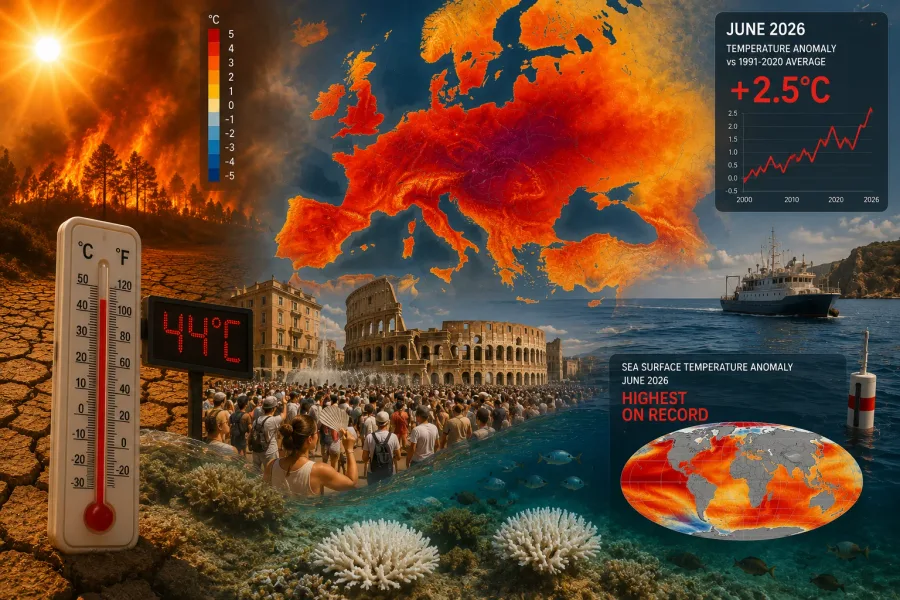
The European Union's Copernicus Climate Change Service (C3S) delivered a stark warning on July 19, 2026: the continent has just lived through its hottest June on record. The data confirms a worrying trend where extreme heat is no longer a sporadic anomaly but a defining, prolonged characteristic of the European summer. Average surface air temperatures soared 2.5 degrees Celsius above the 1991-2020 baseline, shattering the previous record set just three years earlier in June 2023. Scientists are pointing to this rapid succession of heatwaves since May as evidence that the climate system is shifting into a higher gear, pushing past theoretical models into uncharted territory.
The geographical spread of the heat was unprecedented. From the Iberian Peninsula, where Spain's Andalusia region sweltered under 44 degrees Celsius, to the typically cooler climes of Scandinavia, where tropical nights became a reality, no corner of the continent was spared. The persistence of the heat dome over Central and Eastern Europe prevented nighttime cooling, a critical factor in heat-related mortality. This relentless pattern, coupled with below-average spring rainfall, created a tinderbox environment that primed forests for wildfires and placed immense strain on public health systems. The Copernicus report underscores that Europe is warming at roughly twice the global average, making it a climate change hotspot.
The declining influence of El Niño in 2026
One of the most alarming aspects of the June 2026 data is the atmospheric context in which it occurred. The powerful El Niño event that dominated global weather patterns and drove record heat in 2024 and 2025 officially dissipated in early 2026. Historically, the transition to a neutral phase or a La Niña event brings a relative cooling of global surface temperatures. However, 2026 has defied this historical precedent. Despite the Pacific Ocean shifting into a cooler state, global average temperatures have remained stubbornly high, breaching the 1.6 degrees Celsius mark above pre-industrial levels. This decoupling from natural variability strongly suggests that the sheer volume of greenhouse gases accumulated in the atmosphere is now overpowering natural climate drivers.
This has profound implications for climate diplomacy. The symbolic 1.5-degree limit set by the Paris Agreement in 2015 is now viewed by many climatologists as irretrievably lost for the foreseeable future. The June 2026 data will likely serve as a critical reference point in upcoming COP31 negotiations, intensifying calls from vulnerable nations for a global phase-out of fossil fuels. For Europe, the data reinforces the urgency of the European Green Deal's adaptation pillar, shifting the focus from mere mitigation to managing the inevitable impacts of a hotter world.
Oceans under siege: The marine heatwave crisis intensifies globally
While the heat on land was blistering, the conditions beneath the waves were equally catastrophic. The C3S report highlighted that global average sea surface temperatures (SSTs) for June 2026 were the highest on record for the month, continuing a streak of record-breaking months that began in early 2024. The North Atlantic basin, in particular, remains in a state of persistent marine heatwave. Waters off the west coast of Ireland and the United Kingdom registered anomalies of up to 5 degrees Celsius above the norm. This extreme marine heat is decimating commercial fish stocks, forcing cold-water species like cod and mackerel to migrate toward Arctic waters and disrupting the delicate balance of marine food webs.
The Mediterranean Sea, a semi-enclosed basin highly sensitive to global warming, reached surface temperatures exceeding 30 degrees Celsius along the coasts of Italy and Greece. This thermal stress triggered a mass bleaching event in coral reefs and seagrass meadows, which serve as vital carbon sinks and nurseries for marine life. Furthermore, the super-heated waters are accelerating the invasion of non-native species, such as the lionfish from the Indian Ocean, which preys on native Mediterranean biodiversity. The increased evaporation from these hot seas also loads the atmosphere with moisture, setting the stage for the type of catastrophic autumn flooding that has recently devastated regions in Spain and Central Europe.
Economic ripple effects on global fisheries
The sustained ocean heat is sending shockwaves through the global fishing industry, a sector that provides protein and livelihoods for billions. In the North Atlantic, the displacement of pelagic fish stocks is forcing European fishing fleets to travel further north, increasing fuel costs and operational risks. The warming of the Black Sea, a critical fishing ground for Turkey and surrounding nations, has severely impacted anchovy populations, with local scientists at Boğaziçi University's Center for Climate Change and Policy Studies noting a significant drop in catch volumes during the 2026 season. This supply shock is contributing to rising seafood prices at a time when global food inflation remains a persistent concern.
The economic damage extends to aquaculture. Fish farms in the Mediterranean are experiencing higher mortality rates due to heat stress and oxygen depletion in the water column. The insurance sector is also recalibrating risk models for coastal infrastructure, as warmer seas contribute to sea-level rise through thermal expansion and intensify the destructive power of tropical cyclones and mid-latitude storms. In 2026, the concept of a 'Blue Economy' is being redefined, with a new emphasis on climate resilience and the protection of marine carbon sinks rather than purely extractive growth.
Energy and food systems face unprecedented strain in a super-heated world
The June 2026 heatwave exposed critical vulnerabilities in Europe's energy and agricultural infrastructure. The agricultural sector, already reeling from a dry spring, saw soil moisture levels plummet to critical thresholds across the continent's breadbasket regions in France and Germany. The European Commission's Joint Research Centre (JRC) updated its drought maps to show 'severe drought' conditions affecting large swathes of Central Europe. Winter wheat yields are projected to be down by 10 to 15 percent, while summer crops like maize and sunflower are suffering from stunted growth and heat scorch. This production shortfall is tightening global grain markets and pushing up consumer prices for staples like bread and pasta.
The energy sector faced a simultaneous supply-demand crunch. Soaring demand for air conditioning placed an enormous burden on electricity grids, while the supply side struggled with the physical constraints of a hotter world. In France, several nuclear power plants along the Rhône and Garonne rivers had to reduce output because river water was too warm to effectively cool the reactors and environmental discharge limits were reached. Low water levels on Germany's Rhine River disrupted the transport of coal and oil, creating logistical bottlenecks. Even renewable energy sources were impacted; the efficiency of solar photovoltaic panels decreases in extreme heat, and wind patterns became erratic, reducing the reliability of wind power just when it was needed most.
Rethinking urban design for thermal survival
As the 2026 summer heat drags on, cities across Europe and the Middle East are accelerating their adaptation strategies to combat the 'urban heat island' effect. Dense concentrations of concrete and asphalt absorb and radiate heat, making city centers several degrees hotter than surrounding rural areas. In response, Paris has launched an aggressive 'cooling islands' initiative, creating 100 new public spaces equipped with shade trees, misting fountains, and reflective surfaces. Barcelona is pioneering the use of climbing plants on building facades in narrow streets, a low-tech solution that has successfully reduced street-level temperatures by up to 5 degrees Celsius.
These interventions represent a shift from energy-intensive air conditioning toward passive cooling architecture. White roof mandates, the use of permeable pavement to reduce runoff and enhance evaporation, and the creation of urban wind corridors are moving from pilot projects to standard urban planning practice. In Turkey, the Istanbul Metropolitan Municipality is incentivizing rooftop gardens and green terraces as part of its 'Climate-Friendly City' vision. These green infrastructure investments are proving to be dual-purpose, mitigating extreme heat while also absorbing stormwater to reduce the risk of flash floods during the increasingly intense rain events that punctuate the dry spells.
Public health in the era of permanent heatwaves
The human toll of the June 2026 heatwave is measured in hospital admissions and excess mortality. The World Health Organization's (WHO) European Regional Office reported a 40 percent spike in emergency room visits across the continent during the peak heat days. The elderly, children, and those with pre-existing cardiovascular and respiratory conditions are the most vulnerable. Italy's capital, Rome, and Spain's Madrid turned into ghost towns during the afternoon hours as authorities issued red alerts, urging residents to stay indoors. France, haunted by the memory of the 2003 heatwave that claimed 15,000 lives, activated its national heat action plan at the highest level, mobilizing community outreach teams to check on isolated seniors.
Compounding the thermal stress was a severe deterioration in air quality. The high-pressure system that trapped the heat also stagnated the air, causing a buildup of ground-level ozone and particulate matter. Cities like Athens and Milan imposed emergency traffic restrictions and made public transport free to curb emissions. Public health officials are increasingly viewing climate change as a health emergency multiplier, noting that heat-related mortality in Europe could triple by 2050 if adaptation measures are not drastically scaled up. The 2026 data makes it clear that heatwave preparedness is now a permanent, year-round necessity for public health agencies, not just a summer contingency.
