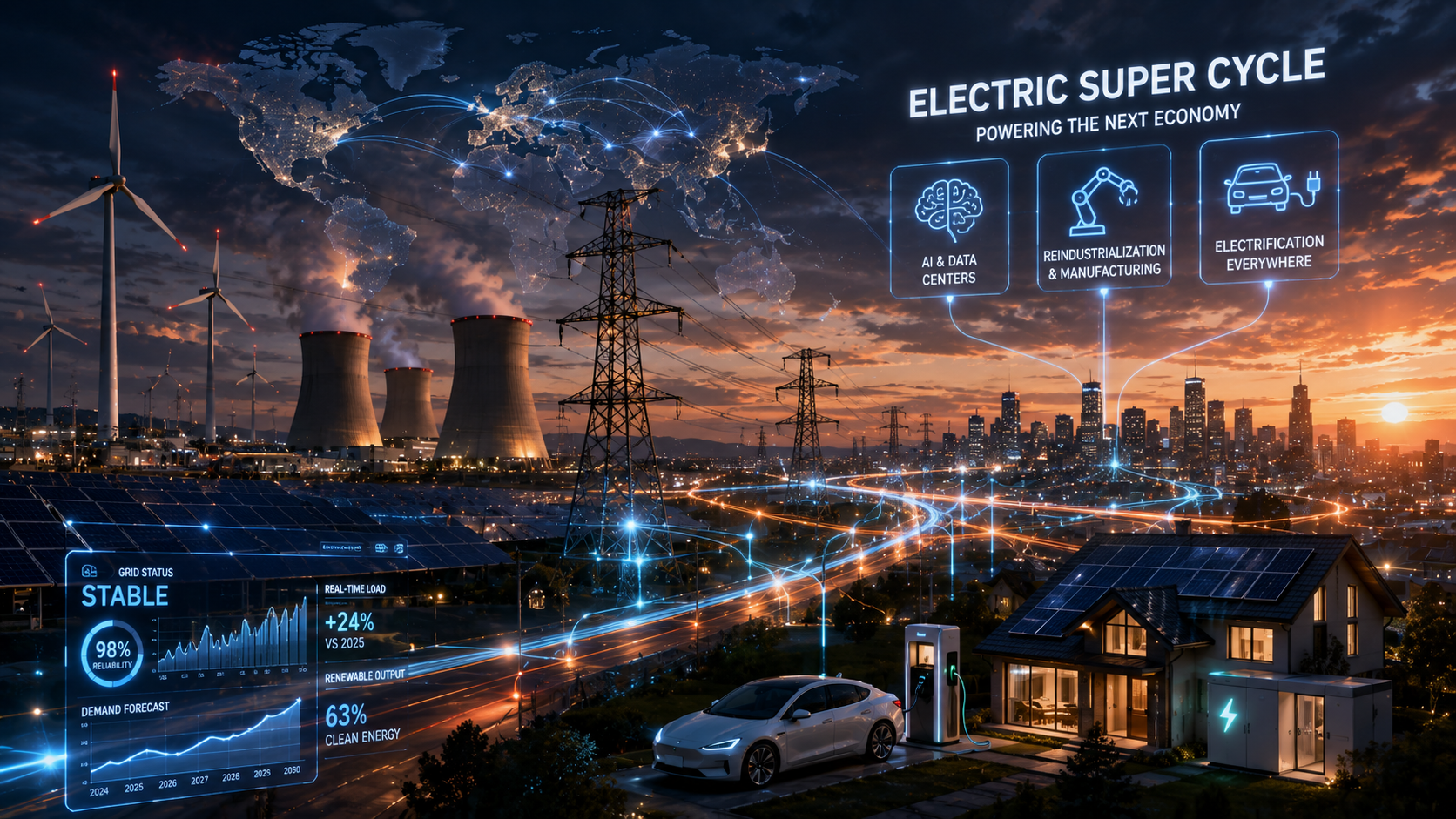
As grid operators brace for the summer of 2026, global electricity demand is charting a vertical ascent. This is not merely a seasonal heatwave spike. According to Andy Lubershane, Managing Director of Research at Energy Impact Partners (EIP), we are in the middle of a structural demand explosion unlike anything seen in decades—what he calls the 'electric supercycle.' Lubershane's latest analysis reveals that grids worldwide are now being tested not just by population growth, but by a profound molecule-to-electron transition seeping into every cell of our economy.
The Perfect Storm: A Vertical Spike in Demand
For the past decade, electricity demand in advanced economies moved in an almost flat line. Efficiency gains largely offset growth. But in 2025, that balance shattered dramatically. According to the data Lubershane highlights, the demand growth projected for the US in 2026 is well above the record levels set last year. It is impossible to pin this on a single factor. The data center construction boom fueled by the AI revolution, colossal factories for chip manufacturing, and the electrification of everything from transport to heating are all slamming the grid simultaneously.
An Economy That Runs on Electrons
Once, electricity demand meant light bulbs and refrigerators. Today, a single AI query consumes ten times the energy of a classic Google search. On the manufacturing front, battery and semiconductor gigafactories rising on both sides of the Atlantic, spurred by government incentives, draw as much power as a small city. Lubershane points out that this trilemma of demand—data centers, re-industrialization, and electrification—is subjecting grids to a permanent stress test, where the concept of 'peak load' now stretches across every month of the year.
Three Technologies Transforming the Grid
Boosting supply is not enough to handle this flood of demand. Lubershane emphasizes that the real revolution lies in how the grid is managed. First, advanced transmission technologies. It is now possible to increase the capacity of existing lines by up to 30% using Dynamic Line Rating (DLR). This system uses sensors and real-time weather data to detect when a line is cooled by the wind, automatically allowing more power to flow. That means a capacity upgrade without pouring a single yard of concrete.
The Rise of Virtual Power Plants and Batteries
Second is the coordination of Distributed Energy Resources (DERs). Millions of rooftop solar panels, home batteries, and EV chargers can be transformed into a giant virtual power plant with the right software. The third critical technology is long-duration energy storage. While lithium-ion batteries have become affordable for 4-hour storage, next-generation solutions like iron-air or flow batteries promise uninterrupted power for over 100 hours. Lubershane predicts that the convergence of these three technologies could make fossil fuel peaker plants economically obsolete well before the 2030s.
The Cost of Uncertainty and the Price of Waiting
The biggest enemy of the supercycle is not a lack of technology, but regulatory inertia. Lubershane's analysis reveals a backlog of over 2,000 gigawatts of projects stuck in interconnection queues—that is nearly twice the entire existing US plant capacity. The queues are now so long that a solar plant applying in 2026 may not be able to deliver power to the grid before 2030. This bottleneck is not only slowing the clean energy transition; it is also pushing data center operators to build their own power islands.
Data Centers Are Building Their Own Grids
This is where market dynamics take a fascinating turn. Hyperscale cloud providers like Amazon, Microsoft, and Google are no longer waiting for the grid. Instead, they are signing direct agreements with nuclear plants or building their own on-site gas turbines. Lubershane notes that this 'behind-the-meter' strategy is breaking the utility monopoly and turning energy into a software problem. By becoming flexible consumers that can shed or ramp up load within milliseconds, data centers may even provide stability back to the grid.
Beyond 2026: Is the Growth Inevitable?
In Lubershane's scenario, the supercycle we are entering is not a temporary fad but a structural shift that will last for decades. By 2030, data centers in the US alone are projected to consume the equivalent electricity of 9 million homes. The global electric vehicle fleet surpassed the 40 million mark by the end of 2025, each unit a battery on wheels. For the grid to handle this load, investment in 24/7 clean sources like advanced nuclear and geothermal is essential on the supply side. On the demand side, as Lubershane underscores, smart meters and dynamic pricing must shift consumption to the sunny midday hours when solar power is abundant.
The electric supercycle has pulled the energy sector out of commodity provision and thrust it into a technology race. The winners will be the countries that embrace this wave not just with more power plants, but with smarter grid software and radical regulatory reform. The question now is: Is your grid ready to ride the wave, or will it suffer the most expensive bottleneck in history?
