A New Energy Milestone in Chongqing
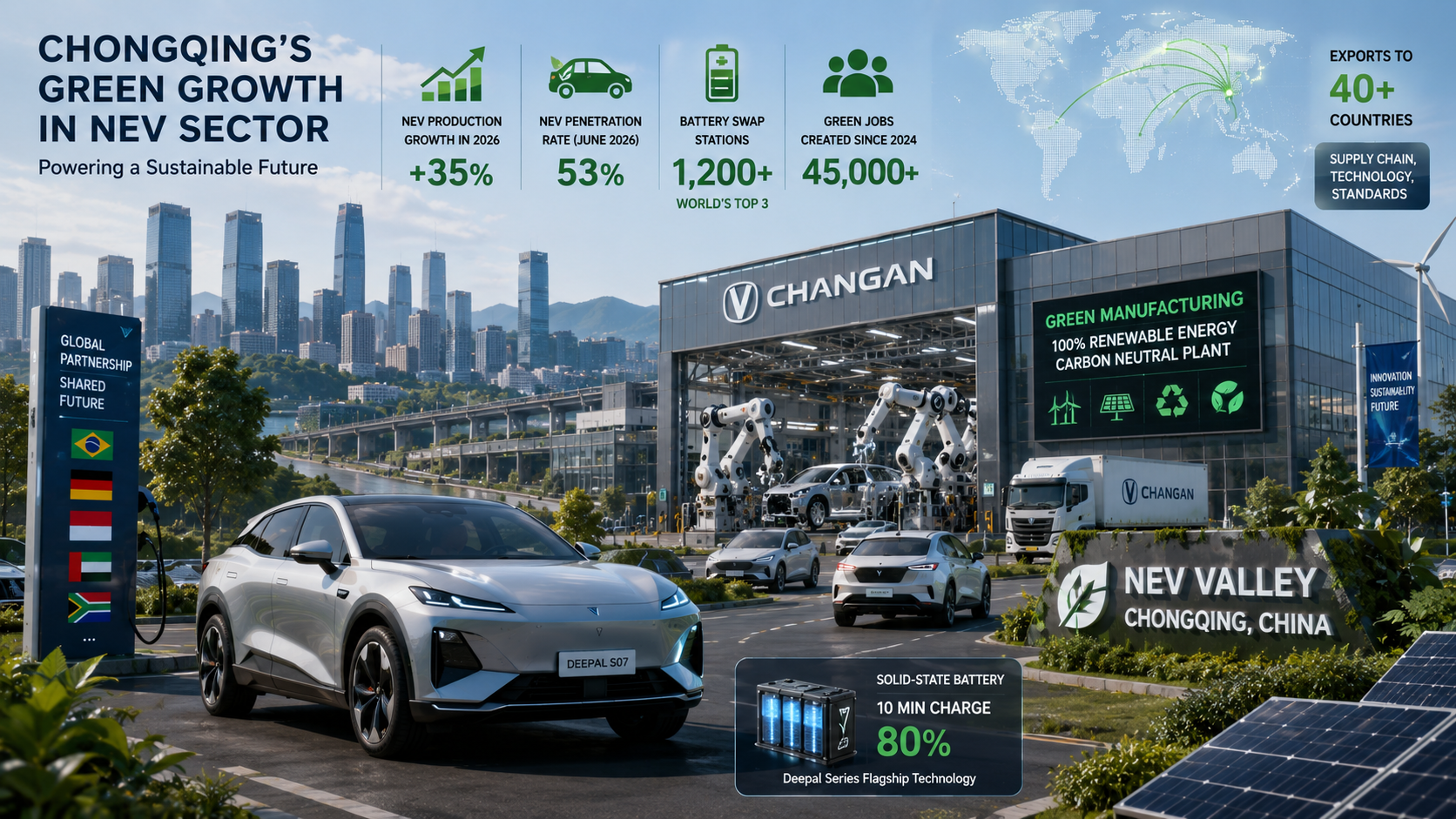
June 20, 2026 – When André Tokarski, Representative of Brazil’s Fundação Maurício Grabois, walked through Changan Automobile’s new energy vehicle (NEV) facility in Chongqing on June 17, it was more than a factory tour. It signaled a growing global conviction that the city has become a blueprint for green industrial transformation. “What I saw here proves that we are part of an ecosystem redefining the boundaries of sustainable mobility,” Tokarski stated, underscoring how Chongqing is emerging as a worldwide reference point. By mid-2026, NEV production in the megacity has soared 35% year-on-year, cementing its role as not just China’s powerhouse but a pivotal node on the global electric vehicle map.
Changan’s Showcase: Innovation Beyond Assembly
The centerpiece of the visit was Changan’s smart factory, capable of producing over 600,000 NEVs annually. The Deepal series, launched in 2025, features a solid-state battery that achieves 80% charge in ten minutes—a leap that sets it apart from competitors. Tokarski noted how such technology could integrate with Brazil’s biofuel infrastructure, creating hybrid models suited to emerging markets. The plant runs entirely on renewable energy and holds carbon-neutral certification, backing Chongqing’s “green growth” claims with hard numbers. Under the local government’s “NEV Valley” initiative launched in 2024, over $8 billion in investments have flowed into the region in the past year alone.
Global Experts Eye Collaboration and Opportunity
Tokarski’s visit was no isolated gesture. In May 2026, the Chongqing International NEV Forum drew over 200 experts from 47 countries, including EU green deal advisors, infrastructure investors from Southeast Asia, and African Union representatives. Data presented at the forum revealed that Chongqing’s supply chain already exports batteries, motors, and software solutions to more than 40 nations as of 2025. “This is no longer a manufacturing miracle—it’s an export of knowledge and standards,” said Prof. Klara Meier of TU Berlin, illustrating how the city has rapidly adapted to Europe’s stringent regulations.
The Brazil Connection: A Symbiotic Growth Model
Tokarski’s agenda went beyond technology transfer. Brazil’s “Route 2030 Neo” program, announced in 2025, aims to forge strategic alliances with Chinese OEMs to boost domestic NEV production. The Chongqing experience offers a scalable model for developing countries, especially in an era of shortened supply chains and software-defined vehicle architectures. Tokarski projected that “hybrid systems powered by biomethane from Brazil’s swamps, combined with Changan’s battery management algorithms, could save 500,000 tonnes of carbon emissions annually.”
The Engines of Green Growth in 2026
Three drivers underpin Chongqing’s 2026 success story: government incentives, deepening R&D investment, and global integration. China’s “NEV 2.0” policy, enacted this year, shifts focus from purchase subsidies to battery swapping networks and smart grid infrastructure. Chongqing now boasts the world’s third-largest battery swap network, with over 1,200 stations operational by end-2025. Meanwhile, automakers like Changan and Seres are developing lidar-free perception systems for autonomous driving, offering alternatives to Tesla and Waymo.
The Data Tells the Transformation
In 2025, 42 out of every 100 vehicles sold in Chongqing were NEVs; by June 2026 that ratio has climbed to 53%. Municipal data shows NEV manufacturing contributes 18% of the city’s gross industrial output. On the employment front, 45,000 new green-collar jobs have been created since 2024. The World Bank’s “E-Mobility in Emerging Markets” report, released last week, described Chongqing as “a textbook example of inclusive green growth.”
Looking Ahead: Challenges and the Roadmap
Despite these positive indicators, Chongqing’s NEV sector faces critical tests. Reliance on rare-earth elements, shrinking export markets amid global recession fears, and inadequate charging infrastructure in rural areas threaten the sustainability of growth. Yet industry leaders remain cautiously optimistic. Changan CEO Zhu Huarong announced, “By 2030 we aim to cut battery costs by another 40% and break lithium dependence with sodium-ion technology.”
Building Resilience Amid Global Uncertainty
Perhaps Chongqing’s most impressive move has been strengthening its local ecosystem against supply chain fragility. As Europe and North America raise protectionist tariffs, Chongqing-based manufacturers have diversified exports by 22% compared to 2025, pivoting to ASEAN, Middle Eastern, and Latin American markets. Tokarski’s visit dovetails with this strategy: in high-potential markets like Brazil where regulations are still maturing, the approach is “bring standards first” to secure long-term influence. The next five years will be a crucial test of whether this smart growth model can scale globally.
So, how can developing nations best leverage China’s green leap—or are they already falling behind in the race?
