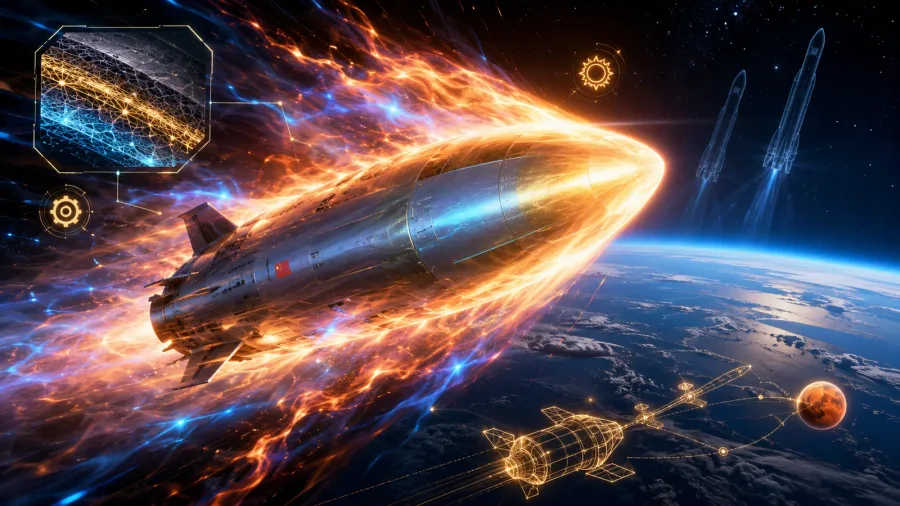
In a development that could significantly alter the balance of power in the commercial space race, Chinese scientists have successfully created and tested a new thermal protection material capable of withstanding temperatures exceeding 2,500 degrees Celsius. Announced on July 13, 2026, the breakthrough directly addresses the single most expensive engineering challenge for reusable launch vehicles: surviving the violent heat of atmospheric re-entry without requiring extensive refurbishment after every flight.
The science behind the 2,500-degree shield
The new material, developed by engineers at one of China's top aerospace research institutes, represents a significant leap forward in ultra-high temperature ceramics (UHTC) and ceramic matrix composites (CMC). Unlike traditional ablative heat shields found on older spacecraft — which burn away during re-entry and must be replaced — this new composite is designed to be fully reusable. It maintains its structural integrity even under the extreme thermal flux encountered when a vehicle slams into the Earth's atmosphere at hypersonic speeds. Early reports indicate the material is not only incredibly heat-resistant but also remarkably lightweight, a critical factor when calculating the cost-per-kilogram of orbital payload delivery.
Outperforming current Western technology
For years, NASA and private firms like SpaceX have relied on proprietary thermal protection tiles, such as the TUFROC (Toughened Uni-piece Fibrous Reinforced Oxidation-Resistant Composite) used on the X-37B space plane. However, these existing solutions often impose strict operational limits on re-entry trajectories to manage peak heating. The new Chinese material appears to allow for much more aggressive, fuel-efficient descent profiles. By pushing the thermal threshold to 2,500 degrees Celsius, Chinese rockets could theoretically shed speed faster in the upper atmosphere, reducing the overall fuel required for a controlled landing and significantly increasing the payload margin for commercial and scientific missions.
How Beijing is reshaping the global space economy
The strategic implications of this technology extend far beyond the laboratory. China has been systematically excluded from the US-led Artemis Accords and faces heavy restrictions under the International Traffic in Arms Regulations (ITAR), which limit the export of American space technology. By independently solving the reusability puzzle, Beijing is not just catching up with SpaceX's Falcon 9 and Starship programs; it is creating a parallel, fully sovereign supply chain for reusable spaceflight. This positions the China National Space Administration (CNSA) to offer competitive commercial launch services to nations in the Global South, including those in Africa, South America, and Southeast Asia, who may be locked out of Western launch markets due to geopolitical or financial barriers.
The commercial launch market faces disruption
In 2026, the global satellite launch market is booming, driven by mega-constellations for broadband internet and Earth observation. SpaceX currently dominates with its Falcon 9 workhorse, but a reusable Chinese rocket equipped with this new heat shield could undercut prices dramatically. Analysts estimate that if the technology proves reliable in upcoming orbital tests, the cost of launching a kilogram to Low Earth Orbit (LEO) could drop by an additional 30 to 40 percent within the next five years. This would accelerate the plans of smaller space agencies — including Turkey's ambitious Milli Uzay Programı (National Space Program) — to deploy indigenous satellite networks and pursue deep-space exploration without relying on expensive foreign launch providers.
Implications for Turkey and emerging space nations
Turkey, which sent its first citizen to space in 2024 and aims for a hard lunar landing by 2028, stands at a crossroads. The nation's defense and aerospace giants, such as Roketsan and TÜBİTAK Uzay (Turkey's Scientific and Technological Research Council's Space Institute), are actively developing liquid-fueled rocket engines. However, Turkey currently lacks a reusable atmospheric re-entry vehicle. The emergence of a commercially available, Chinese-developed thermal shield could allow Ankara to leapfrog decades of costly material science research. By integrating this shield into future indigenous launch vehicles, Turkey could drastically shorten its timeline for achieving independent, low-cost access to orbit — a critical strategic asset for a country situated in a volatile geopolitical region.
Navigating the geopolitical minefield
Despite the clear technological benefits, procuring or co-developing such a system with China would place Turkey in a delicate diplomatic position. As a NATO member, Turkey is deeply integrated into Western defense architectures, and any significant technology transfer from Beijing would likely trigger scrutiny from Washington and Brussels. The risk of secondary sanctions or exclusion from Western space supply chains is real. Turkish policymakers must therefore weigh the immediate engineering advantages against the long-term strategic costs. A potential middle ground could involve joint research with neutral partners or licensing agreements that distance the technology from direct military applications, focusing instead on civilian scientific payloads and commercial satellite deployments.
The future of hypersonic travel and planetary defense
Beyond reusable rockets, a material that can withstand 2,500 degrees Celsius has immediate applications in hypersonic weapons and intercontinental ballistic missile (ICBM) defense systems. China's breakthrough could accelerate the development of maneuverable hypersonic glide vehicles that can survive the intense heat of sustained atmospheric flight at Mach 10 or higher. This adds a new layer of complexity to global strategic stability, as existing missile defense radars and interceptors are largely designed for predictable ballistic trajectories. The dual-use nature of this thermal protection technology ensures that it will be a focal point of arms control discussions and intelligence assessments for the remainder of the 2020s, potentially triggering a new cycle of investment in defensive counter-hypersonic systems by the United States and its allies.
Opening the door to interplanetary civilization
Looking beyond the immediate military and commercial implications, this heat shield represents a fundamental step toward making humanity a multi-planetary species. The ability to cheaply and safely aerobrake in the atmospheres of Mars or Titan is essential for future colonization missions. By 2026, with China's new material poised for its maiden orbital test, the dream of routine, low-cost interplanetary travel feels closer than ever. If the technology diffuses into the global market — or stimulates a new wave of competitive innovation in the West — the next decade could witness the emergence of a truly accessible space economy, where the barriers to entry for nations like Turkey are defined not by physics, but only by ambition and political will.
