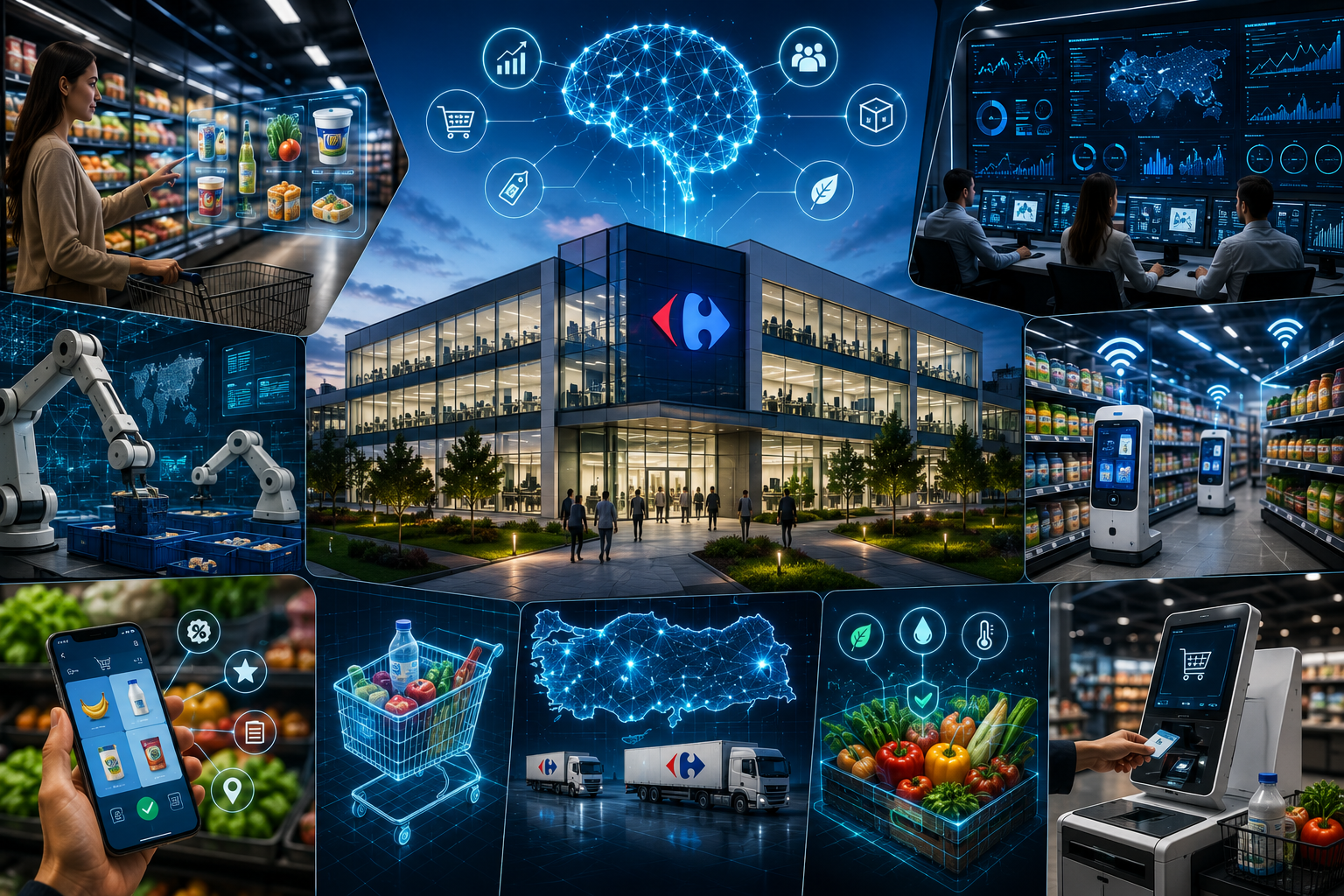
Imagine a supermarket that knows what you'll buy before you even reach the aisle. Shelves that run their own inventory counts, checkouts without cashiers, payments that happen invisibly. CarrefourSA's newly announced R&D Center, officially approved by Turkey's Ministry of Industry and Technology, is being built to turn precisely this vision into reality. The center marks a first among Turkey's chain supermarkets and signals a fundamental shift in how the country's $25 billion organized retail sector operates.
The company began piloting AI-powered inventory management systems in 2025, and now plans to scale these solutions nationwide under the new R&D umbrella. "This center is not just a laboratory—it's a transformation hub that will reshape the backbone of our business model," CarrefourSA's CIO stated at the launch event. With 47 full-time researchers already on board and plans to hire 30 more by year-end 2026, the initiative is being positioned as the engine of the company's next growth phase.
Why Now? The Strategic Timing of CarrefourSA's R&D Bet
CarrefourSA's R&D move is the culmination of a three-year digitalization strategy that the retail giant has been quietly executing. In 2025, the company's technology investments surged 43% year-over-year to reach 1.2 billion Turkish lira, and 2026 projections point toward the 2 billion lira mark. Obtaining government approval from the Ministry of Industry and Technology provides more than prestige—it unlocks substantial tax incentives, including full R&D expenditure deductions from the tax base and social security premium support for research personnel. CarrefourSA is expected to benefit from approximately 400 million lira in incentives across the 2026–2028 period.
The center's launch also coincides with a critical inflection point in Turkish retail. E-commerce penetration in grocery jumped from 3.2% in 2023 to 8.7% in early 2026, forcing brick-and-mortar chains to rethink their value proposition. CarrefourSA's response is to turn physical stores into technology-rich experience hubs rather than mere transaction points. The R&D Center will serve as the laboratory where these next-generation store concepts are born and refined before nationwide rollout.
Who's Inside the Lab?
The center currently houses 47 full-time researchers—18 specializing in data science and machine learning, 12 in software engineering, and the remainder in retail operations and user experience design. Recent job postings emphasize natural language processing and computer vision expertise, hinting at upcoming voice-enabled shopping assistants and visual product recognition systems. By December 2026, the team is expected to expand to 77 researchers, making it one of Turkey's largest private-sector retail technology units.
AI Meets the Aisles: What the R&D Center Is Actually Building
Priority number one inside the R&D Center is AI-driven demand forecasting. Tested across 12 pilot stores in Istanbul last year, the system reduced fresh produce waste by 18%—translating to annual savings exceeding 60 million lira. The algorithm ingests weather data, holiday calendars, regional events, and even social media sentiment to generate daily ordering optimizations for each individual store. In 2026, CarrefourSA aims to roll this out to all 650+ locations, projecting total waste reduction savings of over 300 million lira annually.
The second major workstream is dynamic pricing. Integrated with electronic shelf labels already deployed in 200 stores, the pricing engine analyzes competitor prices, inventory levels, and real-time demand curves to recommend price adjustments. Quietly activated in 5 stores during the final quarter of 2025, the system delivered a 2.1% improvement in gross margins within two months. The R&D Center is now refining the algorithms to handle promotional pricing and bundle offers, with a target of 5% margin uplift across all categories by mid-2027.
How Will AI Reshape the Customer Experience?
One of the center's most ambitious projects involves in-store customer behavior analytics. Using camera systems and sensor fusion, researchers track how shoppers move through aisles, where they pause, and which products they interact with. This data feeds into store layout optimization algorithms. CarrefourSA's data team projects that these insights could boost average basket size by 7% to 12%. The system also powers personalized in-app promotions delivered to customers in real time based on their current location within the store.
The Retail Tech Arms Race Heats Up Across Turkey
CarrefourSA's move intensifies an already fierce technology competition in Turkey's organized retail sector. Rivals have been making their own plays: Migros opened an AI lab in 2025, while discount giant BIM poured over 800 million lira into logistics automation. Yet CarrefourSA's government-certified R&D Center gives it a structural advantage—the formal integration into the national R&D ecosystem provides IP protection benefits and opens doors to university partnerships that informal labs cannot access.
Industry analysts project Turkey's organized retail market will reach 850 billion lira by end of 2026. In this high-stakes environment, technology has shifted from a differentiator to a survival imperative. "You can no longer compete on price alone," CarrefourSA's CEO remarked. "The winners will be those who save customers time, eliminate waste, and deliver personalized experiences at scale." The R&D Center is the company's bet that the future of retail belongs to those who master the intersection of physical stores and digital intelligence.
What's Next on CarrefourSA's Tech Roadmap?
The company's 2026–2027 roadmap features a cashierless store concept as the headline initiative. The first fully autonomous CarrefourSA Mini is slated to open in Istanbul during the first quarter of 2027, using a combination of computer vision, shelf sensors, and mobile payment integration. A blockchain-based supply chain tracking system is also in development, promising end-to-end traceability for fresh produce—from farm to shelf—aimed at preventing food safety incidents before they occur.
The Bigger Picture: AI-Powered Retail Becomes the Norm
CarrefourSA's R&D Center investment represents the clearest signal yet that technology in Turkish retail has graduated from window dressing to core infrastructure. According to McKinsey's 2025 Global Retail Report, retailers investing in AI and data analytics enjoy an average EBITDA margin advantage of 3.5 percentage points over their lagging peers—a gap expected to widen further through 2026. CarrefourSA is betting that capturing even a fraction of this advantage will justify the nine-figure lira investment the R&D Center represents.
The market seems to agree. Following the announcement, CarrefourSA shares (CARFA) on Borsa Istanbul gained 4.8% in a single week, prompting analysts to revise 2026 target prices upward. Investors appear to be pricing in the operational efficiency gains before they fully materialize. The R&D Center's opening has also sparked a broader conversation about how quickly Turkey's retail workforce will need to reskill—supermarkets are now competing with tech firms for software engineers and data scientists.
What Does This Mean for the Future of Shopping?
CarrefourSA's R&D Center will likely trigger a domino effect across Turkey's retail ecosystem, accelerating the sector's transformation into a technology industry in its own right. From suppliers and logistics firms to software companies and academic institutions, the ripple effects will reshape employment structures over the next five years. The notion that supermarkets now employ AI specialists, data scientists, and machine learning engineers signals a permanent structural shift.
As CarrefourSA doubles down on its technology vision, the question is no longer whether AI will transform retail—but how quickly consumers will adapt. Will Turkish shoppers embrace cashierless stores and algorithm-driven recommendations as readily as they adopted contactless payments? How will this reshape neighborhood shopping habits in a country where personal relationships with local grocers still matter? Share your thoughts below.
