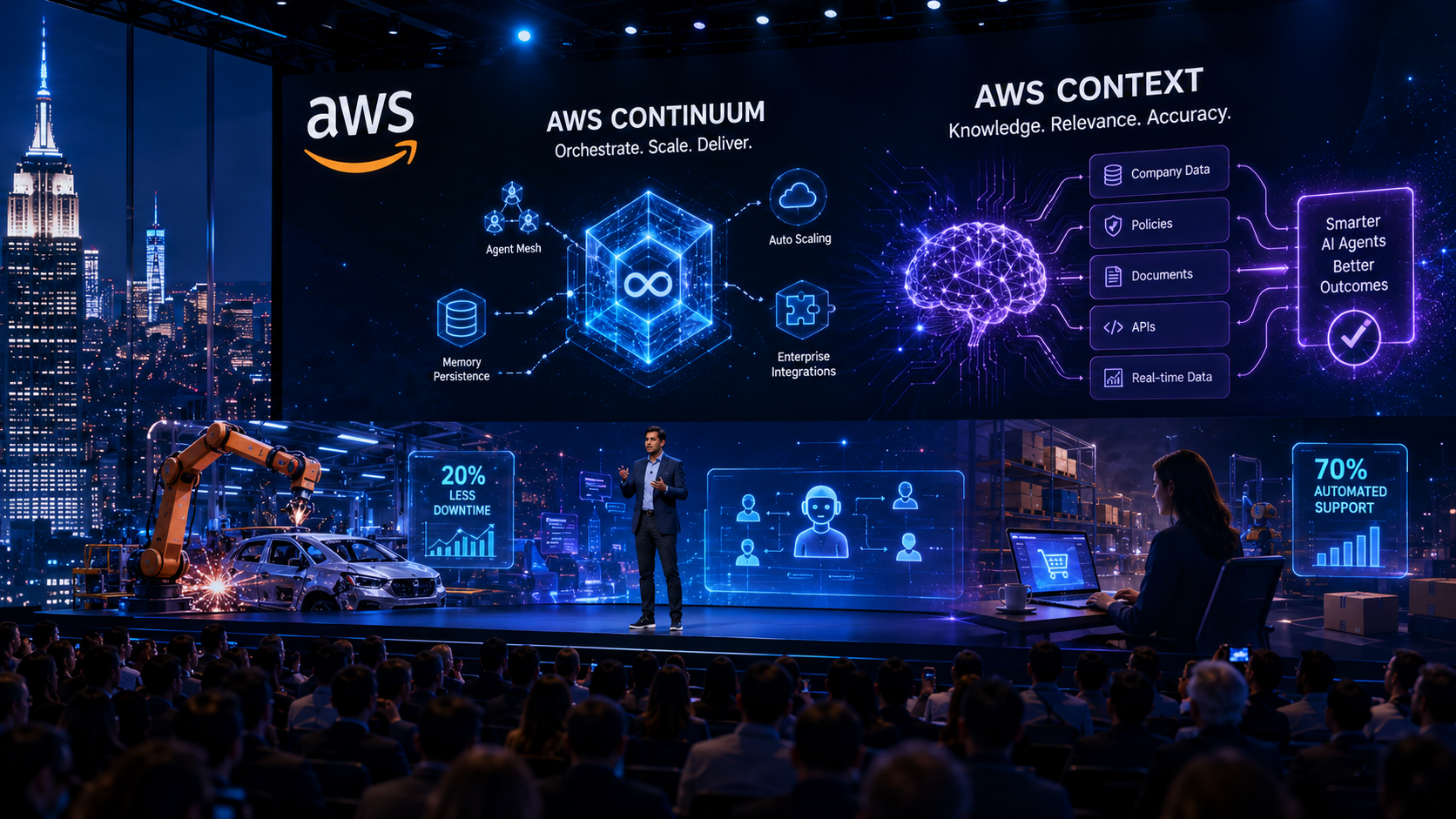
Introduction: The Agentic AI Breakthrough Unveiled in New York
Today, June 20, 2026, the Javits Center in New York is buzzing with a palpable sense of momentum. At AWS Summit New York 2026, the cloud giant didn't just talk about artificial intelligence—it delivered a practical blueprint for how enterprises can finally unlock the full potential of AI agents. Two flagship announcements—AWS Continuum and AWS Context—are poised to change the game, promising to transform isolated chatbots into powerful, organization-wide workforces. In a world where 73% of AI projects still fail to scale beyond the pilot phase, these tools are not incremental updates; they are the missing links between AI hype and measurable business impact.
AWS Continuum: The Engine That Scales Agent Workflows
For years, companies have struggled with a common bottleneck: building a single AI agent that works in a sandbox is easy, but deploying hundreds of them across departments while maintaining reliability is a nightmare. AWS Continuum tackles this head-on. It's a fully managed service that orchestrates multi-agent workflows, handles state and memory persistence, and seamlessly integrates with enterprise systems like ERP, CRM, and legacy databases. According to AWS VP of AI Services Swami Sivasubramanian, early adopters have slashed deployment times by up to 60%, turning months-long integration projects into weeks.
From Pilot Purgatory to Production at Scale
Consider a global financial services firm that participated in the private beta. Before Continuum, their IT team spent six months tuning a customer support agent for mortgage inquiries; scaling it to 20 concurrent users caused crashes. With Continuum's built-in auto-scaling and fault tolerance, they deployed 200 agents in three weeks. The result? A 35% reduction in average response time and a 50% drop in human escalations. Continuum's secret sauce lies in its "Agent Mesh" architecture, which allows agents to collaborate—one agent can hand off complex tasks to specialized sub-agents without losing context. For enterprises, this means AI is no longer a fragile prototype but a resilient factory of digital workers.
AWS Context: Turning Generic Bots into Business Savants
If Continuum is the engine, Context is the brain. Large language models are powerful, but they lack deep knowledge of company-specific policies, product catalogs, or regulatory requirements. AWS Context addresses this by creating a dynamic knowledge layer that agents can query in real time. Think of it as giving each agent an instant, comprehensive briefing book that updates automatically as the business evolves. During a live demo at the Summit, an agent powered by Context accurately answered a complex supply chain query by cross-referencing live inventory data, contractual obligations, and weather forecasts—all within seconds.
Precision Meets Policy: How Context Drives Accuracy
For a U.S.-based healthcare provider, the impact was profound. They deployed agents to pre-process insurance claims, a domain where errors can cost millions. Using Context, the agents ingested policy documents, HIPAA compliance rules, and historical claim data. The outcome: claim processing accuracy hit 98.7%, and what previously took an average of two days was completed in under four hours. AWS reports that agents using Context demonstrate a 45% higher task completion rate compared to those relying solely on foundational models. By grounding agents in authoritative business data, Context reduces hallucinations and builds the trust that enterprise adoption demands.
Real-World Impact: Where AI Agents Deliver Hard ROI
The tire hits the road in manufacturing and retail. A leading automotive parts manufacturer connected shop-floor sensors with Continuum-orchestrated agents and fed procedural manuals into Context. Now, when a machine shows anomalous vibrations, an agent instantly diagnoses the issue, orders spare parts, and schedules a technician. Early data shows a 20% reduction in unplanned downtime, translating to millions in saved revenue. Meanwhile, a top-tier e-commerce platform let agents handle 70% of post-purchase queries—from tracking to returns—without human intervention. Customer satisfaction (CSAT) scores jumped 15 points, and agent cost per interaction dropped by 40%.
From 2025's Lessons to 2026's Reality
Last year, many enterprises dipped their toes into agentic AI but were burned by integration complexity and vague ROI. The announcements at AWS Summit New York 2026 directly address those pain points. With 78% of enterprises planning to increase AI agent budgets this year according to a fresh McKinsey survey, the market is clearly voting for practical, scalable solutions over science experiments. The question is no longer "Can AI agents work?" but "How fast can we operationalize them?" Continuum and Context provide the answer, backed by SLAs and enterprise-grade security that CIOs demand.
The Future of Work: Collaboration, Not Replacement
Perhaps the most important narrative at the Summit is that these agents are designed to augment human talent, not replace it. By automating repetitive, high-volume tasks—data entry, first-line support, report generation—they free employees to focus on creative problem-solving and strategic initiatives. AWS emphasized that all agents built with these services come with built-in guardrails: explainability dashboards, human-in-the-loop override mechanisms, and comprehensive audit trails. As Ana Romero, AWS's Head of Responsible AI, stated, "We're building agents that are not just powerful, but accountable."
Your First Step Toward an Intelligent Enterprise
For business leaders watching the live stream from Jakarta to London, the message is clear: the agentic revolution is no longer a future trend—it's today's competitive imperative. Start by identifying processes with high manual volume and clear decision rules; that's where agents shine first. Then, leverage Continuum to orchestrate and Context to inform. The roadmap has been drawn. Now, the only wrong move is standing still. Will your organization lead the next wave of AI-driven productivity, or be swept away by it?
