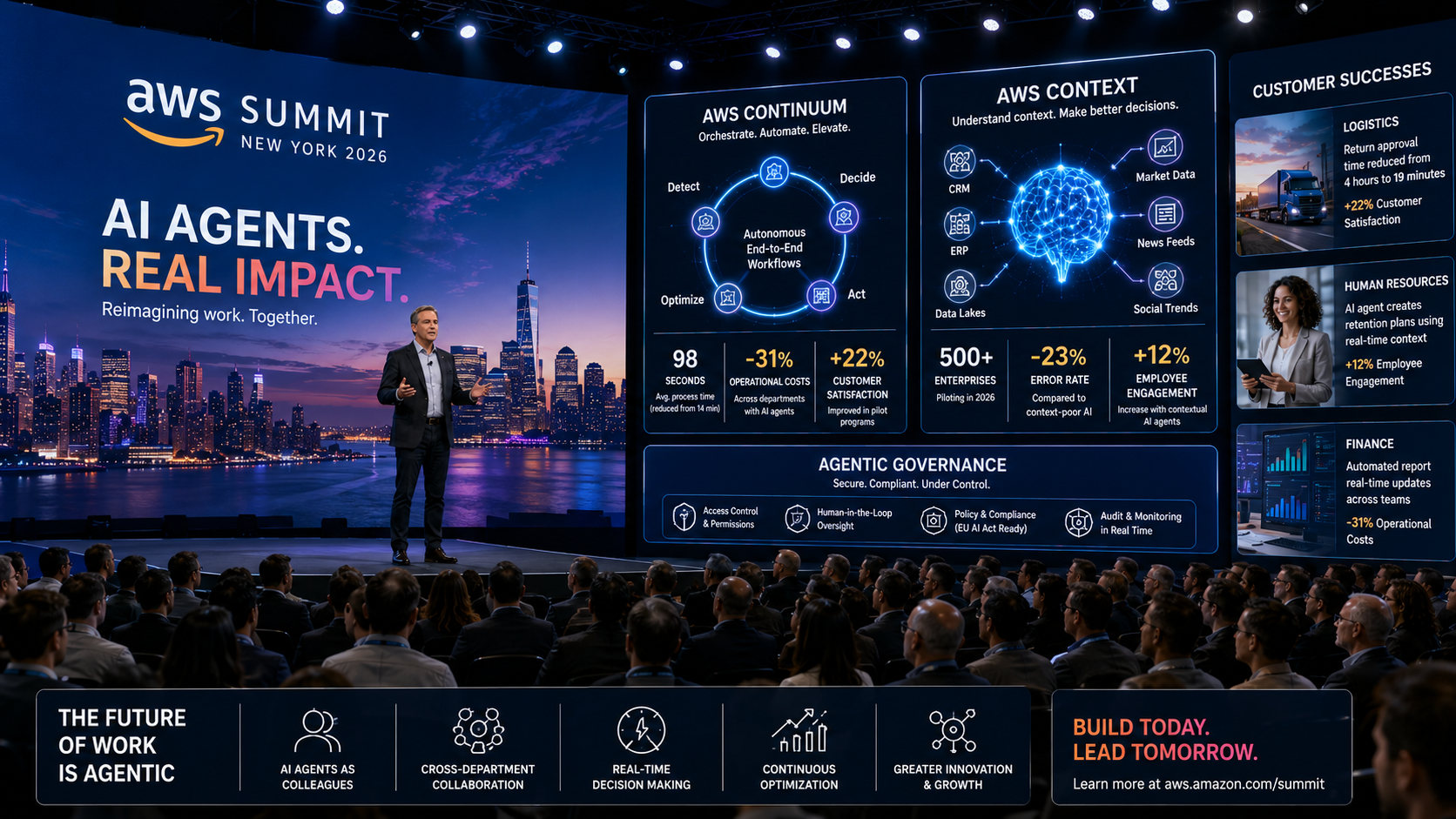
On the morning of June 21, 2026, as executives took the stage at New York’s Javits Center, they delivered more than a product roadmap — they unveiled a blueprint for the future of work. Following the foundational agentic AI capabilities introduced in 2025, this year’s AWS Summit New York pivoted to an even bolder promise: embedding AI agents into every corner of the enterprise and turning them into true digital coworkers. Two announcements — AWS Continuum and AWS Context — eclipsed even the most anticipated cloud infrastructure updates, signaling a new maturity in how organizations will leverage agentic intelligence.
AWS Continuum: Architecting Frictionless Workflows
The first major reveal, AWS Continuum, is an orchestration layer engineered to let AI agents execute long-running, multi-step business processes without human handoffs. Until now, agents typically thrived at single tasks — drafting an email, generating a report — but couldn’t chain together the sequence of actions that email triggered: updating a customer record, generating an invoice, and scheduling a follow-up. Continuum closes exactly that gap. According to a 2025 Gartner report, 67% of enterprises cited process fragmentation as the number one barrier to agentic AI adoption; AWS designed Continuum to dismantle that barrier entirely.
Real-Time Workflow Self-Healing
Continuum’s most striking capability is its self-correcting logic. When an agent hits an unexpected exception — say, a supply chain disruption — it doesn’t stall and wait for a human override. Instead, it queries alternative suppliers, runs cost comparisons, and reroutes the purchase request autonomously. During an onstage demo, AWS showed this bringing down the average resolution time for a procurement hiccup from 14 minutes to just 98 seconds. That’s not merely an efficiency gain; it’s a structural shift that lets human employees focus on judgment-intensive work rather than operational triage.
AWS Context: Giving Agentic Intelligence Real Depth
The second critical innovation, AWS Context, equips agents with a deep understanding of enterprise memory and real-time data streams. An agent can now factor in current company policies, prior interactions, market dynamics, and even seasonal patterns when making decisions. A 2025 McKinsey study found that context-starved AI outputs contributed to a 23% error margin in corporate decision-making — a risk AWS Context aims to slash by anchoring every agent response in a rich tapestry of institutional knowledge.
The Connective Tissue of Enterprise Data
Context securely plugs into internal CRM, ERP, and data lake environments while also pulling from external signals — news feeds, currency fluctuations, social sentiment — through governed APIs. In a live demo, an HR agent detected a flight-risk employee and didn’t just alert the manager; it synthesized industry salary benchmarks, the employee’s promotion timeline, and the latest internal survey results to draft a concrete retention plan. AWS executives noted that the capability had been piloted with over 500 enterprise customers by mid-2026, yielding an average 12% boost in employee engagement scores.
Weaving Agents Across the Organization
AWS’s central message in New York was that isolated agent deployment is no longer enough. Throughout 2025, internal AWS analyses showed that organizations running agents simultaneously across multiple departments achieved up to a 31% reduction in operational costs. Continuum and Context form the technical backbone of that cross-departmental weave. Now, a report generated by a finance agent can instantly update the marketing agent’s budget forecast — Context supplies a shared data understanding, while Continuum ensures the workflow doesn’t break at the seams.
Lessons from 2025 Pilot Programs
A case study presented at the Summit featured a European logistics firm that launched an order-tracking agent in 2025 but failed to connect it to returns processing, leading to stagnant satisfaction scores. After integrating early-access versions of Context and Continuum, their return-approval time plummeted from 4 hours to 19 minutes, and their Net Promoter Score climbed 22%. AWS expects horizontal integration success stories like this to multiply rapidly through the second half of 2026.
The Future of Work at the Agentic Tipping Point
Continuum and Context represent far more than a product launch — they usher in what AWS is calling “agentic governance.” Organizations can now centrally manage which authority level each agent holds, which data it can access, and at which decision thresholds it must escalate to a human. For heavily regulated industries like finance and healthcare, this is a linchpin. It eases compliance with the EU AI Act’s human-oversight requirements that took effect in 2025, while accelerating the legitimacy of agentic AI on the trust curve of enterprise adoption.
Looking Toward 2027: Projections and Perils
Analysts project that once Continuum and Context become generally available later in 2026, more than 40% of Fortune 500 companies will move toward organization-wide agentic AI usage. Yet cautionary voices remain: emergent complexity in multi-agent ecosystems and the persistent threat of data poisoning still rank high on CISO agendas. Even so, the prevailing sentiment at the New York Summit was unmistakable — AI agents are no longer peripheral assistants; they are becoming strategic coworkers. So here’s the question every leader must now answer: what is the single most critical decision you would entrust to an AI agent in your business today?
