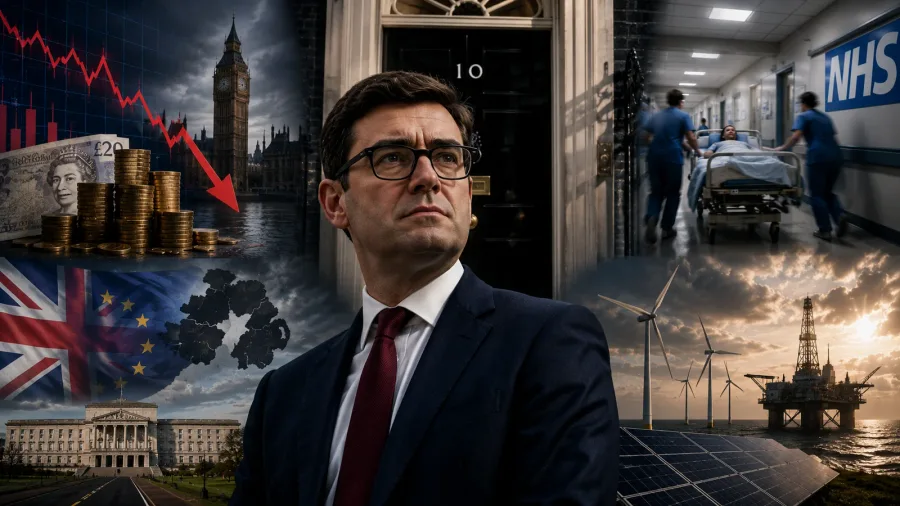
Economic headwinds and the fiscal reality awaiting Burnham
When Andy Burnham walks through the famous black door of 10 Downing Street on Monday, he will inherit an economy that has flatlined for the better part of two years. Britain's GDP growth in 2026 is projected at a meager 0.4 percent, while inflation, though down from its 2023 peak, remains stubbornly above the Bank of England's two percent target at 3.1 percent. The new prime minister's room for fiscal maneuver is razor-thin.
The Institute for Fiscal Studies has warned that Burnham faces the tightest public spending constraints of any incoming prime minister since the 1970s. His campaign promise of no return to austerity clashes with the arithmetic of a national debt that has surpassed 100 percent of GDP. The bond markets, which punished his predecessor Liz Truss so ruthlessly in 2022, are watching closely. Any hint of unfunded spending pledges could trigger a gilt market sell-off that would immediately constrain his government's options.
Burnham's first major decision will be the autumn budget, expected in October 2026. His chancellor, Rachel Reeves, has already signaled that some tax increases are unavoidable. The political challenge is immense: the Labour Party's traditional base demands increased public spending, while middle England swing voters who delivered Burnham's majority are deeply tax-averse. How he squares this circle will define the economic narrative of his premiership.
Labour's fiscal strategy and market expectations in 2026
The new government is exploring a range of revenue-raising measures, including closing carried interest loopholes for private equity executives and imposing a windfall tax on energy companies that have booked record profits. However, City of London analysts warn that aggressive taxation could accelerate the exodus of talent and capital from the UK, a trend that has been evident since Brexit. Burnham must convince both the markets and the public that his government can deliver growth without fiscal profligacy.
The National Health Service in intensive care: A system under strain
The NHS is the closest thing Britain has to a secular religion, and it is in deep crisis. As of mid-2026, the waiting list for elective procedures stands at 7.8 million people. Emergency departments are regularly declaring critical incidents, with ambulance response times for category two calls — which include strokes and heart attacks — averaging over 90 minutes against a target of 18 minutes. For Burnham, who served as Health Secretary from 2009 to 2010, this is both a policy challenge and a deeply personal mission.
The structural problems are decades in the making: an aging population, chronic underinvestment in primary care, and a workforce that is exhausted and demoralized after the COVID-19 pandemic. The British Medical Association estimates that the NHS is short of 10,000 doctors and 50,000 nurses. Burnham has pledged to recruit 15,000 new GPs by 2030, but training a family doctor takes at least five years. The crisis demands immediate action that the pipeline of medical education cannot supply.
Burnham's health team is betting heavily on technology to bridge the gap. A proposed NHS Digital Front Door would allow patients to consult with AI-powered triage systems before seeing a human clinician. Pilot programs in Manchester have shown a 30 percent reduction in unnecessary emergency department visits. But the British public remains skeptical of algorithmic medicine, and the powerful health unions view automation with deep suspicion.
Social care reform: The long-delayed reckoning
No discussion of the NHS is complete without addressing social care. The failure of successive governments to reform the funding of care for the elderly has created a bottleneck that clogs hospital beds. Burnham has promised a cross-party commission on social care, but similar promises have been made — and broken — by every prime minister since Tony Blair. The demographic pressures are now so acute that further delay is simply not an option.
Northern Ireland and the Brexit unfinished business
The Windsor Framework, agreed in 2023, was supposed to resolve the post-Brexit trading arrangements for Northern Ireland. In practice, it has only partially succeeded. The Democratic Unionist Party, which collapsed the Stormont power-sharing government for two years over the protocol, remains deeply dissatisfied. Burnham will need to engage with Brussels and Belfast simultaneously to prevent Northern Ireland's fragile political settlement from unraveling.
The European Union has indicated a willingness to discuss further flexibilities on veterinary checks and parcel deliveries, but it will not reopen the core text of the Withdrawal Agreement. Burnham's challenge is to deliver enough tangible improvements to satisfy unionist concerns without triggering a domino effect of renegotiation demands from other EU member states. The appointment of a dedicated Northern Ireland minister with cabinet rank signals the priority Burnham attaches to this file.
The broader UK-EU relationship is also ripe for a reset. Burnham has spoken of a "new European partnership" that would include a veterinary agreement to ease food exports, mutual recognition of professional qualifications, and a youth mobility scheme. These are modest ambitions compared to the single market membership that many in his party desire, but they represent a significant departure from the confrontational approach of previous Conservative governments.
The UK-EU reset: Ambition versus political reality
While Brussels welcomes Burnham's conciliatory tone, EU officials privately caution that the UK cannot cherry-pick the benefits of membership without accepting the obligations. Freedom of movement remains a red line for the British electorate, and Burnham knows that any deal perceived as backsliding on Brexit would be politically toxic. The path to closer cooperation is narrow and littered with political tripwires on both sides of the Channel.
Climate ambition meets energy security in a volatile world
Britain hosted COP26 in Glasgow in 2021 and has legally binding commitments to reach net zero carbon emissions by 2050. But the global energy crisis triggered by the Ukraine war has scrambled the politics of climate action. British households, still reeling from energy bills that remain 40 percent above pre-crisis levels, are in no mood for policies that could increase costs further. Burnham must decarbonize without deindustrializing or impoverishing voters.
His flagship policy is Great British Energy, a publicly owned clean power company that will invest in offshore wind, solar, tidal, and nuclear projects. The ambition is to decarbonize the electricity grid by 2030, five years earlier than the previous target. Energy experts say the goal is technically achievable but will require a pace of deployment unprecedented in British history. Planning reform, grid connection delays, and supply chain bottlenecks are formidable obstacles.
The prime minister has also pledged to lift the ban on onshore wind farms in England, a policy that his predecessor maintained in the face of backbench Conservative opposition. Local consent will remain a requirement, but the decision-making framework will shift to favor development. The first test will come in rural constituencies where opposition to wind turbines remains intense, even among Labour's own newly elected MPs.
Green jobs and the just transition challenge
Burnham frames his climate agenda as an economic opportunity, promising 500,000 new green jobs by 2030. The transition will require massive retraining programs for workers in carbon-intensive industries. The closure of the Port Talbot steelworks in 2024, with the loss of 3,000 jobs, serves as a stark reminder of the social costs of decarbonization. Burnham's commitment to a "just transition" will be measured by how effectively his government supports communities like Port Talbot through the disruption.
