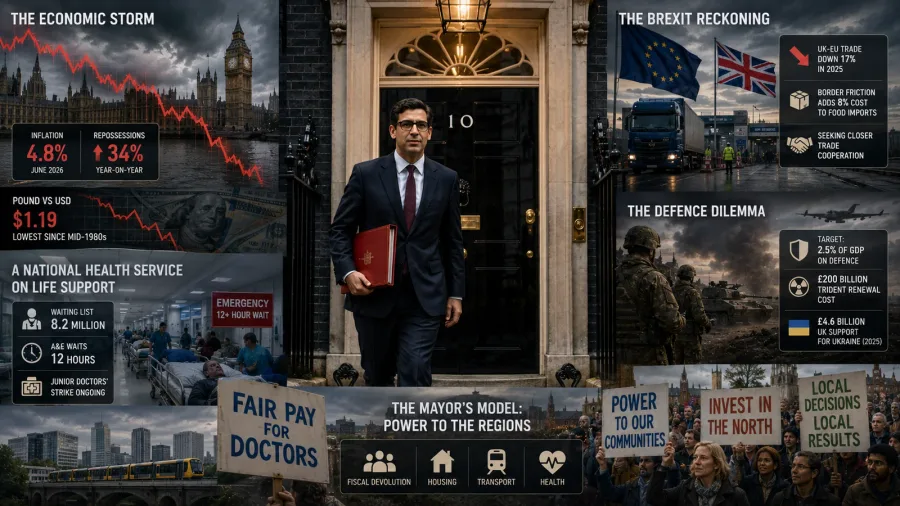
Andy Burnham walked through the iconic black door of 10 Downing Street on Monday, July 19, 2026, carrying the hopes of a weary electorate but facing a cascade of crises that would test even the most seasoned statesman. The former mayor of Greater Manchester, a region in northwest England, arrives with a reputation as a straight-talking political brawler—but governing Britain in 2026 will demand more than rhetorical flair.
The economic storm brewing over Westminster
Britain's public finances are in a state of acute distress, and Burnham's new government inherits a fiscal position that analysts at the Institute for Fiscal Studies describe as 'perilously constrained'. Inflation remains sticky at 4.8% as of mid-2026, stubbornly defying the Bank of England's repeated interest rate hikes that have pushed borrowing costs to their highest since the 2008 financial crisis. Mortgage holders across the country are buckling under the strain, with repossessions up 34% year-on-year.
The centrepiece of Burnham's campaign—a Green Prosperity Fund promising £28 billion annually for renewable energy and green jobs—now confronts the cold reality of gilt market vigilantes. Treasury officials have privately warned the new prime minister that any unfunded spending pledges risk triggering a bond market sell-off reminiscent of the 2022 Truss-Kwarteng mini-budget disaster. The first budget, expected in September 2026, will be a high-wire act balancing ambitious investment against market credibility.
Sterling under sustained pressure from global investors
The pound has weakened to $1.19 against the dollar, a level not seen since the mid-1980s, reflecting deep-seated investor anxiety about Britain's twin deficits. Burnham's chancellor must quickly establish credibility with the City of London while simultaneously delivering on promises to redistribute wealth to the neglected north. The tension between these two imperatives will define the government's first hundred days.
A national health service on life support
As a former health secretary, Burnham knows the anatomy of the National Health Service better than most—but the patient has deteriorated dramatically since he last held the portfolio. The NHS waiting list has swollen to 8.2 million people, emergency departments are recording 12-hour waits, and the junior doctors' strike that began in 2023 continues to disrupt services across England. Burnham has pledged to resolve the dispute within his first month in office, but the British Medical Association's pay demands would require an additional £4 billion that the Treasury simply does not have.
Burnham's solution draws on his Manchester experience: a 'neighbourhood health centre' model that integrates general practitioners, pharmacists, physiotherapists, and mental health specialists under one roof. The pilot programmes in Greater Manchester showed promising results, reducing A&E admissions by 12% in participating areas. Scaling this nationally, however, requires a workforce that does not currently exist. The UK has a shortage of 6,000 GPs and 12,000 nurses, and training pipelines take years to produce results. Burnham's team is exploring accelerated recruitment from Commonwealth countries, but ethical concerns about poaching medical staff from developing nations complicate the strategy.
The long-delayed social care reform
Successive prime ministers have promised and failed to fix England's social care system, and Burnham cannot afford to join that list. The sector faces a funding gap of £8 billion annually, and local councils are warning of widespread provider bankruptcies by early 2027. Burnham has proposed a cross-party commission modeled on the pensions consensus of the early 2000s, but cross-party cooperation in the current fractured political landscape remains a distant prospect.
The Brexit reckoning Britain cannot postpone
Six years after formally leaving the European Union, the economic evidence is damning. UK-EU trade volumes contracted by 17% in 2025, border friction adds an estimated 8% cost to food imports, and the automotive sector is haemorrhaging investment to continental competitors. Burnham campaigned on a platform of 'closer trade cooperation' with Brussels, but the political minefield of renegotiation remains as dangerous as ever. His proposal for a veterinary standards agreement—essentially aligning UK food safety rules with EU regulations to reduce border checks—has already been branded a 'betrayal' by the right-wing press.
The prime minister's approach reflects a careful calibration: pursue practical improvements in trade without reopening the ideological wounds of the 2016 referendum. Brussels diplomats signal cautious optimism, noting that Burnham's pragmatism contrasts favourably with the confrontational style of previous Conservative administrations. Yet any deal requiring even partial acceptance of the European Court of Justice's jurisdiction will face fierce opposition from the Conservative benches and the Brexit-supporting electorate that Burnham needs to keep his parliamentary majority intact.
The defence spending dilemma amid transatlantic tensions
Washington's new administration, elected in 2024, has made clear that European allies must dramatically increase defence spending or face reduced American commitment to NATO. Burnham has pledged to reach 2.5% of GDP on defence, but the £200 billion cost of renewing Britain's Trident nuclear deterrent looms over every other spending decision. The UK's continued military support for Ukraine—amounting to £4.6 billion in 2025 alone—adds another layer of fiscal pressure that cannot be ignored.
Can the 'Burnham model' of devolution work nationally?
Burnham's entire political identity is built on the argument that power must flow away from Westminster to England's regions. As mayor of Greater Manchester, he demonstrated that integrated transport, housing, and health policies could deliver tangible improvements. The question now is whether a prime minister can genuinely devolve power when the gravitational pull of Whitehall is so strong. His proposal for 'full fiscal devolution'—giving regional authorities control over property taxes and a share of income tax revenues—would represent the most radical restructuring of the British state since devolution to Scotland and Wales in 1999.
The political obstacles are formidable. Many Labour MPs from London and the South East view devolution with suspicion, fearing it could disadvantage their constituents. The civil service, concentrated in Westminster, has institutional resistance to dispersing its own power. Burnham's success or failure in this project will determine whether his premiership is remembered as genuinely transformative or merely another chapter in Britain's long story of centralised governance.
As Burnham settles into 10 Downing Street, the weight of these intersecting crises—economic, social, diplomatic, and constitutional—will test whether the 'King of the North' can truly rule the entire kingdom. The honeymoon will be brief; the challenges, enduring.
