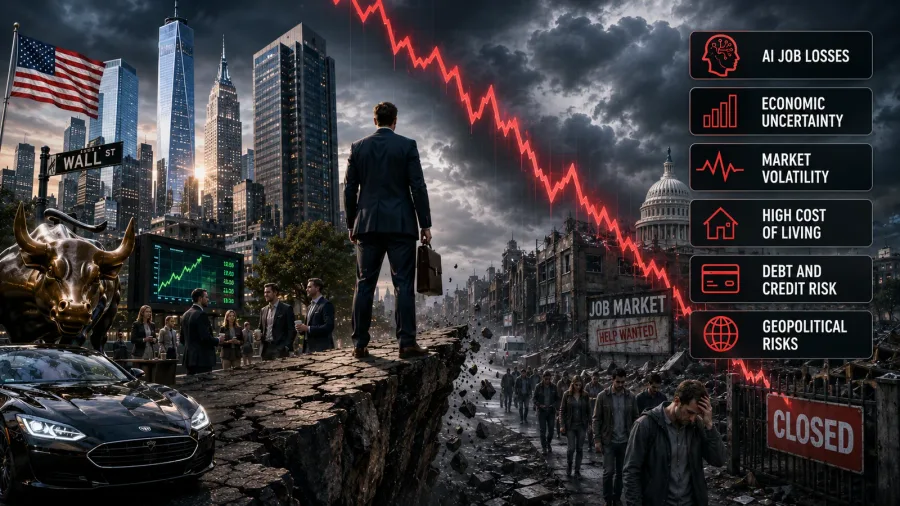
When Sarah Chen, a senior machine learning engineer with a PhD from Stanford and a $350,000 annual compensation package at a major cloud computing company, received her termination notice in March 2026, she wasn't being fired for poor performance. Her role was being 'optimized' — an increasingly common corporate euphemism for the wholesale replacement of human expertise with artificial intelligence systems that her own work had helped train. Chen's story encapsulates the brutal paradox reshaping the American economy in 2026: the very professionals who built the AI revolution are now its first high-profile casualties.
The numbers paint a stark picture of this reversal. According to Layoffs.fyi, a tracking platform that has become essential reading in Silicon Valley, more than 210,000 tech workers have lost their jobs globally in the first half of 2026 alone. In the United States, the figure stands at approximately 142,000 — a 35% increase over the same period in 2025. But the composition of these layoffs has shifted dramatically. Data from Revelio Labs, a workforce intelligence firm, shows that 68% of those laid off from major US tech companies in 2026 held senior individual contributor or management positions, compared to just 35% in 2023. The axe is now falling upward.
The great replacement: How AI is consuming high-skill jobs
The transformation sweeping through America's corporate landscape represents something fundamentally different from previous waves of automation. When manufacturing workers lost jobs to robots in the 1980s and 1990s, the prescription was clear: get an education, develop specialized skills, move into knowledge work. That escape hatch is now closing. Generative AI systems like OpenAI's GPT-5, Anthropic's Claude 3.5, and Google's Gemini Ultra — all released or substantially upgraded between late 2025 and mid-2026 — have demonstrated capabilities that directly compete with tasks performed by lawyers, financial analysts, software developers, and management consultants.
A landmark study published in June 2026 by the Brookings Institution analyzed 1,016 occupations and found that 340 of them — representing 42 million American jobs — face 'high exposure' to AI-driven transformation within the next five years. What distinguishes this wave is its class character. The median salary of highly exposed occupations is $88,000, well above the national median of $59,000. 'For the first time in modern economic history, technological disruption is disproportionately affecting higher-income, higher-education workers,' said Dr. Muro, the study's lead author. 'The protective effect of advanced degrees is eroding in real time.'
Corporate America's new math: Algorithms over headcount
The financial logic driving this transformation is relentless. Klarna, the Swedish fintech giant with major US operations, announced in February 2026 that its AI customer service system now handles the equivalent work of 700 full-time employees, with higher satisfaction scores than human agents. CEO Sebastian Siemiatkowski told investors that the company's headcount had dropped from 5,000 to 3,200 over 18 months, while revenue per employee more than doubled. 'The economics are undeniable,' he said during the company's Q1 2026 earnings call. 'Every percentage point of AI automation drops roughly $40 million to our bottom line annually.'
This calculus is spreading far beyond Silicon Valley. Major law firms including Latham & Watkins and Kirkland & Ellis have deployed AI contract review systems that reduce the time spent on due diligence by 60-80%. Investment banks are using machine learning models for initial pitch deck creation and financial modeling — tasks that once occupied armies of well-compensated junior analysts. Consulting giant McKinsey & Company internally projects that AI tools could handle 45% of the work currently done by its associate-level consultants by 2028. The implications for the traditional professional career ladder are profound and destabilizing.
The psychological unraveling of America's economic winners
The mental health consequences of this professional upheaval are becoming impossible to ignore. Dr. Richard Friedman, a professor of clinical psychiatry at Weill Cornell Medicine in New York, has documented what he terms 'high-achiever precarity syndrome' among his patients in finance and technology. 'These are people who have done everything right — elite educations, relentless work ethics, constant upskilling,' Friedman explained in a widely-cited JAMA Psychiatry article published in April 2026. 'When the ground shifts beneath them, the psychological damage is severe because their entire identity architecture is built on professional success and perceived indispensability.'
Crisis hotlines and executive coaching services are reporting surging demand from this demographic. The Executive Mental Health Institute in Manhattan saw a 90% increase in new patient inquiries in the first quarter of 2026 compared to the previous year. 'The presenting symptoms are remarkably consistent,' said Dr. Alicia Chen, the institute's clinical director. 'Severe anxiety, insomnia, a profound sense of betrayal, and what I can only describe as existential vertigo. Many of these patients genuinely believed their expertise made them immune to economic disruption. That belief system is collapsing.'
The exodus from elite coastal cities accelerates
The combination of job insecurity and persistent remote work options is reshaping America's economic geography. US Census Bureau data for 2026 shows that San Francisco County lost 38,000 residents between July 2025 and June 2026, a 4.2% population decline that ranks among the steepest for any major US county. Manhattan's population declined by 2.8% over the same period. The beneficiaries are mid-tier cities with lower costs of living: Austin added 27,000 new residents, Denver gained 22,000, and Nashville grew by 19,000.
This migration is creating second-order economic effects that are generating political backlash. In Austin, the median home price has surged to $620,000 — a 25% increase since January 2025 — driven partly by an influx of remote-working tech professionals earning coastal salaries. 'We're importing Silicon Valley's inequality along with its workers,' said Austin City Council Member Vanessa Fuentes, who has proposed a progressive tax on remote workers earning above $200,000. 'Our teachers, nurses, and service workers are being priced out of their own city by people whose economic insecurity is still, frankly, the envy of most Americans.'
The policy vacuum: Washington's inadequate response to white-collar displacement
Federal policy has been slow to address the emerging crisis of professional worker displacement. The Workforce Innovation and Opportunity Act, the primary federal legislation governing employment services, was designed for an era when technological disruption primarily threatened manufacturing and routine clerical work. Its provisions — focused on vocational training and blue-collar transition programs — are poorly suited to professionals who already hold advanced degrees. A Government Accountability Office report released in May 2026 found that only 3% of federal workforce development spending targets workers with bachelor's degrees or higher.
The political response has been fragmented and often contradictory. The Biden administration's 2025 executive order on AI and the workforce established a task force that has produced several reports but little concrete action. Meanwhile, congressional Republicans have generally opposed new spending on worker transition programs, framing them as unnecessary government intervention. 'We're facing a market-driven transformation that demands a new social contract for professional workers,' said Dr. David Autor, a labor economist at MIT who has briefed both parties on the issue. 'But neither party has a coherent vision for what that contract should look like.'
The unprecedented rise of white-collar tech unions
Perhaps the most significant response to professional precarity has come from workers themselves. The Alphabet Workers Union, formed in 2021 as a minority union without collective bargaining rights, has transformed into a formidable organizing force. In February 2026, the union won a landmark National Labor Relations Board election to represent 4,200 Google software engineers, securing full collective bargaining rights. Similar campaigns are underway at Amazon Web Services, Microsoft, and Salesforce.
The Communications Workers of America, which has been supporting these organizing drives, reports that tech worker union interest has increased exponentially. 'In 2023, we received maybe two dozen serious inquiries from tech professionals,' said CWA President Claude Cummings Jr. 'In the first half of 2026 alone, we've fielded over 400. These are workers who never imagined themselves in a union. But when you see your entire profession being systematically automated away, collective action stops being an ideological question and becomes a survival imperative.'
As the American economy continues to generate impressive headline growth figures — GDP up 3.2% annualized in Q2 2026, corporate profits at record highs, the S&P 500 repeatedly setting new records — the lived experience of millions of its most credentialed workers tells a different story. The compact that once promised security in exchange for education and effort is fracturing. How this contradiction resolves itself — through policy innovation, collective action, or deepening social unrest — will define the trajectory of American capitalism for decades to come. For now, the winners of the old economy are learning an uncomfortable lesson: in the age of AI, yesterday's competitive advantage can become tomorrow's obsolescence overnight.
