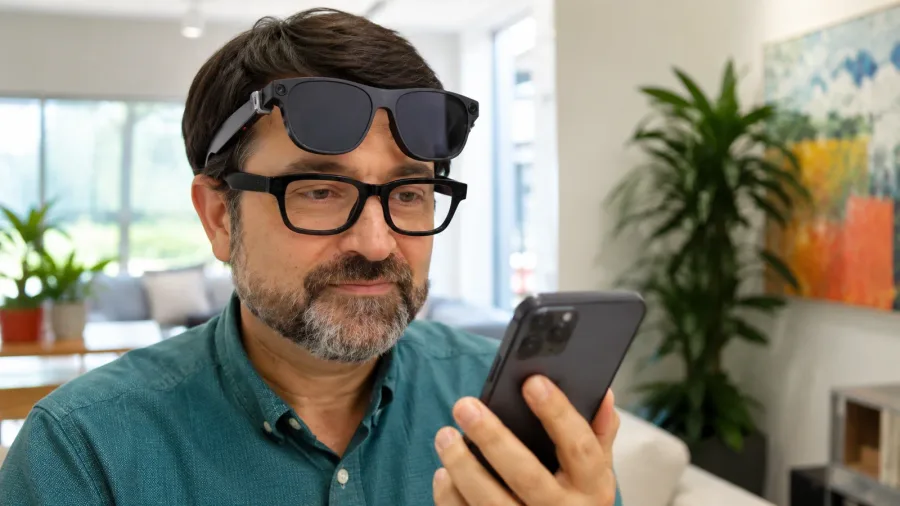
The California showdown: Five headsets enter the arena
The Augmented World Expo 2026, held in Santa Clara, California, has become the definitive battleground for the next generation of wearable computing. Unlike the prototype-heavy showcases of 2025, this year's event is defined by polished, consumer-ready devices that are shipping now or within weeks. The exhibition floor tells a clear story: after years of overpromising, the smart glasses industry is finally delivering hardware that balances capability with wearability. We spent two full days testing five of the most talked-about headsets, putting each through a standardized gauntlet of navigation, real-time translation, holographic calling, and gaming performance tests.
The lineup represents a broad spectrum of approaches to the same fundamental challenge — how to overlay digital information onto the physical world without making the user look like a cyborg. Google returned to the arena with its enterprise-focused Glass Enterprise 3, priced at $899. Snap brought its fifth-generation Spectacles at $699, targeting the creator economy. The surprise standout, Paris Sphere, entered with a disruptive $599 price point that undercuts rivals by hundreds of dollars. Vuzix and Xreal rounded out our testing pool with more specialized offerings. Together, these five devices offer a comprehensive snapshot of where mixed reality stands in mid-2026.
How we tested: A standardized mixed reality gauntlet
Each device was tested for a minimum of 45 minutes across four standardized scenarios: pedestrian navigation in a simulated urban environment, real-time multilingual conversation translation, holographic video calling, and an augmented reality gaming session. We measured not just technical performance — display brightness, latency, field of view — but also comfort over extended wear, ease of initial setup, and how naturally the interface integrated into everyday movement. The results reveal an industry that has made remarkable progress in miniaturization and AI integration, but one that still grapples with fundamental trade-offs between battery life, weight, and processing power.
Paris Sphere at $599: A pricing disruptor with flagship ambitions
The French startup Paris Sphere arrived at AWE 2026 with a clear mission: break the price ceiling that has kept smart glasses out of mainstream adoption. At $599, the Sphere One undercuts Google's offering by $300 and Snap's by $100, yet on paper matches or exceeds their core specifications. The device weighs just 48 grams — the lightest in our test group — thanks to a titanium frame and microLED display technology developed in partnership with Carl Zeiss optics. During our testing, the claimed 6-hour battery life translated to a real-world 5 hours and 20 minutes of mixed use, which remains impressive for this weight class and price bracket.
What truly sets the Sphere apart is its open-source operating system, SphereOS. Built on an Android foundation, it invites developers to create applications without the walled-garden restrictions imposed by larger competitors. At the expo, an independent developer demonstrated a live piano tutoring application that projected virtual markers onto the keys — an intuitive learning experience that drew crowds throughout the event. CEO Marie Dubois told reporters that the company's strategy is ecosystem-first: 'We are not selling hardware; we are building a platform.' The approach mirrors Android's early smartphone strategy, positioning Sphere as the accessible, customizable alternative to whatever Apple eventually brings to market.
What the $599 price tag leaves behind
Achieving that aggressive price point required compromises. The built-in speakers are noticeably inferior to those on the Google and Snap devices, lacking bass depth and clarity at higher volumes. Water and dust resistance is limited to IP54, making the Sphere One unsuitable for use in rain without the optional $79 outdoor kit. The field of view, at 40 degrees, is narrower than the 50 degrees offered by Google. Yet for many consumers, these trade-offs will be acceptable given the $300 savings. Paris Sphere confirmed plans to enter the European and Middle Eastern markets in the second half of 2026, with distribution partnerships already signed in Germany, the UAE, and Turkey.
Google Glass Enterprise 3: AI-powered productivity, with caveats
Google's return to the smart glasses market is a calculated pivot toward the enterprise. The Glass Enterprise 3, priced at $899, is not trying to be a consumer lifestyle device — it is a tool for logistics workers, surgeons, and field technicians. The headline feature is full integration with Google's Gemini AI assistant, allowing users to query inventory databases, pull up schematics, and document compliance through voice commands and eye-tracking gestures. In our simulated warehouse test, the device excelled at visual recognition tasks, instantly identifying damaged packaging and logging reports without requiring manual input.
However, the Gemini integration proved less reliable in the noisy expo environment. Approximately 15% of voice commands were misinterpreted when background conversations were present, particularly with specific queries like 'show inventory for section B-12.' This failure rate would be unacceptable in a fast-paced warehouse or emergency room setting. Google representatives acknowledged the issue, stating that a beamforming microphone update scheduled for late 2026 should reduce error rates to under 5%. The device's 85-gram weight also became noticeable after four hours of continuous wear, causing mild discomfort on the nose bridge — a reminder that even enterprise users have physical limits.
Google's enterprise gamble and the Amazon threat
Google's enterprise-first strategy is widely interpreted as a defensive move against Amazon, which is rumored to be developing Echo Frames Pro for a 2027 launch. By establishing Glass Enterprise 3 in hospitals, factories, and logistics centers now, Google aims to build switching costs that will be difficult for a late entrant to overcome. The company has already secured contracts with several Fortune 500 firms, including a 15,000-unit deployment with a major US logistics provider. Whether this enterprise beachhead can eventually translate into a consumer product remains an open question — but for now, Google seems content to let Paris Sphere and Snap fight for the everyday user while it locks in high-margin corporate clients.
Snap Spectacles 5: Social media's augmented future
Snap's fifth-generation Spectacles represent the company's most serious attempt yet to move beyond novelty status. At $699, the device is no longer a toy but a standalone Android-powered computer worn on your face. The standout hardware addition is a touch-sensitive panel along the right temple, enabling content scrolling, liking, and even voice-dictated commenting without ever reaching for a phone. For Snapchat's core demographic of 16-to-24-year-olds, this frictionless social media interaction is the killer feature — it removes the physical barrier between experiencing a moment and sharing it.
The most compelling software feature we tested was 'Ghost Mode,' an augmented reality gaming layer that transforms any physical space into a multiplayer playground. Walking through the expo hall, we collected virtual objects visible only to other Spectacles wearers and interacted with location-based challenges. The experience evoked the early magic of Pokémon Go, but with the crucial difference that no phone screen mediates the interaction. Snap announced partnerships with over 50 game developers, with titles rolling out through the end of 2026. If even a fraction of these achieve viral traction, Spectacles 5 could become the device that defines social AR.
Battery strategy and the youth market calculus
The Achilles' heel of Spectacles 5 is battery life: just 2 hours and 10 minutes of continuous AR use. Snap defends this limitation as a deliberate design choice, arguing that its target demographic already charges their phones an average of three times daily. The included charging case provides two additional full charges, but users planning a full day out will need to carry it. The 12-megapixel front-facing camera delivers solid low-light performance — a 40% improvement over the 2025 model — making it more than adequate for social media content creation. Whether users will tolerate the battery trade-off for the sake of hands-free social interaction is the question that will define Spectacles 5's commercial fate.
The global smart glasses market in 2026: A tipping point
The Augmented World Expo 2026 leaves little doubt that the smart glasses industry has crossed a critical threshold. After years of bulky prototypes and niche enterprise deployments, devices are now light enough, powerful enough, and — crucially — affordable enough to attract mainstream attention. IDC's latest market forecast projects 18 million units shipped globally in 2026, up from just 8 million in 2025. The entry of Paris Sphere at the $599 price point, combined with Google's enterprise push and Snap's social media play, creates a three-way competition that should accelerate innovation and drive prices down further.
Yet significant hurdles remain. Battery technology has not kept pace with display and processor advances, forcing manufacturers to make uncomfortable trade-offs between weight and longevity. Privacy concerns are intensifying as always-on cameras and microphones become wearable; several European Union member states are drafting legislation specifically addressing augmented reality devices. And Apple's long-rumored entry into the market — now expected in 2027 — casts a shadow over every competitor's strategy. For now, the message from AWE 2026 is clear: the smart glasses era has begun, not with a single revolutionary product, but with a diverse ecosystem of devices each carving out its own niche in a rapidly expanding market.
The enterprise-consumer divide and what comes next
The most significant strategic question emerging from the expo is whether the enterprise and consumer markets will converge or remain separate. Google is betting on divergence, building a specialized tool for professionals while leaving the consumer space to others. Snap and Paris Sphere are pursuing the opposite thesis — that the same device can serve both work and play, provided the software experience adapts contextually. The next 18 months will test both hypotheses. What is certain is that the components and manufacturing techniques displayed at AWE 2026 will enable a wave of even cheaper, lighter devices by 2027. The smart glasses market is no longer asking 'if' — it is asking 'how fast.'
