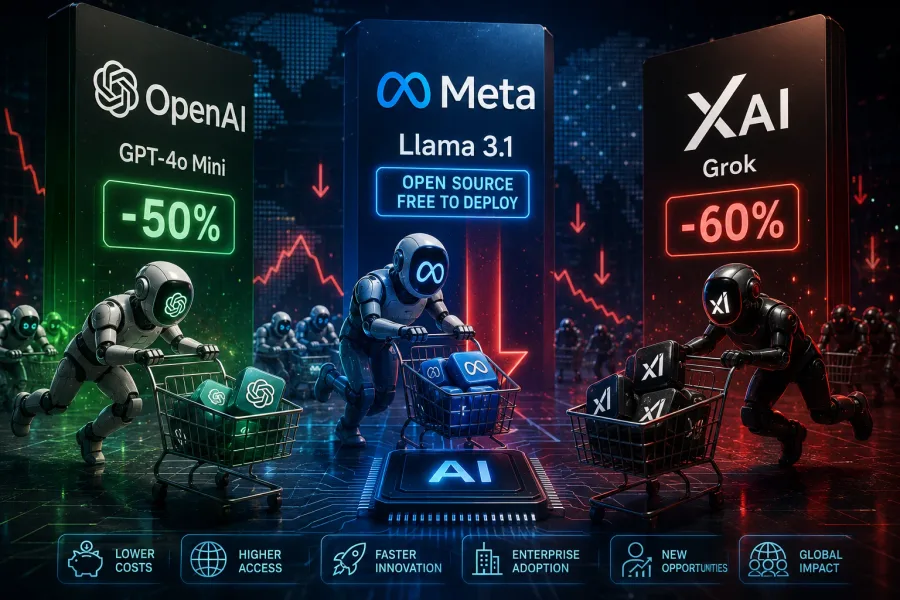
The artificial intelligence industry has entered a brutal new phase where the battleground is no longer just about who has the smartest model — it is about who can offer intelligence at the lowest possible cost. In a span of just seven days, three of the world's most influential AI developers — OpenAI, Meta, and Elon Musk's xAI — have each unveiled new models that promise not only enhanced capabilities but dramatically reduced price tags.
This sudden and aggressive move toward commoditization marks a pivotal shift in the AI landscape as we move through mid-2026. For enterprises that have been hesitant to deploy AI at scale due to prohibitive costs, this price war signals a long-awaited green light. The era of cheap, ubiquitous intelligence may have finally arrived, but it also raises critical questions about sustainability, security, and market consolidation.
The week that reshaped AI economics
The cascade of announcements began with OpenAI, the Microsoft-backed company behind ChatGPT. Their release of GPT-4o Mini was a direct shot across the bow of competitors. This streamlined model delivers approximately 90% of the flagship model's reasoning capabilities at less than half the cost per token. For developers building customer service chatbots or content generation tools, the math became instantly compelling: why pay more for marginal improvements?
Within 48 hours, Meta responded with the launch of Llama 3.1, the latest iteration of its open-source large language model family. CEO Mark Zuckerberg, who has positioned Meta as the champion of open-source AI, claimed the model was 'disruptively cost-effective' compared to proprietary alternatives. Because Llama 3.1 can be downloaded and run on a company's own infrastructure, organizations can eliminate per-token API fees entirely, paying only for their own electricity and hardware.
Musk's xAI and the disruptive entry of Grok
Elon Musk's xAI was the final entrant in this high-stakes week. The company released a new version of Grok, a model Musk has branded as 'anti-woke' and more personality-driven than its rivals. Beyond the marketing rhetoric, the new Grok model came with a pricing structure that undercut even OpenAI's latest reductions. Musk, who has repeatedly warned about the existential risks of AI, appears to be betting that affordability and accessibility are the keys to winning the market.
Musk's strategy is inseparable from his ongoing feud with OpenAI, a company he co-founded but later left. In 2025, he filed a lawsuit against OpenAI, accusing it of abandoning its non-profit mission. Now, in 2026, he is waging a commercial war, using xAI to pressure his former company on pricing. For the broader market, this personal rivalry is accelerating the downward spiral of costs, to the benefit of consumers and developers worldwide.
Enterprise adoption reaches a tipping point
Throughout 2025, corporate spending on AI experiments was massive but often wasteful. Many Fortune 500 companies launched pilot projects that stalled because the cost of scaling them was astronomical. A single high-volume customer support chatbot powered by a frontier model could easily rack up six-figure monthly bills. The 2026 price corrections are changing this calculus overnight. Projects that were shelved due to budget constraints are now being revived.
OpenAI's new enterprise pricing tiers have already triggered a wave of bulk contracts from major corporations. Meanwhile, Meta's open-source approach is proving irresistible to heavily regulated industries such as finance and healthcare. Banks, for instance, can now take Llama 3.1, fine-tune it on proprietary transaction data within their own secure servers, and deploy a custom fraud detection system without ever sending sensitive data to an external API. This combination of privacy, control, and zero licensing fees represents a paradigm shift.
The security dilemma of cheap, accessible AI
The democratization of AI through lower prices carries inherent risks that are becoming impossible to ignore. As the cost of generating realistic text, images, and video plummets, the barrier to entry for malicious actors drops in parallel. Cybersecurity firms are reporting a surge in AI-generated phishing campaigns and deepfake-enabled fraud attempts in 2026, a trend directly correlated with the availability of cheaper, more powerful models.
OpenAI and Meta have emphasized that their new models include robust safety filters. However, open-source models like Llama 3.1 can be modified by users to remove these safeguards. Musk's Grok, marketed as a 'less censored' alternative, has drawn particular scrutiny. Critics argue that in the rush to win the price war, some developers may be deprioritizing the rigorous safety testing that defined earlier, more expensive releases. The industry faces a delicate balancing act between accessibility and responsibility.
How the price war is reshaping global AI markets
While the price war is being waged in Silicon Valley, its effects are rippling across emerging technology markets from Southeast Asia to Latin America. In countries where the cost of frontier AI was previously a luxury reserved for well-funded startups and multinationals, the new pricing models are opening doors for smaller players. A developer in Jakarta or Nairobi can now access essentially the same AI infrastructure as an engineer in San Francisco, at a fraction of last year's cost.
This leveling of the playing field is expected to fuel a wave of innovation in local-language AI applications and region-specific solutions. For instance, agricultural tech startups in India can now afford to build AI advisors for smallholder farmers in regional dialects. The economic ripple effects could be substantial, potentially adding billions of dollars in productivity gains across developing economies by the end of 2026.
Nvidia and the infrastructure gold rush
Ironically, the biggest financial winners of the AI price war may not be the AI companies themselves, but the infrastructure providers that power them. Every new model, whether from OpenAI, Meta, or xAI, requires enormous clusters of GPUs for both training and inference. Nvidia, the dominant player in the AI chip market, has seen its data center revenue soar to unprecedented levels in 2026, as the demand for computing power continues to outstrip supply.
This dynamic creates a curious ecosystem: AI developers are slashing prices to capture market share, often operating at a loss, while their hardware suppliers enjoy record profits. The sustainability of this model is questionable. Just as the ride-sharing wars of the 2010s eventually led to consolidation and price normalization, many analysts predict that the current AI pricing structure is a temporary, venture-capital-subsidized phase. The true cost of intelligence has yet to settle, and when it does, the landscape may look very different.
