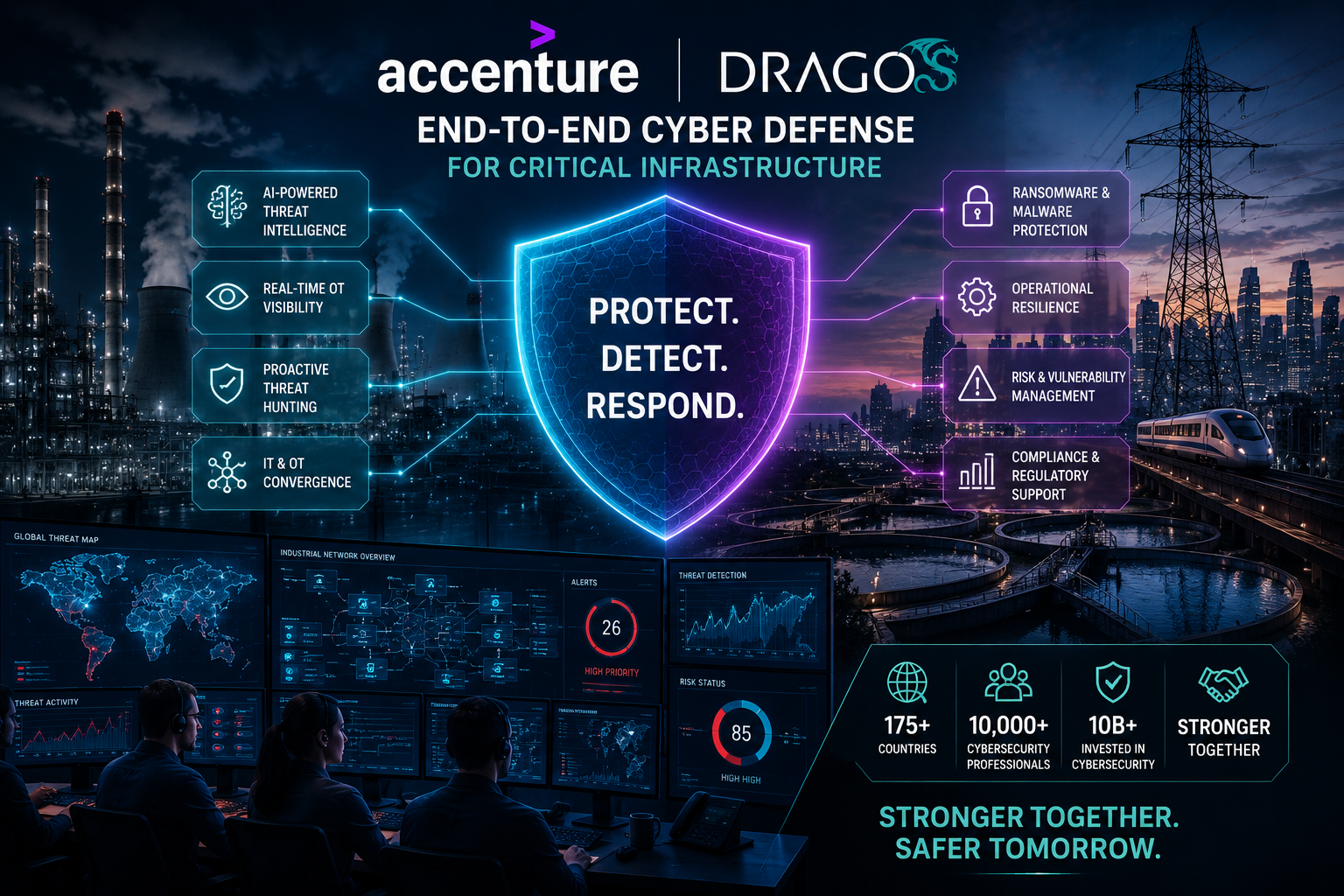
The New Calculus of Cyber Risk: When Blackouts Become Weapons
In the first half of 2026, cyberattacks targeting operational technology (OT) — the hardware and software that keep power grids humming, water plants flowing, and transport networks running — jumped by 140% globally. Armed with generative AI and backed by nation-states, threat actors can now paralyze entire cities, extort millions in ransom, or use civilian infrastructure as a geopolitical bargaining chip. It is against this backdrop that Accenture (NYSE: ACN) today announced the acquisition of a majority stake in Dragos, the premier industrial cybersecurity firm, giving the $10 billion security powerhouse an end-to-end platform built for an era of AI-driven cyberwarfare.
Geopolitical Tensions Turn Critical Infrastructure into Digital Battlefields
From the Black Sea to the South China Sea, energy grids and water systems are increasingly treated as pressure points. In 2025 alone, 12 major European power facilities were disabled by ransomware campaigns that went beyond encryption — attackers manipulated physical equipment using custom malware. By folding Dragos’ deep OT expertise into its global advisory and managed services network, Accenture is betting that the next wave of defense must be proactive, not forensic.
A 2026 report by the U.S. Cybersecurity and Infrastructure Security Agency (CISA) found that 67% of attacks on critical infrastructure now involve AI-generated phishing or automated scanning tools. The Accenture-Dragos platform aims to collapse the blind spots between traditional IT security and the operational processes that actually move water, electricity, and gas.
Inside the $10 Billion Security Empire’s Dragos Gambit
Accenture’s cybersecurity business crossed the $10 billion revenue mark in fiscal 2025, spanning strategy, threat intelligence, and managed detection and response. Yet the missing piece was a native command of industrial control systems (ICS) and SCADA environments — precisely where Dragos, valued at $2.1 billion in its last funding round in 2024, has proven dominance across government and Fortune 500 energy clients.
Why a Majority Stake, Not a Full Acquisition
By taking a majority interest rather than absorbing Dragos outright, Accenture preserves the firm’s agile innovation engine and its independent threat research teams that have uncovered over a dozen novel ICS malware strains since 2023. The structure also allows Dragos to continue serving non-Accenture clients while embedding joint offerings into Accenture’s go-to-market engine. Dragos CEO Robert M. Lee indicated that joint pilot projects at 50-plus global energy and water operators will launch by Q3 2026.
What an End-to-End Platform Actually Delivers on the Ground
Traditional security architectures keep IT and OT in separate silos. The Accenture-Dragos platform merges them. A single dashboard now correlates a phishing email captured on a corporate network with anomalous access to a chlorine pump controller, allowing containment before physical damage occurs. This fusion is what the industry has long promised but seldom delivered.
Real-Time OT Visibility Meets Predictive Defense
Built on Dragos Platform 4.0, launched in 2025, the combined solution can analyze over 100,000 industrial protocol events per second using AI-driven anomaly detection. When integrated with Accenture’s Managed Extended Detection & Response (MxDR) service, the system can simultaneously isolate a compromised IT endpoint and halt an unauthorized instruction sent to a turbine. In a pilot at a North American energy plant during 2025, this approach prevented a six-hour outage and achieved a 94% threat containment rate within the first 90 seconds of detection.
Market Consolidation and the Investor Signal
Accenture’s move could spark a consolidation wave. Rivals Palo Alto Networks and CrowdStrike have each poured over $1.5 billion into OT-focused acquisitions in the past year. By pairing Dragos’ OT-native platform with its own global delivery muscle, Accenture positions itself as the go-to integrator for the $45 billion critical infrastructure security market projected by 2027.
Why the Street Applauded
ACN shares rose 3.2% following the announcement, reflecting investor confidence that end-to-end platforms will secure longer, more lucrative contracts — particularly as AI regulations tighten in Europe and Asia-Pacific. Analysts note that the majority-stake model also limits integration risk, a lesson learned from other tech mega-deals that stumbled post-close.
If your critical infrastructure hasn’t been stress-tested against an OT breach simulation, what exactly are you waiting for?
