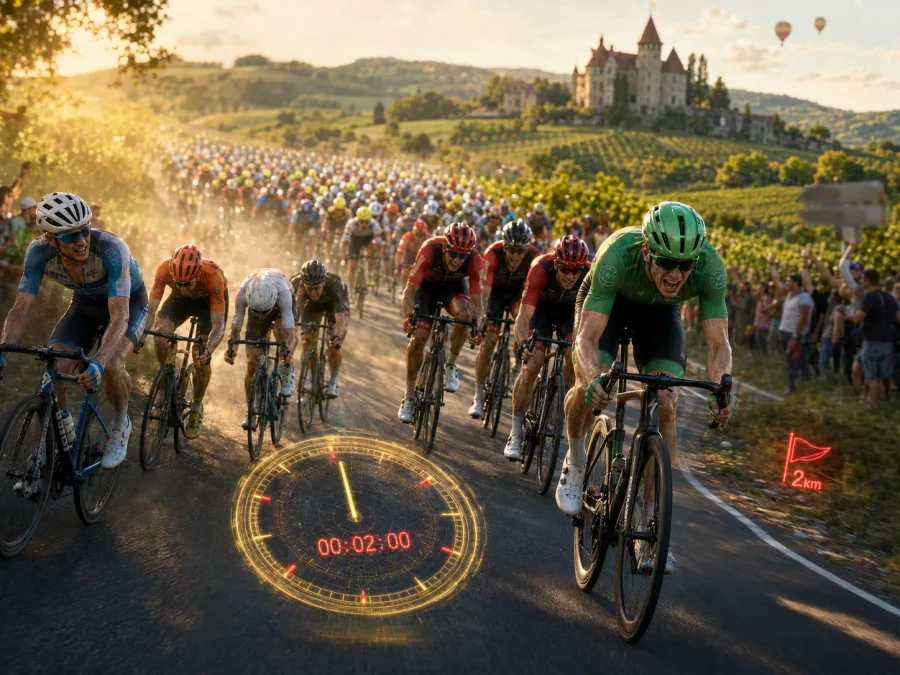
The 2026 Tour de France served up one of its most dramatic sprint finishes in recent memory on stage 8, as Belgian powerhouse Tim Merlier powered to his second stage victory of the race. A four-man breakaway came agonizingly close to pulling off a stunning heist, only to be swallowed up by the charging peloton with a mere 2 kilometers remaining on the 180km route from Périgueux to Bergerac. The stage through the picturesque Dordogne region highlighted the razor-thin margins between triumph and heartbreak in professional cycling.
The breakaway that almost broke the system: A tactical masterclass
For 178 kilometers, the escape group defied the odds and the peloton's calculations. The four riders, none of whom posed a threat to the general classification, worked in perfect harmony through the rolling hills of southwestern France. Their maximum advantage never exceeded three minutes, but their consistency and shared workload kept the sprinters' teams in a state of controlled panic. With 10 kilometers to go, the gap still hovered around 55 seconds — a margin that seemed plausible for a successful breakaway in modern cycling, where peloton coordination can sometimes falter under pressure.
However, the combined firepower of Alpecin-Deceuninck and Soudal Quick-Step proved too much to resist. As the race entered the final 5 kilometers, the gap began to collapse at a rate of nearly 10 seconds per kilometer. The breakaway riders, their legs burning and their dreams of glory within touching distance, could hear the roaring peloton closing in behind them. Their capture at the 2-kilometer mark was both a testament to their extraordinary effort and a cruel reminder of the sport's physics: a well-organized sprint train, with fresh riders and aerodynamic advantages, is almost impossible to hold off on flat terrain.
The anatomy of a near miss: How the peloton timed its chase
The chase was orchestrated with mathematical precision. Alpecin-Deceuninck, riding in service of Tim Merlier, placed riders at the front of the peloton with 30 kilometers remaining. They allowed the gap to remain stable, avoiding panic, before systematically increasing the pace in the final 15 kilometers. This controlled acceleration prevented other teams from launching chaotic counter-attacks and ensured that Merlier would have a clean lead-out into the final corner. The strategy was risky — leaving the catch so late could have backfired if a rider had attacked from the breakaway — but it paid off handsomely.
Merlier's dominance reshapes the points classification battle
With his second stage win of the 2026 Tour, Tim Merlier has firmly established himself as the sprinter to beat. The Belgian national champion, riding for Alpecin-Deceuninck, has shown a level of consistency and raw speed that puts him in pole position for the green jersey. Unlike some of his rivals, Merlier has demonstrated an ability to navigate chaotic finales without losing position — a skill that is often the difference between winning and finishing outside the top five in Tour de France sprints.
The victory in Bergerac was particularly significant because of the quality of the field he defeated. Jasper Philipsen, his compatriot and perennial rival, was boxed in during the final 500 meters and could not unleash his trademark acceleration. Fabio Jakobsen, another top contender, suffered a mechanical issue in the closing kilometers that took him out of contention. Merlier, by contrast, was delivered to the 200-meter mark in perfect position by his lead-out train, requiring only a brief but devastating burst of speed to seal the win. As the Tour heads toward the Pyrenees, Merlier's points cushion gives him a critical buffer before the mountain stages where pure sprinters struggle to survive the time cuts.
The evolution of lead-out trains in modern sprint finishes
Stage 8 was a textbook demonstration of why the lead-out train has become the defining tactical element of flat stages. In the final 3 kilometers, Alpecin-Deceuninck's riders formed a protective shell around Merlier, shielding him from the wind and deterring rivals from moving up. The final lead-out man launched Merlier at precisely 200 meters — close enough to the line that he wouldn't fade, but far enough to prevent anyone from coming around him. This level of coordination requires months of practice and an almost telepathic understanding between teammates, and it is what separates the good sprint teams from the great ones.
Broader implications for the 2026 Tour de France and the road ahead
While stage 8 did not alter the general classification standings, its psychological impact could reverberate through the remainder of the race. The near-success of the breakaway will embolden other riders to attempt similar moves in the transitional stages that follow the Pyrenees. The 2026 Tour has already been marked by unusually aggressive racing, with teams showing a willingness to take risks on stages that were once considered predictable. This trend reflects a broader evolution in professional cycling, where data analytics and improved training methods have narrowed the gap between the peloton and the escapees, but also made the sport more unpredictable.
As the race enters its second week, the focus will shift to the general classification contenders. Riders like Jonas Vingegaard, Tadej Pogačar, and Primož Roglič have been waiting in the wings, conserving energy during the flat stages. The upcoming mountain stages in the Pyrenees will provide the first true test of their form and could reshape the overall standings. For Merlier and the other sprinters, the challenge will be simply to survive the high mountains within the time limit, knowing that more opportunities for glory await on the road to Paris. The Bergerac finish, with its mix of heartbreak and triumph, will be remembered as one of the defining moments of the 2026 Tour.
Bergerac's place in Tour de France history
The town of Bergerac, nestled along the Dordogne River, has hosted the Tour de France on several occasions, each time delivering memorable racing. Its narrow streets and technical final kilometer make it a challenging finish even for the most experienced sprinters. The 2026 edition added another chapter to this history, with Merlier's victory joining the list of iconic moments in this cycling-mad region. For the local fans who lined the route through the vineyards and medieval villages, the stage was a celebration of both the sport and the stunning landscape of the Dordogne.
Tim Merlier's victory in Bergerac was more than just a stage win — it was a statement of intent. In a Tour de France that has already delivered surprises and drama, the Belgian sprinter has positioned himself as one of the dominant figures of the 2026 race. As the peloton rolls toward the high mountains, the memory of this near-perfect heist and its dramatic conclusion will linger, reminding everyone that in cycling, the line between hero and heartbreak is measured in meters and seconds.
